Family tree Dijkstra » Douwe Dijkstra (1886-1940)
Personal data Douwe Dijkstra
- He was born on May 12, 1886 in Saaksum.Source 1
- He died on March 3, 1940 in Groningen, he was 53 years old.Source 2
- Death registration on March 7, 1940.Source 3
- A child of Marten Dijkstra and Antje Muller
- This information was last updated on September 21, 2008.
Household of Douwe Dijkstra
He is married to Mentje Spanninga.
Permission for the marriage has been obtained in Oldehove on September 24, 1911.Source 4
They got married on October 7, 1911 at Oldehove, he was 25 years old.Source 4Child(ren):
- Marten Dijkstra 1911-1987
- Janna Dijkstra 1913-1972
Timeline Douwe Dijkstra
This functionality is only available in Javascript supporting browsers.
Click on the names for more info.
Symbols used:  grandparents
 parents
 brothers/sisters
 children
grandparents
parents
brothers/sisters
children
Image(s) Douwe Dijkstra


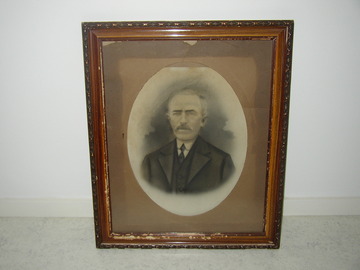
Sources
Matches in other publications
This person also appears in the publication: View all
Historical events
Birthday May 12, 1886
- The temperature on May 12, 1886 was about 6.5 °C. There was 2 mm of rain. The air pressure was 4 kgf/m2 and came mainly from the east-northeast. The airpressure was 76 cm mercury. The atmospheric humidity was 88%. Source: KNMI
- Koning Willem III (Huis van Oranje-Nassau) was from 1849 till 1890 sovereign of the Netherlands (also known as Koninkrijk der Nederlanden)
- In The Netherlands , there was from April 23, 1884 to April 21, 1888 the cabinet Heemskerk, with Mr. J. Heemskerk Azn. (conservatief) as prime minister.
- In the year 1886: Source: Wikipedia
- The Netherlands had about 4.5 million citizens.
- March 27 » Geronimo, Apache warrior, surrenders to the U.S. Army, ending the main phase of the Apache Wars.
- April 8 » William Ewart Gladstone introduces the first Irish Home Rule Bill into the British House of Commons.
- May 29 » The pharmacist John Pemberton places his first advertisement for Coca-Cola, which appeared in The Atlanta Journal.
- June 26 » Henri Moissan isolated elemental Fluorine for the first time.
- July 4 » The Canadian Pacific Railway's first scheduled train from Montreal arrives in Port Moody on the Pacific coast, after six days of travel.
- November 14 » Friedrich Soennecken first developed the hole puncher, a type of office tool capable of punching small holes in paper.
Day of marriage October 7, 1911
- The temperature on October 7, 1911 was between 5.8 °C and 13.0 °C and averaged 9.5 °C. There was 14.8 mm of rain. The average windspeed was 3 Bft (moderate breeze) and was prevailing from the east. Source: KNMI
- Koningin Wilhelmina (Huis van Oranje-Nassau) was from 1890 till 1948 sovereign of the Netherlands (also known as Koninkrijk der Nederlanden)
- In The Netherlands , there was from February 12, 1908 to August 29, 1913 the cabinet Heemskerk, with Mr. Th. Heemskerk (AR) as prime minister.
- In the year 1911: Source: Wikipedia
- The Netherlands had about 6.0 million citizens.
- January 5 » Kappa Alpha Psi, the world's third oldest and largest black fraternity, is founded at Indiana University.
- January 12 » The University of the Philippines College of Law is formally established; three future Philippine presidents are among the first enrollees.
- May 23 » The New York Public Library is dedicated.
- October 13 » Prince Arthur, Duke of Connaught and Strathearn, becomes the first Governor General of Canada of royal descent.
- November 3 » Chevrolet officially enters the automobile market in competition with the Ford Model T.
- December 14 » Roald Amundsen's team, comprising himself, Olav Bjaaland, Helmer Hanssen, Sverre Hassel, and Oscar Wisting, becomes the first to reach the South Pole.
Day of death March 3, 1940
- The temperature on March 3, 1940 was between -5.7 °C and 7.1 °C and averaged 0.4 °C. There was 7.8 hours of sunshine (71%). The average windspeed was 2 Bft (weak wind) and was prevailing from the northwest. Source: KNMI
- Koningin Wilhelmina (Huis van Oranje-Nassau) was from 1890 till 1948 sovereign of the Netherlands (also known as Koninkrijk der Nederlanden)
- In The Netherlands , there was from August 10, 1939 to September 3, 1940 the cabinet De Geer II, with Jonkheer mr. D.J. de Geer (CHU) as prime minister.
- In The Netherlands , there was from September 3, 1940 to July 27, 1941 the cabinet Gerbrandy I, with Prof. dr. P.S. Gerbrandy (ARP) as prime minister.
- In the year 1940: Source: Wikipedia
- The Netherlands had about 8.8 million citizens.
- April 14 » World War II: Royal Marines land in Namsos, Norway in preparation for a larger force to arrive two days later.
- June 14 » World War II: The German occupation of Paris begins.
- June 17 » The three Baltic states of Estonia, Latvia and Lithuania fall under the occupation of the Soviet Union.
- August 25 » World War II: The first Bombing of Berlin by the British Royal Air Force.
- September 7 » World War II: The German Luftwaffe begins the Blitz, bombing London and other British cities for over 50 consecutive nights.
- October 7 » World War II: The McCollum memo proposes bringing the United States into the war in Europe by provoking the Japanese to attack the United States.
Same birth/death day
- 1880 » Lincoln Ellsworth, American explorer († 1951)
- 1885 » Paltiel Daykan, Lithuanian-Israeli lawyer and jurist († 1969)
- 1885 » Saneatsu Mushanokōji, Japanese author († 1976)
- 1886 » Ernst A. Lehmann, German captain and pilot († 1937)
- 1889 » Otto Frank, German-Swiss businessman and Holocaust survivor; father of diarist Anne Frank († 1980)
- 1892 » Fritz Kortner, Austrian-German actor and director († 1970)
- 1927 » J. G. Parry-Thomas, Welsh race car driver and engineer (b. 1884)
- 1927 » Mikhail Artsybashev, Ukrainian author and playwright (b. 1878)
- 1929 » Katharine Wright, American educator (b. 1874)
- 1932 » Eugen d'Albert, Scottish-German pianist and composer (b. 1864)
- 1943 » George Thompson, English cricketer and umpire (b. 1877)
- 1959 » Lou Costello, American actor and comedian (b. 1906)
About the surname Dijkstra
- View the information that Genealogie Online has about the surname Dijkstra.
- Check the information Open Archives has about Dijkstra.
- Check the Wie (onder)zoekt wie? register to see who is (re)searching Dijkstra.
The Family tree Dijkstra publication was prepared by Nieko Dijkstra.
When copying data from this family tree, please include a reference to the origin:
Nieko Dijkstra, "Family tree Dijkstra", database, Genealogy Online (https://www.genealogieonline.nl/stamboom-dijkstra/I104.php : accessed February 4, 2026), "Douwe Dijkstra (1886-1940)".
Nieko Dijkstra, "Family tree Dijkstra", database, Genealogy Online (https://www.genealogieonline.nl/stamboom-dijkstra/I104.php : accessed February 4, 2026), "Douwe Dijkstra (1886-1940)".