Family tree Schovers » Josephus Albertus Schovers (1809-1880)
Personal data Josephus Albertus Schovers
- He was born on January 2, 1809 in Groenlo.
- Profession: Timmerman.
- He died on May 22, 1880 in Groenlo, he was 71 years old.
- A child of Antonius Philippus Schovers and Anna Elisabeth Wefers
- This information was last updated on February 6, 2018.
Household of Josephus Albertus Schovers
He is married to Aleida Kok.
They got married on September 11, 1838 at Groenlo, he was 29 years old.
Adres:
Goudsmidstraat 276 Groenlo
Timmerman
Rooms Katholiek
Child(ren):
- Johannes Hendrikus Schovers 1839-1839
- Hendrika Maria Schovers 1840-1846
- Antonia Eva Schovers 1842-1926
- Josephus Schovers 1845-1914
- Hendrika Maria Schovers 1850-1936
- Aleida Elisabeth Schovers 1854-1933
Timeline Josephus Albertus Schovers
This functionality is only available in Javascript supporting browsers.
Click on the names for more info.
Symbols used:  grandparents
 parents
 brothers/sisters
 children
grandparents
parents
brothers/sisters
children
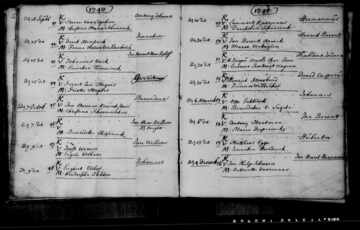
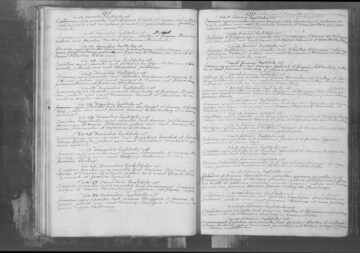
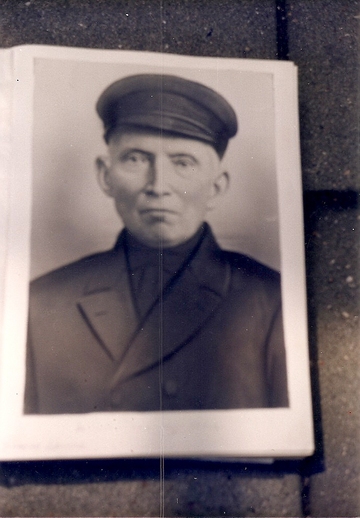
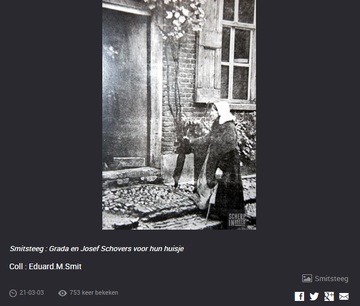
Image(s) Josephus Albertus Schovers

Ancestors (and descendant) of Josephus Albertus Schovers
Josephus Albertus Schovers 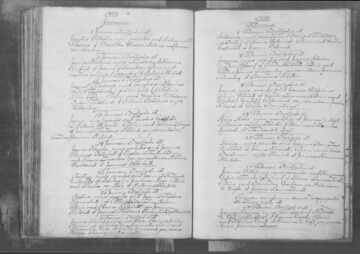 | |||||||||||||||||||||||||||||||||||||||
1838 | |||||||||||||||||||||||||||||||||||||||
Aleida Kok | |||||||||||||||||||||||||||||||||||||||
Relationship Josephus Albertus Schovers
- Josephus Albertus Schovers is the great grandson of Jan Philip Jacobus Schovers:
The data shown has no sources.
Matches in other publications
This person also appears in the publication: View all
- Genealogie Nijhuis (voornamelijk Achterhoek)
- Kwartierstaat Jansen - Middelhoven, one author has confirmed this is the same person
- Kwartierstaat Bel + Aanverwanten., one author has confirmed this is the same person
Historical events
Birthday January 2, 1809
- The temperature on January 2, 1809 was about 0.0 °C. There was 44 mm of rainWind direction mainly east-northeast. Weather type: betrokken sneeuw. Source: KNMI
- This page is only available in Dutch.De Republiek der Verenigde Nederlanden werd in 1794-1795 door de Fransen veroverd onder leiding van bevelhebber Charles Pichegru (geholpen door de Nederlander Herman Willem Daendels); de verovering werd vergemakkelijkt door het dichtvriezen van de Waterlinie; Willem V moest op 18 januari 1795 uitwijken naar Engeland (en van daaruit in 1801 naar Duitsland); de patriotten namen de macht over van de aristocratische regenten en proclameerden de Bataafsche Republiek; op 16 mei 1795 werd het Haags Verdrag gesloten, waarmee ons land een vazalstaat werd van Frankrijk; in 3.1796 kwam er een Nationale Vergadering; in 1798 pleegde Daendels een staatsgreep, die de unitarissen aan de macht bracht; er kwam een nieuwe grondwet, die een Vertegenwoordigend Lichaam (met een Eerste en Tweede Kamer) instelde en als regering een Directoire; in 1799 sloeg Daendels bij Castricum een Brits-Russische invasie af; in 1801 kwam er een nieuwe grondwet; bij de Vrede van Amiens (1802) kreeg ons land van Engeland zijn koloniën terug (behalve Ceylon); na de grondwetswijziging van 1805 kwam er een raadpensionaris als eenhoofdig gezag, namelijk Rutger Jan Schimmelpenninck (van 31 oktober 1761 tot 25 maart 1825).
- In the year 1809: Source: Wikipedia
- March 13 » Gustav IV Adolf of Sweden is deposed in the Coup of 1809.
- April 20 » Two Austrian army corps in Bavaria are defeated by a First French Empire army led by Napoleon at the Battle of Abensberg on the second day of a four-day campaign that ended in a French victory.
- May 22 » On the second and last day of the Battle of Aspern-Essling (near Vienna, Austria), Napoleon I is repelled by an enemy army for the first time.
- May 25 » Chuquisaca Revolution: Patriot revolt in Chuquisaca (modern-day Sucre) against the Spanish Empire, sparking the Latin American wars of independence.
- September 17 » Peace between Sweden and Russia in the Finnish War; the territory that will become Finland is ceded to Russia by the Treaty of Fredrikshamn.
- November 18 » In a naval action during the Napoleonic Wars, French frigates defeat British East Indiamen in the Bay of Bengal.
Day of marriage September 11, 1838
- The temperature on September 11, 1838 was about 13.0 °C. Wind direction mainly north-northeast. Weather type: half bewolkt windstil. Source: KNMI
- This page is only available in Dutch.De Republiek der Verenigde Nederlanden werd in 1794-1795 door de Fransen veroverd onder leiding van bevelhebber Charles Pichegru (geholpen door de Nederlander Herman Willem Daendels); de verovering werd vergemakkelijkt door het dichtvriezen van de Waterlinie; Willem V moest op 18 januari 1795 uitwijken naar Engeland (en van daaruit in 1801 naar Duitsland); de patriotten namen de macht over van de aristocratische regenten en proclameerden de Bataafsche Republiek; op 16 mei 1795 werd het Haags Verdrag gesloten, waarmee ons land een vazalstaat werd van Frankrijk; in 3.1796 kwam er een Nationale Vergadering; in 1798 pleegde Daendels een staatsgreep, die de unitarissen aan de macht bracht; er kwam een nieuwe grondwet, die een Vertegenwoordigend Lichaam (met een Eerste en Tweede Kamer) instelde en als regering een Directoire; in 1799 sloeg Daendels bij Castricum een Brits-Russische invasie af; in 1801 kwam er een nieuwe grondwet; bij de Vrede van Amiens (1802) kreeg ons land van Engeland zijn koloniën terug (behalve Ceylon); na de grondwetswijziging van 1805 kwam er een raadpensionaris als eenhoofdig gezag, namelijk Rutger Jan Schimmelpenninck (van 31 oktober 1761 tot 25 maart 1825).
- In the year 1838: Source: Wikipedia
- The Netherlands had about 2.9 million citizens.
- January 6 » Alfred Vail and colleagues demonstrate a telegraph system using dots and dashes (this is the forerunner of Morse code).
- February 17 » Weenen massacre: Hundreds of Voortrekkers along the Blaukraans River, Natal are killed by Zulus.
- August 18 » The Wilkes Expedition, which would explore the Puget Sound and Antarctica, weighs anchor at Hampton Roads.
- September 1 » Saint Andrew's Scots School, the oldest school of British origin in South America, is established.
- September 3 » Future abolitionist Frederick Douglass escapes from slavery.
- October 5 » The Killough massacre in east Texas sees eighteen Texian settlers either killed or kidnapped.
Day of death May 22, 1880
- The temperature on May 22, 1880 was about 18.2 °C. The air pressure was 13 kgf/m2 and came mainly from the west-southwest. The airpressure was 75 cm mercury. The atmospheric humidity was 45%. Source: KNMI
- Koning Willem III (Huis van Oranje-Nassau) was from 1849 till 1890 sovereign of the Netherlands (also known as Koninkrijk der Nederlanden)
- In The Netherlands , there was from August 20, 1879 to April 23, 1883 the cabinet Van Lijnden van Sandenburg, with Mr. C.Th. baron Van Lijnden van Sandenburg (conservatief-AR) as prime minister.
- In the year 1880: Source: Wikipedia
- The Netherlands had about 4.0 million citizens.
- May 13 » In Menlo Park, New Jersey, Thomas Edison performs the first test of his electric railway.
- June 7 » War of the Pacific: The Battle of Arica, the assault and capture of Morro de Arica (Arica Cape), ends the Campaña del Desierto (Desert Campaign).
- June 24 » First performance of O Canada at the Congrès national des Canadiens-Français. The song would later become the national anthem of Canada.
- June 28 » Australian bushranger Ned Kelly is captured at Glenrowan.
- July 27 » Second Anglo-Afghan War: Battle of Maiwand: Afghan forces led by Mohammad Ayub Khan defeat the British Army in battle near Maiwand, Afghanistan.
- September 1 » The army of Mohammad Ayub Khan is routed by the British at the Battle of Kandahar, ending the Second Anglo-Afghan War.
Same birth/death day
- 1803 » Guglielmo Libri Carucci dalla Sommaja, Italian mathematician and academic († 1869)
- 1822 » Rudolf Clausius, Polish-German physicist and mathematician († 1888)
- 1827 » Pyotr Semyonov-Tyan-Shansky, Russian geographer and statistician († 1914)
- 1833 » Frederick A. Johnson, American banker and politician († 1893)
- 1836 » Mendele Mocher Sforim, Russian author († 1917)
- 1836 » Queen Emma of Hawaii († 1885)
- 1851 » Mordecai Manuel Noah, American journalist and diplomat (b. 1755)
- 1859 » Ferdinand II of the Two Sicilies (b. 1810)
- 1861 » Thornsbury Bailey Brown, American soldier (b. 1829)
- 1868 » Julius Plücker, German mathematician and physicist (b. 1801)
- 1885 » Victor Hugo, French novelist, poet, and playwright (b. 1802)
- 1901 » Gaetano Bresci, Italian-American anarchist, assassin of Umberto I of Italy (b. 1869)
About the surname Schovers
- View the information that Genealogie Online has about the surname Schovers.
- Check the information Open Archives has about Schovers.
- Check the Wie (onder)zoekt wie? register to see who is (re)searching Schovers.
The Family tree Schovers publication was prepared by Jan Schovers.
When copying data from this family tree, please include a reference to the origin:
Jan Schovers, "Family tree Schovers", database, Genealogy Online (https://www.genealogieonline.nl/stamboom-schovers/I47.php : accessed February 15, 2026), "Josephus Albertus Schovers (1809-1880)".
Jan Schovers, "Family tree Schovers", database, Genealogy Online (https://www.genealogieonline.nl/stamboom-schovers/I47.php : accessed February 15, 2026), "Josephus Albertus Schovers (1809-1880)".