Family tree Luberti » Mathilda Maria "Thilda" Luberti (1901-2002)
Personal data Mathilda Maria "Thilda" Luberti
- Nickname is Thilda.
- She was born on November 6, 1901 in Amsterdam.Source 1
- She died on May 21, 2002 in Amstelveen, she was 100 years old.Source 2
- A child of Petrus Bernardus Luberti and Maszina Paulina van der Noen
- This information was last updated on December 9, 2024.
Household of Mathilda Maria "Thilda" Luberti
She is married to Anne Arjen Elzinga.
They got married on August 6, 1925 at Amsterdam, she was 23 years old.Source 3
Timeline Mathilda Maria "Thilda" Luberti
This functionality is only available in Javascript supporting browsers.
Click on the names for more info.
Symbols used:  grandparents
 parents
 brothers/sisters
 children
grandparents
parents
brothers/sisters
children
Image(s) Mathilda Maria "Thilda" Luberti


Ancestors (and descendant) of Mathilda Maria Luberti
Mathilda Maria Luberti .jpg) | ||||||||||||||||||
1925 | ||||||||||||||||||
Anne Arjen Elzinga | ||||||||||||||||||
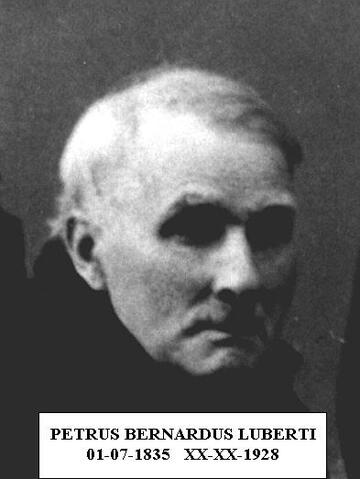
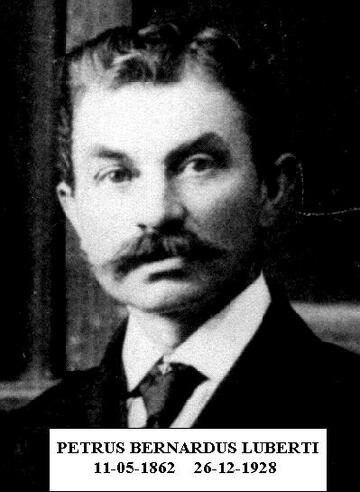
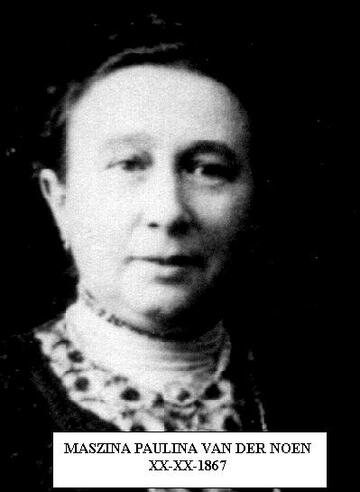
Relationship Mathilda Maria "Thilda" Luberti
- Mathilda Maria Luberti is the 3rd great granddaughter of Schato Sr./Lubbartus/Luberti Degelenkamp:
Sources
Matches in other publications
This person also appears in the publication: View all
Historical events
Birthday November 6, 1901
- The temperature on November 6, 1901 was between -5.8 °C and 9.7 °C and averaged 2.6 °C. There was 2.0 hours of sunshine (21%). Source: KNMI
- Koningin Wilhelmina (Huis van Oranje-Nassau) was from 1890 till 1948 sovereign of the Netherlands (also known as Koninkrijk der Nederlanden)
- In The Netherlands , there was from July 27, 1897 to August 1, 1901 the cabinet Pierson, with Mr. N.G. Pierson (unie-liberaal) as prime minister.
- In The Netherlands , there was from August 1, 1901 to August 16, 1905 the cabinet Kuijper, with Dr. A. Kuijper (AR) as prime minister.
- In the year 1901: Source: Wikipedia
- The Netherlands had about 5.2 million citizens.
- January 1 » Nigeria becomes a British protectorate.
- February 2 » Funeral of Queen Victoria.
- March 2 » The U.S. Congress passes the Platt Amendment limiting the autonomy of Cuba, as a condition of the withdrawal of American troops.
- August 10 » The U.S. Steel recognition strike by the Amalgamated Association of Iron and Steel Workers begins.
- August 21 » Six hundred American school teachers, Thomasites, arrived in Manila on the USAT Thomas.
- December 3 » In a State of the Union message, U.S. President Theodore Roosevelt delivers a 20,000-word speech to the House of Representatives asking Congress to curb the power of trusts "within reasonable limits".
Day of marriage August 6, 1925
- The temperature on August 6, 1925 was between 9.3 °C and 21.8 °C and averaged 16.2 °C. There was 1.6 mm of rain. There was 5.4 hours of sunshine (35%). The average windspeed was 2 Bft (weak wind) and was prevailing from the southwest. Source: KNMI
- Koningin Wilhelmina (Huis van Oranje-Nassau) was from 1890 till 1948 sovereign of the Netherlands (also known as Koninkrijk der Nederlanden)
- In The Netherlands , there was from September 19, 1922 to August 4, 1925 the cabinet Ruys de Beerenbrouck II, with Jonkheer mr. Ch.J.M. Ruys de Beerenbrouck (RKSP) as prime minister.
- In The Netherlands , there was from August 4, 1925 to March 8, 1926 the cabinet Colijn I, with Dr. H. Colijn (ARP) as prime minister.
- In the year 1925: Source: Wikipedia
- The Netherlands had about 7.3 million citizens.
- February 2 » Serum run to Nome: Dog sleds reach Nome, Alaska with diphtheria serum, inspiring the Iditarod race.
- March 16 » An earthquake occurs in Yunnan, China.
- April 10 » The Great Gatsby by F. Scott Fitzgerald is first published in New York City, by Charles Scribner's Sons.
- May 5 » Scopes Trial: Serving of an arrest warrant on John T. Scopes for teaching evolution in violation of the Butler Act.
- July 21 » Malcolm Campbell becomes the first man to exceed 150mph (241km/h) on land. At Pendine Sands in Wales, he drives Sunbeam 350HP built by Sunbeam at a two-way average speed of 150.33mph (242km/h).
- September 8 » Rif War: Spanish forces including troops from the Foreign Legion under Colonel Francisco Franco landing at Al Hoceima, Morocco.
Day of death May 21, 2002
- The temperature on May 21, 2002 was between 14.2 °C and 25.5 °C and averaged 19.7 °C. There was -0.1 mm of rain. There was 8.5 hours of sunshine (53%). The partly or heavily clouded was. The average windspeed was 3 Bft (moderate breeze) and was prevailing from the south east. Source: KNMI
- Koningin Beatrix (Huis van Oranje-Nassau) was from April 30, 1980 till April 30, 2013 sovereign of the Netherlands (also known as Koninkrijk der Nederlanden)
- In The Netherlands , there was from Monday, August 3, 1998 to Monday, July 22, 2002 the cabinet Kok II, with W. Kok (PvdA) as prime minister.
- In The Netherlands , there was from Monday, July 22, 2002 to Tuesday, May 27, 2003 the cabinet Balkenende I, with Mr.dr. J.P. Balkenende (CDA) as prime minister.
- In the year 2002: Source: Wikipedia
- The Netherlands had about 16.1 million citizens.
- January 27 » An explosion at a military storage facility in Lagos, Nigeria, kills at least 1,100 people and displaces over 20,000 others.
- April 26 » Robert Steinhäuser kills 16 at Gutenberg-Gymnasium in Erfurt, Germany before dying of a self-inflicted gunshot.
- May 10 » FBI agent Robert Hanssen is sentenced to life imprisonment without the possibility of parole for selling United States secrets to Russia for $1.4million in cash and diamonds.
- July 1 » The International Criminal Court is established to prosecute individuals for genocide, crimes against humanity, war crimes, and the crime of aggression.
- October 2 » The Beltway sniper attacks begin, extending over three weeks.
- November 15 » Hu Jintao becomes General Secretary of the Communist Party of China and a new nine-member Politburo Standing Committee is inaugurated.
Same birth/death day
- 1884 » May Brahe, Australian composer († 1956)
- 1885 » Martin O'Meara, Irish-Australian sergeant, Victoria Cross recipient († 1935)
- 1887 » Walter Johnson, American baseball player and manager († 1946)
- 1897 » Jack O'Connor, English cricketer († 1977)
- 1900 » Ida Lou Anderson, American orator and professor, pioneer in the field of radio broadcasting († 1941)
- 1908 » Tony Canzoneri, American boxer († 1959)
- 2000 » Barbara Cartland, English author (b. 1901)
- 2000 » John Gielgud, English actor (b. 1904)
- 2000 » Mark R. Hughes, American businessman, founded Herbalife (b. 1956)
- 2002 » Niki de Saint Phalle, French-American sculptor and painter (b. 1930)
- 2003 » Alejandro de Tomaso, Argentinian-Italian race car driver and businessman, founded De Tomaso (b. 1928)
- 2003 » Frank D. White, American captain, banker, and politician, 41st Governor of Arkansas (b. 1933)
About the surname Luberti
- View the information that Genealogie Online has about the surname Luberti.
- Check the information Open Archives has about Luberti.
- Check the Wie (onder)zoekt wie? register to see who is (re)searching Luberti.
The Family tree Luberti publication was prepared by Yvonne Luberti.
When copying data from this family tree, please include a reference to the origin:
Yvonne Luberti, "Family tree Luberti", database, Genealogy Online (https://www.genealogieonline.nl/stamboom-luberti/I908.php : accessed March 13, 2026), "Mathilda Maria "Thilda" Luberti (1901-2002)".
Yvonne Luberti, "Family tree Luberti", database, Genealogy Online (https://www.genealogieonline.nl/stamboom-luberti/I908.php : accessed March 13, 2026), "Mathilda Maria "Thilda" Luberti (1901-2002)".