Family tree Leemborg » Engelina Doddema (1886-1948)
Personal data Engelina Doddema
- She was born on March 24, 1886 in Zuidbroek (Gr).
- She died on March 22, 1948 in Groningen (Gr), she was 61 years old.
- A child of Geert Doddema and Anje Leemborg (Leenborg)
- This information was last updated on January 21, 2006.
Household of Engelina Doddema
She is married to Hendrik Koning.
They got married on March 12, 1910 at Hoogezand (Gr), she was 23 years old.
Child(ren):
- Kornelis Koning 1913-
Timeline Engelina Doddema
This functionality is only available in Javascript supporting browsers.
Click on the names for more info.
Symbols used:  grandparents
 parents
 brothers/sisters
 children
grandparents
parents
brothers/sisters
children
Image(s) Engelina Doddema


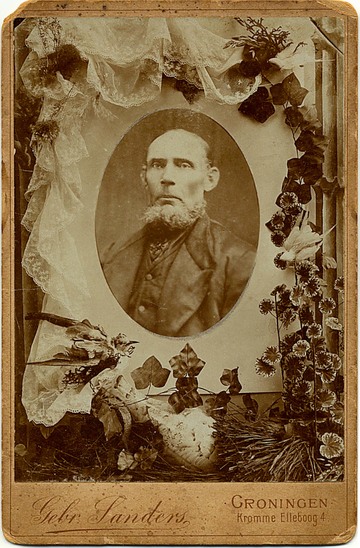
The data shown has no sources.
Matches in other publications
This person also appears in the publication: View all
Historical events
Birthday March 24, 1886
- The temperature on March 24, 1886 was about 15.9 °C. The air pressure was 12 kgf/m2 and came mainly from the east-southeast. The airpressure was 76 cm mercury. The atmospheric humidity was 53%. Source: KNMI
- Koning Willem III (Huis van Oranje-Nassau) was from 1849 till 1890 sovereign of the Netherlands (also known as Koninkrijk der Nederlanden)
- In The Netherlands , there was from April 23, 1884 to April 21, 1888 the cabinet Heemskerk, with Mr. J. Heemskerk Azn. (conservatief) as prime minister.
- In the year 1886: Source: Wikipedia
- The Netherlands had about 4.5 million citizens.
- February 23 » Charles Martin Hall produced the first samples of aluminium from the electrolysis of aluminium oxide, after several years of intensive work. He was assisted in this project by his older sister, Julia Brainerd Hall.
- March 1 » The Anglo-Chinese School, Singapore is founded by Bishop William Oldham.
- May 1 » Rallies are held throughout the United States demanding the eight-hour work day, culminating in the Haymarket affair in Chicago, in commemoration of which May 1 is celebrated as International Workers' Day in many countries.
- June 13 » A fire devastates much of Vancouver, British Columbia.
- July 4 » The Canadian Pacific Railway's first scheduled train from Montreal arrives in Port Moody on the Pacific coast, after six days of travel.
- November 27 » German judge Emil Hartwich sustains fatal injuries in a duel, which would become the background for Theodor Fontane's Effi Briest.
Day of marriage March 12, 1910
- The temperature on March 12, 1910 was between 4.6 °C and 10.3 °C and averaged 7.0 °C. There was 0.2 mm of rain. There was 0.7 hours of sunshine (6%). The average windspeed was 3 Bft (moderate breeze) and was prevailing from the north. Source: KNMI
- Koningin Wilhelmina (Huis van Oranje-Nassau) was from 1890 till 1948 sovereign of the Netherlands (also known as Koninkrijk der Nederlanden)
- In The Netherlands , there was from February 12, 1908 to August 29, 1913 the cabinet Heemskerk, with Mr. Th. Heemskerk (AR) as prime minister.
- In the year 1910: Source: Wikipedia
- The Netherlands had about 5.9 million citizens.
- January 1 » Captain David Beatty is promoted to Rear admiral, and becomes the youngest admiral in the Royal Navy (except for Royal family members) since Horatio Nelson.
- February 8 » The Boy Scouts of America is incorporated by William D. Boyce.
- March 28 » Henri Fabre becomes the first person to fly a seaplane, the Fabre Hydravion, after taking off from a water runway near Martigues, France.
- May 11 » An act of the U.S. Congress establishes Glacier National Park in Montana.
- October 21 » HMSNiobe arrives in Halifax Harbour to become the first ship of the Royal Canadian Navy.
- December 21 » An underground explosion at the Hulton Bank Colliery No. 3 Pit in Over Hulton, Westhoughton, England, kills 344 miners.
Day of death March 22, 1948
- The temperature on March 22, 1948 was between 6.4 °C and 10.7 °C and averaged 7.9 °C. There was 6.9 hours of sunshine (56%). The average windspeed was 4 Bft (moderate breeze) and was prevailing from the west-northwest. Source: KNMI
- Koningin Wilhelmina (Huis van Oranje-Nassau) was from 1890 till September 4, 1948 sovereign of the Netherlands (also known as Koninkrijk der Nederlanden)
- Koningin Juliana (Huis van Oranje-Nassau) was from September 4, 1948 till April 30, 1980 sovereign of the Netherlands (also known as Koninkrijk der Nederlanden)
- In The Netherlands , there was from July 3, 1946 to August 7, 1948 the cabinet Beel I, with Dr. L.J.M. Beel (KVP) as prime minister.
- From August 7, 1948 till March 15, 1951 the Netherlands had a cabinet Drees - Van Schaik with the prime ministers Dr. W. Drees (PvdA) and Mr. J.R.H. van Schaik (KVP).
- In the year 1948: Source: Wikipedia
- The Netherlands had about 9.7 million citizens.
- March 18 » Soviet consultants leave Yugoslavia in the first sign of the Tito–Stalin Split.
- April 3 » In Jeju Province, South Korea, a civil-war-like period of violence and human rights abuses begins, known as the Jeju uprising.
- June 20 » The Deutsche Mark is introduced in Western Allied-occupied Germany. The Soviet Military Administration in Germany responded by imposing the Berlin Blockade four days later.
- August 3 » Whittaker Chambers accuses Alger Hiss of being a communist and a spy for the Soviet Union.
- September 24 » The Honda Motor Company is founded.
- October 5 » The Ashgabat earthquake kills between 10,000 and 110,000 people.
Same birth/death day
- 1884 » Peter Debye, Dutch-American physicist and chemist, Nobel Prize laureate († 1966)
- 1885 » Charles Daniels, American swimmer († 1973)
- 1885 » Dimitrie Cuclin, Romanian violinist and composer († 1978)
- 1886 » Edward Weston, American photographer († 1958)
- 1886 » Robert Mallet-Stevens, French architect and designer († 1945)
- 1887 » Roscoe Arbuckle, American actor, director, and screenwriter († 1933)
- 1942 » Frederick Cuming, English cricketer (b. 1875)
- 1942 » William Donne, English captain and cricketer (b. 1875)
- 1945 » John Hessin Clarke, American lawyer and judge (b. 1857)
- 1952 » D. S. Senanayake, 1st Prime Minister of Sri Lanka (b. 1883)
- 1955 » Ivan Šubašić, Croatian lawyer and politician, 23rd Prime Minister of Yugoslavia (b. 1892)
- 1958 » Mike Todd, American film producer (b. 1909)
About the surname Doddema
- View the information that Genealogie Online has about the surname Doddema.
- Check the information Open Archives has about Doddema.
- Check the Wie (onder)zoekt wie? register to see who is (re)searching Doddema.
The Family tree Leemborg publication was prepared by Roelf Schrik.
When copying data from this family tree, please include a reference to the origin:
Roelf Schrik, "Family tree Leemborg", database, Genealogy Online (https://www.genealogieonline.nl/stamboom-leemborg/I66.php : accessed March 16, 2026), "Engelina Doddema (1886-1948)".
Roelf Schrik, "Family tree Leemborg", database, Genealogy Online (https://www.genealogieonline.nl/stamboom-leemborg/I66.php : accessed March 16, 2026), "Engelina Doddema (1886-1948)".