Family tree Bol » Frederika Beunk (1865-1920)
Personal data Frederika Beunk
- She was born on June 30, 1865 in Meppel, Drenthe, Nederland.
- She died on October 23, 1920 in Amsterdam, Noord-Holland, Nederland, she was 55 years old.
- This information was last updated on July 17, 2020.
Household of Frederika Beunk
She is married to Albertus Hagedoorn.
They got married on November 20, 1886 at Meppel, Drenthe, Nederland, she was 21 years old.
Child(ren):
Ancestors (and descendant) of Frederika Beunk
Frederika Beunk | ||||||||||||||||||||||||||||||||||
1886 | ||||||||||||||||||||||||||||||||||
Albertus Hagedoorn 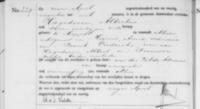 | ||||||||||||||||||||||||||||||||||
The data shown has no sources.
Matches in other publications
This person also appears in the publication: View all
- Kwartierstaat Dietz, both authors confirmed that this is the same person
- Stamboom Dietz, one author has confirmed this is the same person
Historical events
Birthday June 30, 1865
- The temperature on June 30, 1865 was about 13.2 °C. There was 23 mm of rain. The air pressure was 0.5 kgf/m2 and came mainly from the west-southwest. The airpressure was 74 cm mercury. The atmospheric humidity was 94%. Source: KNMI
- Koning Willem III (Huis van Oranje-Nassau) was from 1849 till 1890 sovereign of the Netherlands (also known as Koninkrijk der Nederlanden)
- In The Netherlands , there was from February 1, 1862 to February 10, 1866 the cabinet Thorbecke II, with Mr. J.R. Thorbecke (liberaal) as prime minister.
- In the year 1865: Source: Wikipedia
- The Netherlands had about 3.6 million citizens.
- March 25 » American Civil War: In Virginia, Confederate forces temporarily capture Fort Stedman from the Union.
- April 9 » American Civil War: Robert E. Lee surrenders the Army of Northern Virginia (26,765 troops) to Ulysses S. Grant at Appomattox Court House, Virginia, effectively ending the war.
- May 9 » American Civil War: President Andrew Johnson issues a proclamation ending belligerent rights of the rebels and enjoining foreign nations to intern or expel Confederate ships.
- May 17 » The International Telegraph Union (later the International Telecommunication Union) is established in Paris.
- July 14 » First ascent of the Matterhorn by Edward Whymper and party, four of whom die on the descent.
- November 11 » Treaty of Sinchula is signed whereby Bhutan cedes the areas east of the Teesta River to the British East India Company.
Day of marriage November 20, 1886
- The temperature on November 20, 1886 was about 6.9 °C. The air pressure was 4 kgf/m2 and came mainly from the south. The airpressure was 77 cm mercury. The atmospheric humidity was 97%. Source: KNMI
- Koning Willem III (Huis van Oranje-Nassau) was from 1849 till 1890 sovereign of the Netherlands (also known as Koninkrijk der Nederlanden)
- In The Netherlands , there was from April 23, 1884 to April 21, 1888 the cabinet Heemskerk, with Mr. J. Heemskerk Azn. (conservatief) as prime minister.
- In the year 1886: Source: Wikipedia
- The Netherlands had about 4.5 million citizens.
- January 18 » Modern field hockey is born with the formation of The Hockey Association in England.
- March 1 » The Anglo-Chinese School, Singapore is founded by Bishop William Oldham.
- March 27 » Geronimo, Apache warrior, surrenders to the U.S. Army, ending the main phase of the Apache Wars.
- March 29 » John Pemberton brews the first batch of Coca-Cola in a backyard in Atlanta.
- May 1 » Rallies are held throughout the United States demanding the eight-hour work day, culminating in the Haymarket affair in Chicago, in commemoration of which May 1 is celebrated as International Workers' Day in many countries.
- November 27 » German judge Emil Hartwich sustains fatal injuries in a duel, which would become the background for Theodor Fontane's Effi Briest.
Day of death October 23, 1920
- The temperature on October 23, 1920 was between -4.5 °C and 14.4 °C and averaged 3.7 °C. There was 8.8 hours of sunshine (86%). The average windspeed was 2 Bft (weak wind) and was prevailing from the east. Source: KNMI
- Koningin Wilhelmina (Huis van Oranje-Nassau) was from 1890 till 1948 sovereign of the Netherlands (also known as Koninkrijk der Nederlanden)
- In The Netherlands , there was from September 9, 1918 to September 18, 1922 the cabinet Ruys de Beerenbrouck I, with Jonkheer mr. Ch.J.M. Ruys de Beerenbrouck (RKSP) as prime minister.
- In the year 1920: Source: Wikipedia
- The Netherlands had about 6.8 million citizens.
- January 19 » The United States Senate votes against joining the League of Nations.
- February 24 » Nancy Astor becomes the first woman to speak in the House of Commons of the United Kingdom following her election as a Member of Parliament (MP) three months earlier.
- June 4 » Hungary loses 71% of its territory and 63% of its population when the Treaty of Trianon is signed in Paris.
- August 16 » Polish–Soviet War: The Battle of Radzymin concludes; the Soviet Red Army is forced to turn away from Warsaw.
- August 20 » The first commercial radio station, 8MK (now WWJ), begins operations in Detroit.
- October 14 » Finland and Soviet Russia sign the Treaty of Tartu, exchanging some territories.
Same birth/death day
- 1843 » Ernest Mason Satow, English orientalist and diplomat († 1929)
- 1864 » Frederick Bligh Bond, English architect and archaeologist († 1945)
- 1884 » Georges Duhamel, French author and critic († 1966)
- 1889 » Archibald Frazer-Nash, English motor car designer, engineer and founder of Frazer Nash († 1965)
- 1890 » Paul Boffa, Maltese physician and politician, 5th Prime Minister of Malta († 1962)
- 1891 » Man Mountain Dean, American wrestler and sergeant († 1953)
- 1910 » Chulalongkorn, Thai king (b. 1853)
- 1915 » W. G. Grace, English cricketer and physician (b. 1848)
- 1916 » Richard McFadden, Scottish footballer and soldier (b. 1889)
- 1917 » Eugène Grasset, Swiss illustrator (b. 1845)
- 1921 » John Boyd Dunlop, Scottish businessman, founded Dunlop Rubber (b. 1840)
- 1935 » Charles Demuth, American painter and educator (b. 1883)
About the surname Beunk
- View the information that Genealogie Online has about the surname Beunk.
- Check the information Open Archives has about Beunk.
- Check the Wie (onder)zoekt wie? register to see who is (re)searching Beunk.
The Family tree Bol publication was prepared by D. v.d. Werff v.d. Mije.
When copying data from this family tree, please include a reference to the origin:
D. v.d. Werff v.d. Mije, "Family tree Bol", database, Genealogy Online (https://www.genealogieonline.nl/parenteel-bol/I335.php : accessed January 29, 2026), "Frederika Beunk (1865-1920)".
D. v.d. Werff v.d. Mije, "Family tree Bol", database, Genealogy Online (https://www.genealogieonline.nl/parenteel-bol/I335.php : accessed January 29, 2026), "Frederika Beunk (1865-1920)".