Family tree Bol » Albertus Hagedoorn (1867-1941)
Personal data Albertus Hagedoorn
- He was born on June 8, 1867 in Meppel, Drenthe, Nederland.
- He died on April 7, 1941 in Amsterdam, Noord-Holland, Nederland, he was 73 years old.
- This information was last updated on June 4, 2020.
Household of Albertus Hagedoorn
He is married to Frederika Beunk.
They got married on November 20, 1886 at Meppel, Drenthe, Nederland, he was 19 years old.
Child(ren):
Image(s) Albertus Hagedoorn

Ancestors (and descendant) of Albertus Hagedoorn
Albertus Hagedoorn 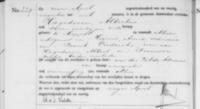 | ||||||||||||||||||||||||||||||||||
1886 | ||||||||||||||||||||||||||||||||||
Frederika Beunk | ||||||||||||||||||||||||||||||||||
The data shown has no sources.
Matches in other publications
This person also appears in the publication: View all
- Kwartierstaat Dietz, both authors confirmed that this is the same person
- Kwartierstaat Marcus Bredero, one author has confirmed this is the same person
- Stamboom Dietz, one author has confirmed this is the same person
Historical events
Birthday June 8, 1867
- The temperature on June 8, 1867 was about 14.2 °C. There was 0.1 mm of rain. The air pressure was 8 kgf/m2 and came mainly from the northwest. The airpressure was 76 cm mercury. The atmospheric humidity was 53%. Source: KNMI
- Koning Willem III (Huis van Oranje-Nassau) was from 1849 till 1890 sovereign of the Netherlands (also known as Koninkrijk der Nederlanden)
- From June 1, 1866 till June 4, 1868 the Netherlands had a cabinet Van Zuijlen van Nijevelt - Heemskerk with the prime ministers Mr. J.P.J.A. graaf Van Zuijlen van Nijevelt (AR) and Mr. J. Heemskerk Azn. (conservatief).
- In the year 1867: Source: Wikipedia
- The Netherlands had about 3.6 million citizens.
- February 17 » The first ship passes through the Suez Canal.
- March 2 » The U.S. Congress passes the first Reconstruction Act.
- March 30 » Alaska is purchased from Russia for $7.2 million, about 2-cent/acre ($4.19/km²), by United States Secretary of State William H. Seward.
- September 28 » Toronto becomes the capital of Ontario, having also been the capital of Ontario's predecessors since 1796.
- November 3 » Giuseppe Garibaldi and his followers are defeated in the Battle of Mentana and fail to end the Pope's Temporal power in Rome (it would be achieved three years later).
- December 4 » Former Minnesota farmer Oliver Hudson Kelley founds the Order of the Patrons of Husbandry (better known today as the Grange).
Day of marriage November 20, 1886
- The temperature on November 20, 1886 was about 6.9 °C. The air pressure was 4 kgf/m2 and came mainly from the south. The airpressure was 77 cm mercury. The atmospheric humidity was 97%. Source: KNMI
- Koning Willem III (Huis van Oranje-Nassau) was from 1849 till 1890 sovereign of the Netherlands (also known as Koninkrijk der Nederlanden)
- In The Netherlands , there was from April 23, 1884 to April 21, 1888 the cabinet Heemskerk, with Mr. J. Heemskerk Azn. (conservatief) as prime minister.
- In the year 1886: Source: Wikipedia
- The Netherlands had about 4.5 million citizens.
- January 18 » Modern field hockey is born with the formation of The Hockey Association in England.
- March 1 » The Anglo-Chinese School, Singapore is founded by Bishop William Oldham.
- March 29 » John Pemberton brews the first batch of Coca-Cola in a backyard in Atlanta.
- May 1 » Rallies are held throughout the United States demanding the eight-hour work day, culminating in the Haymarket affair in Chicago, in commemoration of which May 1 is celebrated as International Workers' Day in many countries.
- June 26 » Henri Moissan isolated elemental Fluorine for the first time.
- July 3 » The New-York Tribune becomes the first newspaper to use a linotype machine, eliminating typesetting by hand.
Day of death April 7, 1941
- The temperature on April 7, 1941 was between 1.0 °C and 7.8 °C and averaged 4.0 °C. There was 10.1 hours of sunshine (76%). The average windspeed was 5 Bft (very strong wind) and was prevailing from the north-northeast. Source: KNMI
- Koningin Wilhelmina (Huis van Oranje-Nassau) was from 1890 till 1948 sovereign of the Netherlands (also known as Koninkrijk der Nederlanden)
- In The Netherlands , there was from September 3, 1940 to July 27, 1941 the cabinet Gerbrandy I, with Prof. dr. P.S. Gerbrandy (ARP) as prime minister.
- In The Netherlands , there was from July 27, 1941 to February 23, 1945 the cabinet Gerbrandy II, with Prof. dr. P.S. Gerbrandy (ARP) as prime minister.
- In the year 1941: Source: Wikipedia
- The Netherlands had about 8.9 million citizens.
- January 17 » Franco-Thai War: Vichy French forces inflict a decisive defeat over the Royal Thai Navy.
- May 30 » World War II: Manolis Glezos and Apostolos Santas climb the Athenian Acropolis and tear down the German flag.
- October 31 » After 14 years of work, Mount Rushmore is completed.
- December 5 » World War II: Great Britain declares war on Finland, Hungary and Romania.
- December 10 » World War II: The Royal Navy capital ships HMSPrince of Wales and HMSRepulse are sunk by Imperial Japanese Navy torpedo bombers near British Malaya.
- December 23 » World War II: After 15 days of fighting, the Imperial Japanese Army occupies Wake Island.
Same birth/death day
- 1859 » Smith Wigglesworth, English evangelist († 1947)
- 1860 » Alicia Boole Stott, Irish-English mathematician and theorist († 1940)
- 1867 » Frank Lloyd Wright, American architect, designed the Price Tower and Fallingwater († 1959)
- 1868 » Robert Robinson Taylor, American architect († 1942)
- 1872 » Jan Frans De Boever, Belgian painter and illustrator († 1949)
- 1875 » Ernst Enno, Estonian poet and author († 1934)
- 1938 » Suzanne Valadon, French painter (b. 1865)
- 1939 » Joseph Lyons, Australian educator and politician, 10th Prime Minister of Australia (b. 1879)
- 1943 » Alexandre Millerand, French lawyer and politician, 12th President of France (b. 1859)
- 1943 » Jovan Dučić, Serbian-American poet and diplomat (b. 1871)
- 1947 » Henry Ford, American engineer and businessman, founded the Ford Motor Company (b. 1863)
- 1949 » John Gourlay, Canadian soccer player (b. 1872)
About the surname Hagedoorn
- View the information that Genealogie Online has about the surname Hagedoorn.
- Check the information Open Archives has about Hagedoorn.
- Check the Wie (onder)zoekt wie? register to see who is (re)searching Hagedoorn.
The Family tree Bol publication was prepared by D. v.d. Werff v.d. Mije.
When copying data from this family tree, please include a reference to the origin:
D. v.d. Werff v.d. Mije, "Family tree Bol", database, Genealogy Online (https://www.genealogieonline.nl/parenteel-bol/I334.php : accessed February 14, 2026), "Albertus Hagedoorn (1867-1941)".
D. v.d. Werff v.d. Mije, "Family tree Bol", database, Genealogy Online (https://www.genealogieonline.nl/parenteel-bol/I334.php : accessed February 14, 2026), "Albertus Hagedoorn (1867-1941)".