maximum test » Leo "Leo VI 'The Wise' Byzantine Emperor" (866-912)
Persoonlijke gegevens Leo "Leo VI 'The Wise' Byzantine Emperor"
Bron 1- Roepnaam is Leo VI 'The Wise' Byzantine Emperor.
- Hij is geboren op 19 september 866Constantinople
Eastern Roman Empire. - Hij is overleden op 11 mei 912, hij was toen 45 jaar oudConstantinple
Eastern Roman Empire. - Hij is begraven in Church of the Holy ApostlesConstantinople
Eastern Roman Empire. - Een kind van ... en Eudokia Игориевна Ingerina
Gezin van Leo "Leo VI 'The Wise' Byzantine Emperor"
Hij is getrouwd met Zoë Karbonopsina.
Zij zijn getrouwd te Constantinople, Turkey.
Kind(eren):
Notities over Leo "Leo VI 'The Wise' Byzantine Emperor"
Name Suffix:Vi, Byzantine Emperor "The Wise"
Leon var keiser av Bysants 886 - 912.
I følge Mogens Bugge i ?Våre forfedre? var Leon sønn til Basileios ?Makedonieren?
(813 - 886) som var keiser i Bysants fra 867 til han døde. Basileios var sønn til en bonde i
Adrianopel og fikk på grunn av sin styrke og skjønnhet plass ved de kongelige staller i
Konstantinopel. Han oppnådde som hestetemmer keiser Michael III's gunst og steg hurtig i
gradene til overstallmester og storkammerherre. I 866 ble han utnvent til Cæsar. Året etter lot
han den uverdige keiser rydde av veien og hadde nå selv makten Han var som keiser dyktig
og omsiktsfull, klok og økonomisk. Basileios døde på jakt ved et ulykkestilfelle. Ifølge Bugge
ble han gift ca. 865 med Eudoxia Ingeria av Bysants. Hun oppgis å være datter til
den østromerske keiseren Theofilos.
Ifølge til Bent og Vidar Billing Hansens ?Rosensverdslektens forfedre? var imidlertid
Leon sønn til keiser Michael III Drankeren, født 838 og keiser i Bysants fra 842 til han døde i
867 og Eudoxia Ingeria som var hans konkubine. Basileios I var kun proforma gift med Eudoxia
mens Michael III levde og ble derfor offisielt regnet for å være Leons far. Leons farfar blir
derved Theophilos (se ovenfor), og hans oldefar Michael II ?den Stamme?. Michael II grunnla
det frygiske eller amoriske dynasti som regjerte fra 820 til 867. Deretter overtok det
makedonske dynasti fra 867 til 1057.
Leon var ikke i stand til å avverge angrep fra ytre fiender, men hadde fortjenester av
rikets indre ordning. Han fullførte en ny lovbok og økte sentraliseringen av statens styre. Leon
var en lærd man som utga teologiske verk, skrev vers og drev spådom.
Han var gift
1. gang i 881 med Theofano,
2. gang i 894 med Zoè, datter til Stylien etter først å ha hatt henne som elskerinne,
3. gang med Eudoxia.
Etter Eudoxias død tok han Zoè Karbonopsina som konkubine. Med sine 3 første
hustruer hadde han ingen barn som levde opp.
Den vestre halvdel av romerriket falt fra hverandre i småriker med overveiende
germansk preg. Den østlige delen, derimot, fortsatte i tusen år å eksistere som et romersk
keiserrike, takket være blant annet hovedstadens gode forsvarsmuligheter. I virkeligheten var
heller ikke denne staten romersk lenger, det vil si latinsk, selv om de moderne innbyggere i
Hellas med stolthet har holdt romernavnet i hevd like til dette århundre. Gresk ble snart
nasjonalspråket, og kulturen kan vi betegne som en ennå levende hellenisme med meget
sterke innslag fra Orienten. Akkurat hvor langt denne orientalske innflytelsen strakte seg, og
hvor dens viktigste kilder i Østen lå, er det delte meninger om blant de forskere som
beskjeftiger seg med denne overordentlig viktige og fengslende kulturepoken, som vi kaller
bysantinismen etter Konstantinopels gamle navn. Andre foretrekker betegnelsen ?det greske
keiserrike?, men i våre dager benyttes dette navnet nokså sjelden.
I århundrer levde her et stykke antikk kultur videre i kristen drakt. Ofte ble roen
forstyrret av bitre dogmestrider, av pøbeloppløp og av hoffintriger hvor herskesyke damer,
listige evnukker og ærgjerrige embetsmenn gjerne spilte hovedrollen. Men den bysantiske stat
tålte påkjenningene, dens livskraft var utrolig seig. Lik en værbitt klippe, skurt ren av
folkevandringenes skred og stormer, sto det romerske dominat ennå ubeseiret i øst, og ennå
skulle historiens sol skinne og dens regn falle over tredve slektledd før Diokletians og
Konstantins veldige byggverk forvitret.
I dag, da man har et veldig historisk og arkeologisk materiale å grunne tanker om det
bysantiske rike på, må man nærmest smile av den forestillingen som så lenge var på moten, å
avferdige hele den bysantiske epoken med noen ord om ?forfall?. Treffende peker den
fremstående tyske bysantinolog Heinrich Gelzer på at ?et rike som tilbringer tusen år i
kontinuerlig ?forfall?, likevel må være noe ganske respektabelt. Andre stater får være tilfreds
om deres oppkomst, blomstringstid og forfall tilsammen fyller et tidsrom på tusen år.?
Å skape noe virkelig, epokegjørende nytt ble ikke den bysantiske kultur forunt. Sin
store innsats gjorde den når det gjaldt å bevare resultatet av antikkens kulturarbeid, forvalte
det og omforme det gjennom århundrer i en ny tids ånd, og formidle det til andre. Men bare det
er en innsats vi må bøye oss for i ærbødighet og takknemlighet, når vi tenker på de uavlatelige
kamper på liv og død som dette gamle riket måtte føre, mot fremstormende barbarer, fulle av
friske krefter og vill kamplyst - mot sine jevnbyrdige rivaler, de sasanidiske storkonger i Persia,
like fullt som mot frekke parvenyer i historien - mot folk som kjempet med giftpiler, som
korsfestet sine fanger eller flådde dem levende - mot madjarer og arabere, slavere og tyrkere,
og ikke minst mot folk vestfra som kalte seg kristne og siviliserte, men som ikke sto tilbake for
noen av troens og kulturens fiender i råskap eller uvettig ødeleggelseslyst. Hvor mange ganger
har ikke ville horder med mord og brann oversvømt keiserens land og trengt helt fram til
hovedstadens porter!
De gjengse skildringer forteller om bysantinere som fråtset bak sine bymurer i alle de
raffinerte nytelser en overmoden sivilisasjon byr - der i verdenshovedstaden, det herlige
Konstantinopel, smykket med praktfulle bygninger, og fylt av rov fra antikkens skjønneste
kunstbyer. Men bildet blir ikke fullstendig hvis man glemmer at livsnytelsen stadig kunne bli
spolert av angsten for innfall fra blodtørstige naboer. ?Innenfor murene var det alltid fest,?
skriver Gelzer, ?utenfor hersket dødsfaren til enhver tid. Det fantes perioder da enhver som
nødtvungent eller av uforsiktighet forlot byen, gikk den visse død i møte. Han risikerte å bli
truffet av spydet til en slavisk marodør, eller bli slept avsted til slavemarkedet av arabiske
pirater, eller bli levende flådd av tyrkere.?
Gjennom hele dette årtusen var det bysantiske rike Europas skjold mot øst.
Beskyttelsen som dets sterke festninger og våpen ga, gjorde at Vestens kultur fikk slå rot og
utvikle seg. Diplomatiets våpen ble heller ikke forsømt av de østromerske keisere i kampen mot
barbarene. Med århundrers oppsamlet erfaring i den gamle romerske kunst å splitte og herske,
hisset de det ene folk opp mot det andre. Og hele tiden mens denne kampen sto på,
gjennomførte Bysants sin verdenshistoriske oppgave ved å kristne og sivilisere slavere og
andre folk i øst, og ved å hjelpe dem til en fast statsorganisasjon. Det Roma ble for
germanerne, ble Bysants for Øst-Europa.
Men ikke nok med det, hva ville vi ha visst om madjanernes, slavernes eller
bulgarernes eldste historie, om vi ikke hadde hatt det bysantiske kildematerialet? Vi ville ha
hatt like lite kjennskap til disse folkegruppenes barndom som vi ville ha visst om germanerne
uten Cæsar og Tacitus. For ennå en gang å tale med Gelzer, bysantinerne ?nøyde seg med å
være menneskehetens bibliotekarer. Men det er ingen ringe fortjeneste å ha vernet om en slik
arv, både med våpenmakt og med diplomatisk dyktighet.?
LEO VI, surnamed "The Wise" and "The Philosopher," Byzantine emperor,886-911. He was the son of Basil I the Macedonian and his second wife, Eudocia Ingerina, although it has been suggested that he was, in fact, the son of Eudocia by Michael III. The chief event of his reign was the capture of Thessalonica (904) by Mohammedan pirates under the renegade Leo of Tripolis. In Sicily and Lower Italy the imperial arms were unsuccessful, and the Bulgarian Symeon, who assumed the title of "Czar of the Bulgarians and autocrat of the Romaei" secured the independence of his church by the establishment of a patriarchate. But thoughGibbon may be right in calling his surname "absurd," he did lasting work in reforming the civil administration of the empire. His works include seventeen Oracula, in iambic verse, on the destinies of future emperors and patriarchs of Constantinople; thirty-three Orations, chiefly on theological subjects (such as church festivals); Basilica, the completion of the digest of the laws of Justinian, begun by Basil I., the father of Leo; some epigrams in the Greek Anthology; an iambic lament on the melancholy condition of the empire; and some palindromic verses, curiously called "karkiuoi" (crabs). The treatise on military tacticts, attibuted to him, is possibly by Leo III, the Isaurian. [Encyclopaedia Britannica, 1961 ed. Vol. 13, p. 930-31. LEO VI]
---------
LEO VI, byname LEO THE WISE, or THE PHILOSOPHER (b. Sept. 19, 866--d.May 11, 912, Constantinople), Byzantine coemperor from 870 and emperor from 886 to 912, whose imperial laws, written in Greek, became the legal code of the Byzantine Empire. Leo was the son of Basil I the Macedonian, who had begun the codification, and his second wife, Eudocia Ingerina. Made coemperor in 870, Leo succeeded to the throne on his father's death. His foreign policy was directed mainly against the Arabsand the Bulgars. The able commander Nicephorus Phocas the Elder was recalled from his successful campaigns against the Lombards in south Italy to assist in the Balkans. After this Byzantium met with reverses in the West: Sicily was lost to the Arabs in 902, Thessalonica was sacked by Leo of Tripoli, and the Aegean was open to constant attack fromArab pirates. Steps were taken to strengthen the Byzantine navy, which successfully attacked the Arab fleet in the Aegean in 908. But the naval expedition of 911-912 was defeated by Leo of Tripoli. Byzantium's enemy to the north was Simeon, the Bulgar ruler. Hostilities arose out of a trade dispute in 894, and the Byzantines, aided by the Magyars of the Danube-Dnieper region, forced Simeon to agree to a truce. With the help of the nomadic Pechenegs, however, Simeon in 896 took revenge on the Byzantines, forcing them to pay an annual tribute to the Bulgars.
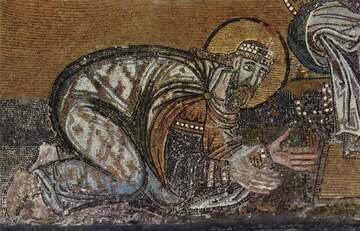
During Leo's reign the Russian prince Oleg sailed to Constantinople and in 907 obtained a treaty regulating the position of Russian merchants in Byzantium, which was formally ratified in 911. Because of his anxiety for a male heir Leo married four times, thus incurring the censure of the church. Educated by the patriarch Photius, Leo was more scholar than soldier. In addition to completing the canon of laws, he wrote several decrees (novels) on a wide range of ecclesiastical and secular problems. He also wrote a funeral panegyric on his father, liturgical poems, sermons and orations, secular poetry, and military treatises. Leo's image is in a mosaic over the central door of Hagia Sophia.
LEO VI, surnamed "The Wise" and "The Philosopher," Byzantine emperor,886-911. He was the son of Basil I the Macedonian and his second wife, Eudocia Ingerina, although it has been suggested that he was, in fact, the son of Eudocia by Michael III. The chief event of his reign was the capture of Thessalonica (904) by Mohammedan pirates under the renegade Leo of Tripolis. In Sicily and Lower Italy the imperial arms were unsuccessful, and the Bulgarian Symeon, who assumed the title of "Czar of the Bulgarians and autocrat of the Romaei" secured the independence of his church by the establishment of a patriarchate. But thoughGibbon may be right in calling his surname "absurd," he did lasting work in reforming the civil administration of the empire. His works include seventeen Oracula, in iambic verse, on the destinies of future emperors and patriarchs of Constantinople; thirty-three Orations, chiefly on theological subjects (such as church festivals); Basilica, the completion of the digest of the laws of Justinian, begun by Basil I., the father of Leo; some epigrams in the Greek Anthology; an iambic lament on the melancholy condition of the empire; and some palindromic verses, curiously called "karkiuoi" (crabs). The treatise on military tacticts, attibuted to him, is possibly by Leo III, the Isaurian. [Encyclopaedia Britannica, 1961 ed. Vol. 13, p. 930-31. LEO VI]
---------
LEO VI, byname LEO THE WISE, or THE PHILOSOPHER (b. Sept. 19, 866--d.May 11, 912, Constantinople), Byzantine coemperor from 870 and emperor from 886 to 912, whose imperial laws, written in Greek, became the legal code of the Byzantine Empire. Leo was the son of Basil I the Macedonian, who had begun the codification, and his second wife, Eudocia Ingerina. Made coemperor in 870, Leo succeeded to the throne on his father's death. His foreign policy was directed mainly against the Arabsand the Bulgars. The able commander Nicephorus Phocas the Elder was recalled from his successful campaigns against the Lombards in south Italy to assist in the Balkans. After this Byzantium met with reverses in the West: Sicily was lost to the Arabs in 902, Thessalonica was sacked by Leo of Tripoli, and the Aegean was open to constant attack fromArab pirates. Steps were taken to strengthen the Byzantine navy, which successfully attacked the Arab fleet in the Aegean in 908. But the naval expedition of 911-912 was defeated by Leo of Tripoli. Byzantium's enemy to the north was Simeon, the Bulgar ruler. Hostilities arose out of a trade dispute in 894, and the Byzantines, aided by the Magyars of the Danube-Dnieper region, forced Simeon to agree to a truce. With the help of the nomadic Pechenegs, however, Simeon in 896 took revenge on the Byzantines, forcing them to pay an annual tribute to the Bulgars.
During Leo's reign the Russian prince Oleg sailed to Constantinople and in 907 obtained a treaty regulating the position of Russian merchants in Byzantium, which was formally ratified in 911. Because of his anxiety for a male heir Leo married four times, thus incurring the censure of the church. Educated by the patriarch Photius, Leo was more scholar than soldier. In addition to completing the canon of laws, he wrote several decrees (novels) on a wide range of ecclesiastical and secular problems. He also wrote a funeral panegyric on his father, liturgical poems, sermons and orations, secular poetry, and military treatises. Leo's image is in a mosaic over the central door of Hagia Sophia.
LEO VI, surnamed "The Wise" and "The Philosopher," Byzantine emperor,886-911. He was the son of Basil I the Macedonian and his second wife, Eudocia Ingerina, although it has been suggested that he was, in fact, the son of Eudocia by Michael III. The chief event of his reign was the capture of Thessalonica (904) by Mohammedan pirates under the renegade Leo of Tripolis. In Sicily and Lower Italy the imperial arms were unsuccessful, and the Bulgarian Symeon, who assumed the title of "Czar of the Bulgarians and autocrat of the Romaei" secured the independence of his church by the establishment of a patriarchate. But thoughGibbon may be right in calling his surname "absurd," he did lasting work in reforming the civil administration of the empire. His works include seventeen Oracula, in iambic verse, on the destinies of future emperors and patriarchs of Constantinople; thirty-three Orations, chiefly on theological subjects (such as church festivals); Basilica, the completion of the digest of the laws of Justinian, begun by Basil I., the father of Leo; some epigrams in the Greek Anthology; an iambic lament on the melancholy condition of the empire; and some palindromic verses, curiously called "karkiuoi" (crabs). The treatise on military tacticts, attibuted to him, is possibly by Leo III, the Isaurian. [Encyclopaedia Britannica, 1961 ed. Vol. 13, p. 930-31. LEO VI]
---------
LEO VI, byname LEO THE WISE, or THE PHILOSOPHER (b. Sept. 19, 866--d.May 11, 912, Constantinople), Byzantine coemperor from 870 and emperor from 886 to 912, whose imperial laws, written in Greek, became the legal code of the Byzantine Empire. Leo was the son of Basil I the Macedonian, who had begun the codification, and his second wife, Eudocia Ingerina. Made coemperor in 870, Leo succeeded to the throne on his father's death. His foreign policy was directed mainly against the Arabsand the Bulgars. The able commander Nicephorus Phocas the Elder was recalled from his successful campaigns against the Lombards in south Italy to assist in the Balkans. After this Byzantium met with reverses in the West: Sicily was lost to the Arabs in 902, Thessalonica was sacked by Leo of Tripoli, and the Aegean was open to constant attack fromArab pirates. Steps were taken to strengthen the Byzantine navy, which successfully attacked the Arab fleet in the Aegean in 908. But the naval expedition of 911-912 was defeated by Leo of Tripoli. Byzantium's enemy to the north was Simeon, the Bulgar ruler. Hostilities arose out of a trade dispute in 894, and the Byzantines, aided by the Magyars of the Danube-Dnieper region, forced Simeon to agree to a truce. With the help of the nomadic Pechenegs, however, Simeon in 896 took revenge on the Byzantines, forcing them to pay an annual tribute to the Bulgars.
During Leo's reign the Russian prince Oleg sailed to Constantinople and in 907 obtained a treaty regulating the position of Russian merchants in Byzantium, which was formally ratified in 911. Because of his anxiety for a male heir Leo married four times, thus incurring the censure of the church. Educated by the patriarch Photius, Leo was more scholar than soldier. In addition to completing the canon of laws, he wrote several decrees (novels) on a wide range of ecclesiastical and secular problems. He also wrote a funeral panegyric on his father, liturgical poems, sermons and orations, secular poetry, and military treatises. Leo's image is in a mosaic over the central door of Hagia Sophia.
Probably son of Emperor Michael III, rather than his mother's husband, the future Basil I.
Leo VI
From Wikipedia, the free encyclopedia.
Jump to: navigation, search
This article is about the Byzantine Emperor. There is also an article on Pope Leo VI
The Byzantines considered themselves the true Romans. This follis by Leo VI bears the Byzantine Emperors' offcial title, BASILEVS ROMEON, Emperor of the Romans.Leo VI the Wise (September 19, 866 – May 11, 912) was Byzantine emperor from 886 to 912 during one of the most brilliant periods of the state's history.
Contents [hide]
1 Background
2 Fourth marriage dispute
3 War troubles
4 Legends
[edit]
Background
He inherited from his father Basil I an empire that was stronger than it ever had been since the height of the Roman Empire in the 3rd century. However, he and his father hated each other; it is possible that Leo was not Basil's son at all, but the son of his predecessor, Michael III. Basil had almost had Leo blinded as a teenager. In 886, Basil died in a hunting accident, though he claimed on his deathbed that there was an assassination attempt in which Leo was possibly involved.
Leo's somewhat absurd surname may be explained by the facts that he "was less ignorant than the greater part of his contemporaries in church and state, that his education had been directed by the learned Photius, and that several books of profane and ecclesiastical science were composed by the pen, or in the name, of the imperial philosopher" (Gibbon). Leo completed work on the Basilica, the Greek translation and update of the law code created by Justinian I, which had been started during the reign of Basil.
[edit]
Fourth marriage dispute
Leo caused a major scandal with his numerous marriages which failed to produce a legitimate heir to the throne. His first wife, whom Basil had forced him to marry, died in 897, and he re-married Zoë Zaützina, daughter of his counsellor Zaützes, though she died as well in 899. Upon this marriage Leo created the title of basilopator ("father of the emperor") for his father-in-law.
After Zoë's death a third marriage was technically illegal, but he married again, only to have his third wife die in 901. Instead of marrying a fourth time, which would have been an even greater sin than a third marriage (according to the Patriarch Nicholas Mysticus) Leo instead took a mistress, Zoe "of the coal eyes". He was allowed to marry her when she gave birth to a son in 904, but with many penalties, such as the refusal to legitimize his wife as empress.
[edit]
War troubles
Leo VI and his father Basil.Leo was a weak-minded ruler, chiefly occupied with unimportant wars with barbarians and struggles with churchmen. He was not as successful in battle as Basil had been. Basil had never lost to the Bulgarians, but in 894 they routed Leo's army. In 895 he was more successful, after first allying with the Magyars, but in 896, without Magyar help, the Byzantines were again defeated. Finally, Bulgarian Symeon, who assumed the title of "Czar of the Bulgarians and autocrat of the Romaei" secured the independence of his church by the establishment of a patriarchate.
The chief event of his middle reign was the capture of Thessalonica (904) by Muslim pirates (described in The Capture of Thessalonica by John Cameniata) under the renegade Leo of Tripolis. In 907 Constantinople was attacked by the Kievan Rus', who were seeking favourable trading rights with the empire. Leo paid them off, but they attacked again in 911, and a trade treaty was finally signed.
In Sicily and Calabria the imperial arms were unsuccessful, as the Arabs defeated his fleet when he attempted to take back Crete in 912. After this defeat Leo quickly became ill and died. As his son was still a child, Leo's brother and nominal (though powerless) co-emperor Alexander became full emperor.
[edit]
Legends
Probably inspired by stories about the ways of Harun al-Rashid, he would sometimes disguise himself and look for injustice or corruption. On one account, he was even captured by the city guards during one of his investigations. He wanted to know if the city patrol was doing its job appropriately. He was walking alone, disguised, late in the evening without any documentation. He bribed two patrols for 12 nomizmas, and moved on. But, the third city patrol arrested him. When a terrified guardian recognized the ruler in the morning, he was rewarded to his duty, and other patrols have been dismissed and punished severely.
Preceded by:
Basil I Byzantine Emperor
Succeeded by:
Alexander III
-------------------
Leo VI was a son of Eudoxia and officially also of Basil I, but there is strong evidence that Leo was really a son of Michael III
He was proclaimed Co-Emperor with his brother Constantine at the age of 41/2, and succeeded to the throne on his father's death, as his brother died in 879.
A literate man, educated by the Patriarch Photius, he was the empire's greatest legal reformer since Justinian I, and authorized a wide range of laws reflecting the transition of the Byzantine state into an autocratic bureaucracy.
He also wrote a number of religious works as well as several essays on military matters, including the famous "Tactica". He directed most of his military efforts against the Arabs and Bulgars. His wars against the latter caused the recall of his able commander Nicholas Phocas the Elder from southern Italy and led to the loss of both Taormina, the last Byzantian stronghold in Sicily on Aug. 1, 902, and Thessaloniki in 904.
In the meantime, he had made an alliance with the Magyars and forced the Bulgar Czar Simeon to agree to a truce after a brief war in 894. Simeon in turn made an alliance with the nomadic Petchnegs and defeated the Magyars before turning on the Byzantines and defeating them at the Battle of Bulgarophygon in 896, thus forcing Leo to agree to a disadvantageous peace in 897.
He concluded an alliance with Russian Prince Oleg when Oleg's fleet arrived off Constantinople in 907, and sponsored several successful naval operations against the Arabs in the Aegean and eastern Meditteranean, but his great expedition to Crete under Himerius failed in 911 and the fleet was smashed off Chios on its way home in spring of 912.
He secured the coronation of his Constantine VII as co-emperor on May 15, 908.
Although he was not a notably strong ruler by Byzantine standards, and more interested in writing than in governing, his legal reforms gave character to Imperial government for nearly two centuries, and the "Tactica" provides an important picture of Byzantine military practices.
[From Wikipedia.org]
Leo VI "the Wise" or "the Philosopher", (September 19, 866 - May 11, 912) was Byzantine emperor from 886 to 912 during one of the most brilliant periods of the state's history.
Background
Leo was born to Eudokia Ingerina who was at the time mistress of Emperor Michael III and wife of his Caesar Basil. Which of the two men was his father is uncertain. He was officially acknowledged by Basil as his son, but he apparently regarded Leo as Michael's son-although Basil only had eyes for his son Constantine, which may have worsened Leo and his Basil's relations and contributed to Basil's belief in Leo's illegitimacy.
On the night of September 23-September 24, 867, Michael was assassinated by Basil who succeeded him as Emperor Basil I. As the second eldest son of the Emperor, Leo was associated on the throne in 870 and became the direct heir on the death of his older half-brother Constantine in 879. However, he and his father hated each other and Basil had almost had Leo blinded as a teenager. On August 29, 886, Basil died in a hunting accident, though he claimed on his deathbed that there was an assassination attempt in which Leo was possibly involved.
Leo's sobriquet may be explained by the facts that he "was less ignorant than the greater part of his contemporaries in church and state, that his education had been directed by the learned Photios, and that several books of profane and ecclesiastical science were composed by the pen, or in the name, of the imperial philosopher" (Edward Gibbon).
Domestic Policy
One of the first actions of Leo VI after his succession was the reburial of Michael III in Constantinople, which may have contributed to the suspicion that he was Michael's son. Seeking political reconciliation, the new emperor secured the support of the officials in the capital, and surrounded himself with bureaucrats like Stylianos Zoutzes and the eunuch Samonas. His attempts to control the great aristocratic families (e.g., the Phokadai and the Doukai) occasionally led to serious conflicts. Leo also attempted to control the church through his appointments to the patriarchate. He dismissed the Patriarch Photios of Constantinople, who had been his tutor, and replaced him with his own 16-year old brother Stephen in December 886. On Stephen's death in 893, Leo replaced him with Zaoutzes' nominee, Antony II Kaleuas, who died in 901. Leo then promoted his own imperial secretary (mystikos) Nicholas, but replaced him with his spiritual father Euthymios in 907.
Leo completed work on the Basilica, the Greek translation and update of the law code issued by Justinian I, which had been started during the reign of Basil.
International Policy
Leo VI was not as successful in battle as Basil had been. In indulging his chief counselor Stylianos Zaoutzes, Leo provoked a war with Simeon I of Bulgaria in 894, but was defeated. Bribing the Magyars to attack the Bulgarians from the north, Leo scored an indirect success in 895. However, deprived of his new allies, he lost the major Battle of Boulgarophygon in 896 and had to make the required commercial concessions and to pay annual tribute.
The Emirate of Sicily took Taormina, the last Byzantine outpost on the island of Sicily, in 902. In 904 the renegade Leo of Tripolis sacked Thessalonica with his Muslim pirates (an event described in The Capture of Thessalonica by John Kameniates). In 907 Constantinople was attacked by the Kievan Rus' under Oleg of Novgorod, who was seeking favourable trading rights with the empire. Leo paid them off, but they attacked again in 911, and a trade treaty was finally signed. The admiral Himerios, a relative of Leo's last wife, Zoe Karbonopsina scored some successes against the Muslim fleets in 908 and raided Cyprus in 910, but in 912 was soundly defeated in his attempt to conquer Crete.
Fourth marriage dispute
Leo VI caused a major scandal with his numerous marriages which failed to produce a legitimate heir to the throne. His first wife, whom Basil had forced him to marry, died in 897, and he married Zoe Zaoutzaina, the daughter of his adviser Stylianos Zaoutzes, though she died as well in 899. Upon this marriage Leo created the title of basileopato-r ("father of the emperor") for his father-in-law.
After Zoe's death a third marriage was technically illegal, but he married again, only to have his third wife die in 901. Instead of marrying a fourth time, which would have been an even greater sin than a third marriage (according to the Patriarch Nicholas Mystikos) Leo took as mistress, Zoe Karbonopsina. He married her only after she had given birth to a son in 905, but incurred the opposition of the patriarch. Replacing Nicholas Mystikos with Euthymios, Leo got his marriage recognized by the church, but openend up a conflict within it and allowed new grounds for papal intervention into Byzantine affairs when he sought and obtained papal consent.
Succession
The future Constantine VII was the illegitimate son born before Leo's uncanonical fourth marriage to Zoe Karbonopsina. To strengthen his son's position as heir, Leo had him crowned as co-emperor on May 15, 908, when he was only two years old. Leo VI died on May 2, 912. He was succeeded by his younger brother Alexander, who had reigned as emperor alongside his father and brother since 879.
Legends
According to Bishop Liutprand of Cremona, and probably inspired by stories about the caliph Harun al-Rashid, Leo would sometimes disguise himself and look for injustice or corruption. On one account, he was even captured by the city guards during one of his investigations. He wanted to know if the city patrol was doing its job appropriately. He was walking alone, disguised, late in the evening without any documentation. He bribed two patrols for 12 nomismas, and moved on. However, the third city patrol arrested him. When a terrified guardian recognized the jailed ruler in the morning, the arresting officer was rewarded for doing his duty, while the other patrols were dismissed and punished severely.
Rootsweb Feldman
URL: http://worldconnect.genealogy.rootsweb.com/cgi-bin/igm.cgi?op=GET&db=:3044567&id=I02397
# ID: I02397
# Name: Leon VI Byzantine EMPIRE 1 2 3 4 5
# Sex: M
# Birth: 19 SEP 866 in Constantinople, Turkey 1 2 3 4 5
# Death: 12 MAY 912 1 2 3 4 5
# Change Date: 15 JAN 2004 5
# Change Date: 15 DEC 2001 2 3 4 5
# Note:
[Joanne's Tree.1 GED.GED]
2 SOUR S332582
3 DATA
4 TEXT Date of Import: 14 Jan 2004
[daveanthes.FTW]
Name Suffix: Emperor of the
Father: Basil The Macedonian' Byzantine EMPIRE b: 812 in Adrianople, Turkey
Mother: Eudoxia INGERINA b: 835 in Constantinople, Turkey
Marriage 1 Zautzina Byzantine EMPIRE b: ABT 874 in Constantinople, Turkey
* Married: 886 1 2 3 4 5
Children
1. Has Children Anna PORPHYROGENETIA b: 886 in Constantinople, Turkey
2. Has Children Konstantinos VII Byzantine EMPIRE b: ABT 906 in Constantinople, Constantinople, Turkey
Sources:
1. Title: daveanthes.FTW
Note: ABBR daveanthes.FTW
Note: Source Media Type: Other
Repository:
Call Number:
Media: Book
Text: Date of Import: 14 Jan 2004
2. Title: daveanthes.FTW
Note: ABBR daveanthes.FTW
Note: Source Media Type: Other
Repository:
Call Number:
Media: Book
Text: Date of Import: Jan 13, 2004
3. Title: Spare.FTW
Repository:
Call Number:
Media: Other
Text: Date of Import: Jan 18, 2004
4. Title: Spare.FTW
Repository:
Call Number:
Media: Other
Text: Date of Import: 21 Jan 2004
5. Title: Joanne's Tree.1 GED.GED
Repository:
Call Number:
Media: Other
Text: Date of Import: Feb 6, 2004
The question of whether Leo's father was Basil I or Michael III is, according to Todd Farmerie, unresolvable, despite what any author's give as proof, and despite who the people at the time might have thought was the father. They wouldn't have known for sure then, and we couldn't now. So, take your pick? See Todd's post to SGM, 29 May 1998, below:
From: Todd A. Farmerie ((XXXXX@XXXX.XXX)) Subject: Re: Father of Leo VI Philosophus
Newsgroups: soc.genealogy.medieval Date: 1998/05/29
(XXXXX@XXXX.XXX) wrote:
> This is from Sir Ian Moncreiffe, Royal Highness, p. 59. He says that Leo VI was almost certainly NOT the child of Basil I and was much more likely the child of Michael III, the Drunkard. Odd as it may seem, I've seen that same kind of description in three other places. I've never seen a complete argument as to why that would be so, but the modern authors are all dumping Basil I in favor of Michael III. I think we have to send it back to Michael III as father of Leo VI. JAMS, Vol. VI, #77, table 12 agrees with Moncreiffe. - Marlyn Lewis
> Does anyone know how to resolve this dilemma?
The question can be summed up real simply. A year or so before Leo came to be, Michael married his mistress (Leo's mother) to Basil. Short of a time machine and a DNA test we will not be able to resolve the question. Whatever he might have suspected (and it has been argued that he mistreated Leo because he suspected that Leo really wasn't his son) I doubt Basil knew, (same for Michael) and perhaps even the mother didn't. Moncreiffe is overstating the case. Bet. 886 - 912
From Wikipedia, the free encyclopedia.
This article is about the Byzantine Emperor.
Leo VI the Wise (September 19, 866 - May 11, 912) was Byzantineemperor from 886 to 912. He inherited from his father Basil I anempire that was much larger and stronger than it had been since theheight of the Roman Empire in the 2nd century. However, he and hisfather hated each other; it is possible that Leo was not Basil's sonat all, but the son of Michael III, the emperor before Basil. Basilhad almost had Leo blinded as a teenager. In 886, Basil died in ahunting accident, though he claimed on his deathbed that there was anassassination attempt in which Leo was possibly involved.
Leo completed work on the Basilica, the Greek translation and updateof the law code created by Justinian I, which had been started duringthe reign of Basil.
Leo was not as successful in battle as Basil had been. Basil had neverlost to the Bulgars, but in 894 they routed Leo's army. In 895 he wasmore successful, after first allying with the Magyars, but in 896,without Magyar help, the Byzantines were again defeated.
Leo caused a minor scandal with his numerous marriages. His firstwife, whom Basil had forced him to marry, died in 897, and here-married Zoë Zaützina, daughter of his counsellor Zaützes, thoughshe died as well in 899. After this marriage Leo created the title ofbasilopator ("father of the emperor") for his father-in-law. AfterZoë's death a third marriage was technically illegal, but he marriedagain, only to have his third wife die in 901. Instead of marrying afourth time, which would have been an even greater sin than a thirdmarriage (according to the Patriarch Nicholas Mysticus) Leo insteadtook a mistress. He was allowed to marry her when she gave birth to ason in 904, but with many penalties, such as the refusal to legitimizehis wife as empress.
In 907 Constantinople was attacked by the Kievan Rus', who wereseeking favourable trading rights with the empire. Leo paid them off,but they attacked again in 911, and a trade treaty was finally signed.However, Leo was not as successful against the Arabs, who defeated hisfleet when he attempted to take back Crete in 912. After this defeatLeo quickly became ill and died. As his son was still a child, Leo'sbrother and nominal (though powerless) co-emperor Alexander becamefull emperor.
#Générale##Générale#de Constantinople, de Macédoine
s:Auréjac
note couple : #Générale#
note couple : #Générale#s:Auréjac
note couple : #Générale#s:Auréjac
note couple : #Générale#s:Auréjac
#Générale#Controversé : nous suivons ici l'opinion de ChristianSettipani.D'autres sources en font le fils de Basile Ier.
Profession : Empereur de Byzance de 870 à 912.
{geni:about_me} ==''The identity of his father is uncertain. His mother was the wife of [http://www.geni.com/people/Basil-I-the-Macedonian-Emperor-of-the-Byzantine-Empire/6000000002434099128 Basil I] but mistress of [http://www.geni.com/people/Michael-III/6000000003051267350 Michael III].''==
Leo VI "the Wise" or "the Philosopher" (Greek: Λέων ΣΤ΄, Leōn VI), (September 19, 866 – May 11, 912) was Byzantine emperor from 886 to 912 during one of the most brilliant periods of the state's history.
'''Wives'''
*Theophano Martiniake
*Zoe Zaoutzaina
*Eudokia Baïana
*Zoe Karbonopsina
'''Issue'''
*Eudokia
*Anna
*Anna
*Basil
*Constantine VII
http://en.wikipedia.org/wiki/Leo_VI_the_Wise
--------------------
Leo VI, called the Wise or the Philosopher (Greek: Λέων ΣΤ΄ ὁ Σοφός, Leōn VI ho Sophos, 19 September 866 – 11 May 912), was Byzantine Emperor from 886 to 912. The second ruler of the Macedonian dynasty (although his parentage is unclear), he was very well-read, leading to his epithet. During his reign, the renaissance of letters, begun by his predecessor Basil I, continued; but the Empire also saw several military defeats in the Balkans against Bulgaria and against the Arabs in Sicily and the Aegean. His reign also witnessed the formal discontinuation of several ancient Roman institutions, such as the Roman consul and Senate (in this period also known as the Byzantine Senate), which continued to exist in name only and lost much of their original functions and powers.
Born to the empress Eudokia Ingerina, Leo was either the illegitimate son of Emperor Michael III or the second son of his predecessor, Basil I the Macedonian. Eudokia was both Michael III's mistress and Basil’s wife. In 867, Michael was assassinated by Basil, who succeeded him as Emperor. As the second eldest son of the Emperor, Leo was associated on the throne in 870 and became the direct heir on the death of his older half-brother Constantine in 879. However, Leo and Basil did not like each other; a relationship that only deteriorated after Eudokia's death, when Leo, unhappy with his marriage to Theophano, took up a mistress in the person of Zoe Zaoutzaina. Basil married Zoe off to an insignificant official, and later almost had Leo blinded when he was accused of conspiring against him. On August 29, 886, Basil died in a hunting accident, though he claimed on his deathbed that there was an assassination attempt in which Leo was possibly involved.
One of the first actions of Leo VI after his succession was the reburial, with great ceremony, of the remains of Michael III in the imperial mausoleum within the Church of the Holy Apostles in Constantinople. This contributed to the suspicion that Leo was (or at least believed himself to be) in truth Michael's son. Seeking political reconciliation, the new Emperor secured the support of the officials in the capital, and surrounded himself with bureaucrats like Stylianos Zaoutzes (the father of his mistress, Zoe Zaoutzaina) and the eunuch Samonas, an Arab defector whom Leo raised to the rank of patrikios and who stood in as godfather to Leo’s son, Constantine VII. His attempts to control the great aristocratic families (e.g., the Phokadai and the Doukai) occasionally led to serious conflicts, the most significant being the revolt of Andronikos Doukas in 906.
Leo also attempted to control the church through his appointments to the patriarchate. He dismissed the Patriarch Photios, who had been his tutor, and replaced him with his own 19-year-old brother Stephen in December 886. On Stephen's death in 893, Leo replaced him with Zaoutzes' nominee, Antony II Kauleas, who died in 901. Leo then promoted his own Imperial secretary (mystikos) Nicholas, but suspicions that he was involved in the failed assassination attempt against Leo in 903 as well as his opposition to Leo’s fourth marriage saw Nicholas replaced with Leo’s spiritual father Euthymios in 907.
The magnificent Church of Ayios Lazaros in Larnaca was constructed during the rule of Leo VI in the late 9th century, and it was built after the relics of St. Lazaros were transported from Crete to Constantinople. The church is one of the best examples of Byzantine architecture. Leo also completed work on the Basilika, the Greek translation and update of the law code issued by Justinian I, which had been started during the reign of Basil.
Bishop Liutprand of Cremona gives an account similar to those about Caliph Harun al-Rashid, to the effect that Leo would sometimes disguise himself and go about Constantinople looking for injustice or corruption. According to one story, he was even captured by the city guards during one of his investigations. Late in the evening, he was walking alone and disguised. Though he bribed two patrols with 12 nomismata and moved on, a third city patrol arrested him. When a terrified guardian recognized the jailed ruler in the morning, the arresting officer was rewarded for doing his duty, while the other patrols were dismissed and punished severely.
Leo VI's fortune in war was more mixed than Basil's had been. In indulging his chief counselor Stylianos Zaoutzes, Leo provoked a war with Simeon I of Bulgaria in 894, but he was defeated. Bribing the Magyars to attack the Bulgarians from the north, Leo scored an indirect success in 895. However, deprived of his new allies, he lost the major Battle of Boulgarophygon in 896 and had to make the required commercial concessions and to pay annual tribute.
Although he won a victory in 900 against the Emirate of Tarsus, in which the Arab army was destroyed and the Emir himself captured, in the west the Emirate of Sicily took Taormina, the last Byzantine outpost on the island of Sicily, in 902. Nevertheless, Leo continued to apply pressure on his eastern frontier through the creation of the new thema of Mesopotamia, a Byzantine invasion of Armenia in 902, and the sacking of Theodosiopolis, as well as successful raids in the Arab Thughur.
Then, in 904 the renegade Leo of Tripolis sacked Thessalonica with his pirates – an event described in The Capture of Thessalonica by John Kaminiates – while a large-scale expedition to recover Crete under Himerios in 911–912 failed disastrously. Nevertheless, the same period also saw the establishment of the important frontier provinces (kleisourai) of Lykandos and Leontokome on territory recently taken from the Arabs. In 907 Constantinople was attacked by the Kievan Rus' under Oleg of Novgorod, who was seeking favourable trading rights with the empire. Leo paid them off, but they attacked again in 911, and a trade treaty was finally signed.
Leo VI caused a major scandal with his numerous marriages which failed to produce a legitimate heir to the throne. His first wife Theophano, whom Basil had forced him to marry on account of her family connections to the Martinakioi, and whom Leo hated, died in 897, and Leo married Zoe Zaoutzaina, the daughter of his adviser Stylianos Zaoutzes, though she died as well in 899. Upon this marriage Leo created the title of basileopatōr ("father of the emperor")for his father-in-law.
After Zoe's death a third marriage was technically illegal, but he married again, only to have his third wife Eudokia Baïana die in 901. Instead of marrying a fourth time, which would have been an even greater sin than a third marriage (according to the Patriarch Nicholas Mystikos) Leo took as mistress Zoe Karbonopsina. He married her only after she had given birth to a son in 905, but incurred the opposition of the patriarch. Replacing Nicholas Mystikos with Euthymios, Leo got his marriage recognized by the church (albeit with a long penance attached, and with an assurance that Leo would outlaw all future fourth marriages).
The future Constantine VII was the illegitimate son born before Leo's uncanonical fourth marriage to Zoe Karbonopsina. To strengthen his son's position as heir, Leo had him crowned as co-emperor on May 15, 908, when he was only two years old. Leo VI died on May 11, 912. He was succeeded by his younger brother Alexander, who had reigned as Emperor alongside his father and brother since 879.
Leo VI was a prolific writer, and he produced works on many different topics and in many styles, including political orations, liturgical poems, and theological treatises. On many occasions he would personally deliver highly wrought and convoluted sermons in the churches of Constantinople.
In the subject matter of legal works and treatises, he established a legal commission that carried out his father's original intent of codifying all of existing Byzantine law. The end result was a six-volume work consisting of 60 books, entitled the Basilika. Written in Greek, the Basilika translated and systematically arranged practically all of the laws preserved in the Corpus Juris Civilis, thereby providing a foundation upon which all later Byzantine laws could be built. Leo then began integrating new laws issued during his reign into the Basilika. Called "Novels", or "New Laws", these were codes that dealt with current problems and issues, such as the prohibition on fourth marriages. Both the Basilika and the Novels were concerned with ecclesiastical law (canon law) as well as secular law. Most importantly, from a historical perspective, they finally did away with much of the remaining legal and constitutional architecture that the Byzantine Empire had inherited from the Roman Empire, and even from the days of the Roman Republic. Obsolete institutions such as the Curiae, the Roman Senate, even the Consulate, were finally removed from a legal perspective, even though these still continued in a lesser, decorative form.
The supposed Book of the Eparch and the Kletorologion of Philotheos were also issued under Leo's name and testify to his government’s interest in organization and the maintenance of public order. The Book of the Eparch described the rules and regulations for trade and trade organizations in Constantinople, while the Kletorologion was an attempt to standardize officials and ranks at the Byzantine court. Leo is also the author, or at least sponsor, of the Tactica, a notable treatise on military operations.
Succeeding generations saw Leo as a prophet and a magician, and soon a collection of oracular poems and some short divinatory texts, the so-called Oracles of Leo the Wise, at least in part based on earlier Greek sources, were attached to the Emperor's name in later centuries and were believed to foretell the future of the world.
Finally, Leo is credited with translating the relics of St. Lazarus to Constantinople in the year 890. There are several stichera (hymns) attributed to him that are chanted on Lazarus Saturday in the Eastern Orthodox Church. He also composed hymns that are sung on the Great Feast of the Exaltation of the Cross.
By his first wife, Theophano, Leo VI had one daughter:
Eudokia, who died in 892.
By his second wife, Zoe Zaoutzaina, Leo had one daughter:
Anna, betrothed and married to the Holy Roman Emperor Louis the Blind, though Dr. Shaun Tougher, Reader in Ancient History at Cardiff University, doubts they were married.
By his third wife, Eudokia Baïana, Leo had one son:
Basil, who survived for only a few days.
By his fourth wife, Zoe Karbonopsina, Leo had two children:
Anna
Constantine VII
------------------------------------
Лев VI Мудрий чи Філософ (грец. Λέων ΣΤ΄ ὁ Σοφός, ὁ Φιλόσοφος, * 19 вересня 866 — †11 травня 912) — імператор Візантії з 886 по 912 роки.
Матір'ю Лева була Євдокія Інґеріна, в минулому наложниця імператора Михайла ІІІ, а потім дружина імператора Василія І. Стосунки між батьком і сином були дуже напруженими. Хоча припускають, що Лев був сином Михайла ІІІ, однак це твердження не має достатньо аргументів. Лев бере участь у 883 році у заговорі проти Василія І і у 886 році його через це заарештовують.
По смерті Василія Лев вступає на трон та управляє імперією із своїм братом Александром, хоча фактична влада належала лише йому.
У зовнішній політиці напружені стосунки з болгарами привели до війни в якій Візантія отримує ряд поразок, найбільша з яких була у 896 році. Після неї Лев був змушений укласти з болгарами мирний договір і платити данину.
У 907 році пробуючи зробити для себе привілеї у торгівлі на Візантію нападає великий князь київський Олег. У 911 таки Візантія укладає торговий договір з Києвом. Обставини нападу та умови договору проте не згадуються у візантійських хроніках.
Проти арабів Візантія також втрачає силу: 902 року втрачена Таорміна в Сицилії внаслідок чого втрачено і контроль над морем у цьому регіоні. У 911 Лев пробує відвоювати цю територію і готує велику армію. Однак наступ не вдався. Після поразки Лев захворів і помер. Оскільки його син Костянтин ще був дитиною, фактичним імператором стає його брат Александр.
Source MANTEYER BUSQUET et SETTIPANI
Source MANTEYER BUSQUET et SETTIPANI
Leo VI "de Wijze" van Byzantium, ref. nr. 30.11.2004 Gen1995p479, Mumm, HdBp85, GMA, BdzRp218,[12],[13],[14],4,[15] (zie info 629). Keizer van Byzantium 886/913, mederegent was zijn broer Alexander. Hij trouwde (1) 882 Theophano Ingerina, ovl. 897, trouwde (3) 900 Eudokia Paiana, trouwde (4) 902 Zoe Karborospina, ovl. 919 als non. Anna stamde van zijn 2e vrouw, maar buitenechtelijk. Een andere dochter Anna van zijn vierde vrouw trouwde waarschijnlijk met Berlingar I van Italië. Hij trouwde met Zoe Zauchina, getrouwd 898.
A mãe de Leão, Eudokia Ingerina, era amante do Imperador Michael III e esposa de Caesar Basil. seu pai biológico é portanto, incerto. Basil reconheceu-o legalment como seu filho, mas a forma como o tratava sugere que ele sabia queLeão era filho de Michael (ou suspeitava ao menos).
Se ele for filho de Michael, sua linha genealógica segue nos levando aos faraós do egito, da seguinte forma:
Michael é filho de Teófilo Imperador de Bizâncio com Santa Teodora
Teofilo era filho de Miguel II, o gago Imperador de Bizâncio com Tecla Turcina.
Teodora era filha de Marino Mamikonian com Teoctista Florina.
Marino era filho de Artavazd II Mamikonian
Artvazd era filho de Hemayakes III Mamikonian de Adrianopolis
Hemeyakes era filho de Artavazd Mamikonian
Artavazd era filho Hamazasp II Mamikonian (10.ð vice-rei da Arménia) com Rrincesa de Roushtoni.
Hamazasp era filho de David Mamikonian Príncipe de Taron
A Princesa de Roushtoni era filha de Teodoro I Príncipe de Roushtoni, 9.ð vice-rei da Arménia.
David era filho de Vahan Mamikonian II, o lobo Príncipe de Taron, governador da Arménia
Vahan era filho de Mousegh I Mamikonian Vice-rei da Arménia
Mousegh era filho de Hemayakes II Mamikonian
SEGUINDO:
Hemayakes era filho de Vard Patrik Mamikonian Vice-rei da Arménia
Vard era filho de Hemayeakes Mamikonian com Dzoyk de Artsruni.
Hemayeakes era filho de Hamazasp I Príncipe de Mamikonids, condestável da Arménia com Sahakanoysh Souren Pahlav
Hamazasp era filho de Artaschir III Príncipe de Mamikonids
Sahakanoysh era filha de São Isaac o Grande Rei da Arménia
Isaac era filho de São Narso, o Grande Rei da Arménia com Sandukht Mamikonian.
Narso era filho de At'anakines Souren Pahlav com Bambisn Princesa da Arménia
Sandukht era filha de Vardan I Mamikonian Principe de Mamikonids
Banbisn era filha de Chosroes III Rei da Arménia
Chosrores era filho de Tiridat IV, o grande Rei da Arménia com Asxen Princesa da Alania.
Tiridat IV era filho de Khusraw II o valente Rei da Arménia Ocidental
Khusraw II era filho de Tiridat II Rei da Arménia
SEGUINDO:
Tridat II era filho de Khusraw I, o Bravo Rei da Arménia.
Khusraw I era filho de Vologaeses V, o Grande Rei da Pérsia com N Princesa da Ibéria.
Vologaeses V era filho de Vologaeses I Arsacid Rei da Arménia
A Princesa da Ibéria era filha de Pharamenses III Rei da Ibéria na Geórgia
Vologaeses I era filho de Sanatruces Rei da Arménia
Pharamenses III era filho de Rhadamiste I Rei da Ibéria na Geórgia
Sanatruces era filho de Mithradates Rei da Arménia com Aude Princesa de Osrhorne.
Rhadamiste era filho de Pharasmenes II Rei da Ibéria na Geórgia
Mithradates era filho de Vologaeses I Rei de Partia
Pharasmenes II era filho de Amazaspus I Rei da Ibéria na Geórgia
Vologaeses era filho de Vonones II Rei de Parthia nascido em 5 a.C.
Amazaspus I era filho de Mithradates I Rei da Ibéria na Geórgia
Mithradates I era filho de Pharasmenes I Rei da Ibéria na Geórgia
Pharasmenes I era filho de Koudjide Kartham com N Princesa da Ibéria
SEGUINDO:
Princesa da Ibéria era filha de Pharnabazus I Rei da Ibéria na Geórgia
Pharnabazus I era filho de Artaces I Rei da Ibéria na Geórgia
Artaces I era filho de Artaxias II Rei da Ibéria na Geórgia
Artaxias II era filho de Artavasdes I Rei da Arménia
Artavasdes I era filho de Tigranes I Rei da Arménia
Tigranes I era filho de Artaxias I Rei da Arménia
Artaxias I era filho de Zariadres I Rei de Sophene
Zariadres I era filho de Xerxes I Rei da Arménia com Antiochis da Síria.
Xerxes I era filho de Arsames I Rei da Arménia
Arsames era filho de Samos I Rei da Arménia
Samos I era filho de Aroandes III Rei da Arménia
Aroandes III era filho de Mithranes I Rei da Arménia
SEGUINDO:
Mithranes I era filho de Aroandes II Rei da Arménia
Aroandes II era filho de Aroandes I Satrap da Arménia com Rodogune Princesa da Pérsia
Rodogune era filha de Artaxerxes II Rei da Pérsia
Artaxerxes II era filha de Dario II Rei da Pérsia (450 a.C.) com Parysatis.
Dario II era filho de Artaxerxes I Rei da Pérsia (475 a.C.) com Andia
Artaxerxes I era filho de Xerxes I, o Grande Rei da Pérsia (500 a.C) com Esther
Xerxes I era filho de Dario I Rei da Pérsia (550 a.C) com Atossa Princesa da Pérsia.
Esther era filha de Abiail
Atossa era filha de Cirio II, o Grande Rei da Pérsia com Neithiyti.
Neithiyti era filha de Apries "Wahibre Ha'a'ib.re" do Egipto (590 a.C)
SEGUINDO:
Apries era filho de Psamtek II "Neferibre" do Egipto
Psamtek era filho de Necho II "Wehemibre" do Egipto
Necho II era filho de Psamtek I "Wahibre" Rei do Egipto
Psamtek I era filho de Necho I "Menkheperre" Rei do Egipto
Necho I era filho de Nekau ba Irib Re' Rei do Egipto
Nekau era filho de Bakenranef Wah-ka-re Rei do Egipto
Bakenranef era filho de Tefnakhte Shepses-re Rei do Egipto
Tefnakhte era filho de Osorkon IV Grão-chefe de Me
Osorkon era filho de Pimay, o Gato Grão-chefe de Me
Pimay era filho de Shoshenk III Grão-chefe de Me com Es Ankh Djed Bast
SEGUINDO:
Es Ankh é filha de Takelot Sumo Sacerdote de Path
Takelot é filho de Shoshenk Sumo Sacerdote de Path
Shoshenk é filho de Osorkon II Faraó do Egipto
Osorkon II é filho de Osorkon I Faraó do Egipto com Maat Ka-Re.
Maat é filha de Psusennes II de Tebas Sumo Sacerdote de Amon
Psusennes II é filho de Pinudjem II de Tebas Sumo Sacerdote de Amon
Pinudjem II é filho de Menkheperre de Tebas Sumo Sacerdote de Amon com Istemkheb
Istemkheb é filha de Psibkha'emne
SEGUINDO:
Psibkha'emne é filha do Governador de Tanis Smedes casou-se com Henttawy Princesa do Egipto
Henttawy é filha de Ramses XI Faraó do Egipto
Ramses XI é filho de Ramses X Faraó do Egipto
Ramses X é filho de Ramses IX Faraó do Egipto
Ramses IX é filho de Ramses VI Faraó do Egipto
Ramses VI é filho de Ramses III Faraó do Egipto com Isis
Ramses III é filho de Setnakht Faraó do Egipto
Setnakht é filho de Ramses II, o grande Faraó do Egipto
Ramses II é filho de Sety I Faraó do Egipto com Tuy
Sety é filho de Ramses I Faraó do Egipto com Satrê
Tuy é filha de Raia e Rouia
Ramses I é filho de Sety em 1400 A.C e Tiou
-
443594360. Keiser Leo VI FILOSOFUS av Bysanz(16498) was born on 1 Sep 866.(16499) He died on 11 May 912.(16500) He was a Keiser in Bysantz.(16501) Var ikke istand til å avverge angrep av ytre fiender, menhdde fortjenester av rikets indre ordning, fullførte en ny lovbok og forødet centraliseringen av statens styre. Var en lærd mann,utgav teologiske verker, skrev vers og drev spådom. He was married to Zoe CARBONOPSINA. (16502)
Leão VI ficou famoso por seus numerosos casamentos que falharam em produzir a ele um herdeiro letítimo ao trono. Sua primeira mulher, Theophano, com quem foi forçado a casar por Basil, moreu em 897. Ele se casou com Zoe Zaoutzaina, filha de seu conselhieiro Stylianos Zaoutzes, ela morreu em 899. Seu 3o casamento foi tecnicamente ilegal, mas ele se casou mesmo assim com Eudokia Baïana que morre em 901. Ao invés de se casar novamente, Leão tomou como amante Zoe Karbonopsina e se casou com ela apenas depois dela lhe dar um filho e herdeiro em 905.
RESEARCH NOTES:
Emperor in Byzantium
Was ikke in stand til aa avverge angrep of ytre fiender, men had fortjenester
of rikets indre ordning. Fullf*rte en lovbok and for”ket sentraliseringen av
landets styre. Was en laerd mann, utga teologiske verker, skrev vers and drev
spaadom. Hadde tre hustruer uten barn som levde opp. After at den siste av
disse was d*d, tok han Zoe som konkubine. Det hevdes at hans virkelige far
was Michael III.
SOURCE NOTES:
Bu131
Leo VI, Emperor of Byzantium 886-912, married his mistress Zoe Tzautzi na. Leo finished the revision of the legal code started by his father.
1 NAME the Wise //
2 GIVN the Wise
2 SURN
2 NICK the Wise
1 NAME Leo VI the Philosopher of /Byzantium/ 2 SOUR S033320 3 DATA 4 TEXT Date of Import: Jan 17, 2001 1 BIRT 2 DATE 1 SEP 866 2 SOUR S033320 3 DATA 4 TEXT Date of Import: Jan 17, 2001 1 DEAT 2 DATE 12 MAY 912 2 SOUR S033320 3 DATA 4 TEXT Date of Import: Jan 17, 2001
Leo VI, Emperor of Byzantium 886-912, married his mistress Zoe Tzautzina.Leo finished the revision of the legal code started by his father.(Ancestral Roots of Certain Colonists, by Frederick L. Weis, 1995)
[De La Pole.FTW]
Sources: A. Roots 141A-16, 141B-18; RC 253; Settipani.
RC: King of Byzantium. Emperor of the East, 886-912.
Roots: Leo VI, Emperor of Byzantium 886-912. RC goes back to this man and then Settipani takes over. Says, in French, he was Leon VI Philosophos, Empereur de Byzance, 30 aout 886 to 11 Mai 912. Leo VI is No. 7 on the Settipani chart, and it goes up 78 generations to No. 85, Ramses II. Whew!!!! And good luck.
1 NAME the Wise //
2 GIVN the Wise
2 SURN
2 NICK the Wise
1 NAME Leo VI the Philosopher of /Byzantium/ 2 SOUR S033320 3 DATA 4 TEXT Date of Import: Jan 17, 2001 1 BIRT 2 DATE 1 SEP 866 2 SOUR S033320 3 DATA 4 TEXT Date of Import: Jan 17, 2001 1 DEAT 2 DATE 12 MAY 912 2 SOUR S033320 3 DATA 4 TEXT Date of Import: Jan 17, 2001
Leo VI, Emperor of Byzantium 886-912, married his mistress Zoe Tzautzina.Leo finished the revision of the legal code started by his father.(Ancestral Roots of Certain Colonists, by Frederick L. Weis, 1995)
[De La Pole.FTW]
Sources: A. Roots 141A-16, 141B-18; RC 253; Settipani.
RC: King of Byzantium. Emperor of the East, 886-912.
Roots: Leo VI, Emperor of Byzantium 886-912. RC goes back to this man and then Settipani takes over. Says, in French, he was Leon VI Philosophos, Empereur de Byzance, 30 aout 886 to 11 Mai 912. Leo VI is No. 7 on the Settipani chart, and it goes up 78 generations to No. 85, Ramses II. Whew!!!! And good luck.
1 NAME the Wise //
2 GIVN the Wise
2 SURN
2 NICK the Wise
1 NAME Leo VI the Philosopher of /Byzantium/ 2 SOUR S033320 3 DATA 4 TEXT Date of Import: Jan 17, 2001 1 BIRT 2 DATE 1 SEP 866 2 SOUR S033320 3 DATA 4 TEXT Date of Import: Jan 17, 2001 1 DEAT 2 DATE 12 MAY 912 2 SOUR S033320 3 DATA 4 TEXT Date of Import: Jan 17, 2001
Leo VI, Emperor of Byzantium 886-912, married his mistress Zoe Tzautzina.Leo finished the revision of the legal code started by his father.(Ancestral Roots of Certain Colonists, by Frederick L. Weis, 1995)
[De La Pole.FTW]
Sources: A. Roots 141A-16, 141B-18; RC 253; Settipani.
RC: King of Byzantium. Emperor of the East, 886-912.
Roots: Leo VI, Emperor of Byzantium 886-912. RC goes back to this man and then Settipani takes over. Says, in French, he was Leon VI Philosophos, Empereur de Byzance, 30 aout 886 to 11 Mai 912. Leo VI is No. 7 on the Settipani chart, and it goes up 78 generations to No. 85, Ramses II. Whew!!!! And good luck.
EMPORER OF BYZANTIUM 886-912; EASTERN ROMAN EMPORER 886-912; ACTUAL FATHER
UNCERTAIN (EITHER MICHAEL III OR BASIL I)
Leo VI the Wise or the Philosopher
http://trees.ancestry.com/rd?f=document&guid=db0c9419-9174-43e6-b105-1dae5b4b05e9&tid=10145763&pid=-350615739
Leo VI the Wise or the Philosopher
http://trees.ancestry.com/rd?f=document&guid=db0c9419-9174-43e6-b105-1dae5b4b05e9&tid=10145763&pid=-350615739
He ruled from 886 to 912.
Byzantine flag after 395
http://trees.ancestry.com/rd?f=image&guid=ccde4d4b-4328-4ef6-89d7-2f1a0c3415b4&tid=10145763&pid=-350615739
Byzantine flag after 395
http://trees.ancestry.com/rd?f=image&guid=ccde4d4b-4328-4ef6-89d7-2f1a0c3415b4&tid=10145763&pid=-350615739
Leo VI is said to have assassinated his stepfather, Basil I. He was cunning enough to have the assassination look like a hunting accident.
Along with his consort, wife he also had at least three mistresses. History records them, but it doesn't record their children. I won't record either of the women or their sire too.
The Oxford Dictionary of Byzantium: Oxford Univ Press 1991.
Michael Psellus, Chronographia, New Haven: Yale University Press, 1953 Vol 1,2,3,4,5,6,7
http://www.fordam.edu/halsall/basis/psellus-chrono-02.html
Tijdbalk Leo "Leo VI 'The Wise' Byzantine Emperor"
Deze functionaliteit is alleen beschikbaar voor browsers met Javascript ondersteuning.
Klik op de namen voor meer informatie.
Gebruikte symbolen:  grootouders
 ouders
 broers/zussen
 kinderen
grootouders
ouders
broers/zussen
kinderen



Bronnen
Aanknopingspunten in andere publicaties
Deze persoon komt ook voor in de publicatie: Bekijk alle
De publicatie maximum test is opgesteld door Ard van Bergen.
Wilt u bij het overnemen van gegevens uit deze stamboom alstublieft een verwijzing naar de herkomst opnemen:
Ard van Bergen, "maximum test", database, Genealogie Online (https://www.genealogieonline.nl/maximum-test/I6000000000437064603.php : benaderd 26 februari 2026), "Leo "Leo VI 'The Wise' Byzantine Emperor" (866-912)".
Ard van Bergen, "maximum test", database, Genealogie Online (https://www.genealogieonline.nl/maximum-test/I6000000000437064603.php : benaderd 26 februari 2026), "Leo "Leo VI 'The Wise' Byzantine Emperor" (866-912)".