maximum test » Constantine "Constantine VII Porphyrogenetis" Porphyrogennetos (905-959)
Persoonlijke gegevens Constantine "Constantine VII Porphyrogenetis" Porphyrogennetos
- Alternatieve naam: Emperor Constantine VII of the /Ea
- Roepnaam is Constantine VII Porphyrogenetis.
- Hij is geboren op 17 mei 905 in Constantinople, Byzantine Empire.
 Let op: Leeftijd bij trouwen (27 april 919) lag beneden de 16 jaar (13).
 - Hij werd gedoopt in het jaar 905 in Constantinople-son of Leo VI.
- Alternatief: Hij werd gedoopt in het jaar 913 in Emperor, born, Purple Chamber.
- Alternatief: Hij werd gedoopt in het jaar 913 in Emperor, born, Purple Chamber.
- Alternatief: Hij werd gedoopt in het jaar 913 in Emperor, born, Purple Chamber.
- Hij is gedoopt op 6 januari 906 in St Sophia, Constantinople, Byzantine Empire.
- Beroepen:
- Keiser.
- Keiser.
- Princess of the Byzantine Empire.
- Empereur, de Byzance, 911.
- Princess of the Byzantine Empire.
- Princess of the Byzantine Empire.
- Princess of the Byzantine Empire.
- unknown in Byzantine Emperor.
- Keiser av Bysants.
- Princess of the Byzantine Empire.
- Hij is overleden op 9 november 959 in Constantinople, Byzantine Empire, hij was toen 54 jaar oud.
- Hij is begraven rond november 959 in Constantinople, Byzantine Empire.
- Een kind van Leo en Zoë Karbonopsina
- Deze gegevens zijn voor het laatst bijgewerkt op 7 februari 2018.
Gezin van Constantine "Constantine VII Porphyrogenetis" Porphyrogennetos
Hij is getrouwd met Hélène Lekapene.
Zij zijn getrouwd op 27 april 919 te Constantinople,Byzantium, hij was toen 13 jaar oud.
Kind(eren):
Notities over Constantine "Constantine VII Porphyrogenetis" Porphyrogennetos
Name Suffix:Byzantine Empero
Keiser av Bysants 913 - 959.
Konstantin kom på tronen knapt 8 år gammel under formynderskap av sin mor, Zoè.
Han gjorde store innsatser for litteraturen og opptråtte selv som forfatter.
Constantine VII
From Wikipedia, the free encyclopedia.
Constantine VII Porphyrogenitos ("the Purple-born") (Constantinople, 905 – Constantinople, November 9, 959) was the son of Byzantine emperor Leo VI and his fourth wife Zoe Karvounopsina. He was also the nephew of Alexander III. He is famous for his two descriptive books, De Administrando Imperio and De Ceremoniis.
His nickname alludes to the Purple Room of the imperial palace, where legitimate children of the emperors were normally born. Constantine was also born in this room, although his mother Zoe had not been married to Leo at that time. Nevertheless, the epithet allowed him to underline his position as the legitimized son, as opposed to all others who claimed the throne during his lifetime.
Contents [hide]
1 Reign
2 Books
3 References
4 External links
[edit]
Reign
Constantine succeeded to the throne at the age of seven in 913, under the regency of the Patriarch Nicholas Mysticus. His regent was presently forced to make peace with Tsar Simeon of Bulgaria, whom he reluctantly recognized as Bulgarian emperor. Because of this, Nicholas was driven out of the regency by Constantine's mother Zoë.
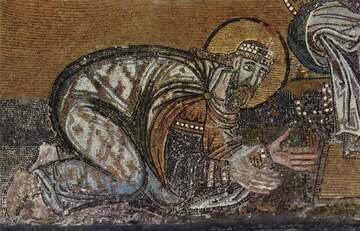
Christ Crowning Constantine VII (945).Zoë was no more successful with the Bulgars, and in 919 she was replaced with Romanus Lecapenus, who married his daughter Helena to Constantine.
Constantine's youth had been a sad one for his unpleasant appearance, his taciturn nature and his relegation at the third level of succession behind the two sons of Romanus Lecapenus. Neverthless, he was a very intelligent young man with a large range of interests, and dedicated those years to study the court's ceremonial.
Romanus took power for himself and mantained it until 944, when he was deposed by his sons. After a life spent in the shadow, at the age of 39 Constantine could be finally recognized as emperor.
In 949 Constantine launched another attack against the Arab corsairs hiding in Crete, but like his father's attempt to retake the island in 911, this attempt also failed. On the Eastern frontier things went better, even if with alternate success: in 949 the Byzantines conquered Germanicea, repeatedly defeated the enemy armies and in 952 crossed the Euphrates. But in 953 the Arab amir Saif ad-Dawla retook Germanicea and entered the imperial territory. The land in the east was eventually recovered by Nicephorus Phocas, who conquered Hadath, in northern Syria, in 958, and by the Armenian general John Tzimisces, who one year later captured Samosata, in northern Mesopotamia. An Arab fleet was also destroyed by Greek fire in 957.
Constantine had intense diplomatic relationships with foreign courts, including the caliph of Cordoba Adb ar-Rahman III and the western emperor Otto I. In the autumn of 957 Constantine was visited by Olga, princess of the Kievan Rus'. The reasons of this voyage had never been cleared: anyway, she was baptised with the name Helena, and began to convert her people to Christianity.
Constantine died in 959 and was succeeded by his son Romanus II.
[edit]
Books
Although he was a satisfactory emperor, Constantine is more well known for his abilities as a writer and scholar. He wrote, or had others write in his name, the works De cerimoniis aulae byzantinae ("On Ceremonies"), describing the kinds of court ceremonies also described later in a more negative light by Liutprand of Cremona; De Administrando Imperio ("On the Administration of the Empire"), giving advice on running the empire internally and also how to fight external enemies; and a history of the Empire covering events following the death of the chronographer Theophanes in 817. Though these books are not as insightful as Constantine believed them to be, they nevertheless are a most useful source of information about nations neighbouring with Byzantium. Constantine was a great collector of books, manuscripts and art works in general, and was indeed a good painter.
[edit]
References
Runciman, Steven. The Emperor Romanus Lecapenus and his Reign. Cambridge: University Press, 1990. (Originally published 1929.) ISBN 0-521-35722-5
Toynbee, Arnold. Constantine Porphyrogenitus and his world. Oxford, 1973. ISBN 0-19-215253-X. 768pp.
A biography of Constantine VII
He was described as tall and broad shouldered, a ruddy complexion half-hidden by a thick black beard, above which shone eys of a brilliant pale blue. succeeded his uncle, Alexander, to the imperial title in 913. Emperor at Byzantine Empire between 913 and 9 November 959. he siezed full control of the empire after the sons of Romanus tried to usurp their father in 945.
#Générale#note décès : empoisonné par son fils
#Générale#de Constantinople
s:Auréjac
note couple : #Générale#s:webpark
{geni:about_me} http://en.wikipedia.org/wiki/Constantine_VII
http://genealogics.org/getperson.php?personID=I00215864&tree=LEO
-------------------
And in Turkish:
http://tr.wikipedia.org/wiki/VII._Konstantin
Constantine VII Porphyrogennetos or Porphyrogenitus, "the Purple-born" (Greek: Κωνσταντίνος Ζ΄ Πορφυρογέννητος, Kōnstantinos VII Porphyrogennētos), (September 2, 905 – November 9, 959) was the son of the Byzantine emperor Leo VI and his fourth wife Zoe Karbonopsina. He was also the nephew of the Emperor Alexander. He is famous for his four descriptive books, De Administrando Imperio, De Ceremoniis, De Thematibus and Vita Basilii.
His nickname alludes to the Purple Room of the imperial palace, decorated with the stone porphyry, where legitimate children of reigning emperors were normally born. Constantine was also born in this room, although his mother Zoe had not been married to Leo at that time. Nevertheless, the epithet allowed him to underline his position as the legitimized son, as opposed to all others who claimed the throne during his lifetime. Sons born to a reigning Emperorheld precedence in the Byzantine line of ascension over elder sons not born "in the purple".
Reign
Constantine was born at Constantinople, an illegitimate son born before an uncanonical fourth marriage. To help legitimize him, his mother gave birth to him in the Purple Room of the imperial palace, hence his nickname Porphyrogennetos. He was symbolically elevated to the throne as a two-year-old child by his father and uncle on May 15, 908. After the death of his uncle Alexander in 913 and the failure of the usurpation of Constantine Doukas, he succeeded to the throne at the age of seven, under the regency of the Patriarch Nicholas Mystikos.
His regent was presently forced to make peace with Tsar Simeon of Bulgaria, whom he reluctantly recognized as Bulgarian emperor. Because of this unpopular concession, Nicholas was driven out of the regency by Constantine's mother Zoe.
Zoe was no more successful with the Bulgarians, by whom her main supporter, the general Leo Phokas, was defeated in 917, and in 919 she was replaced by the admiral Romanos Lekapenos, who married his daughter Helena Lekapene to Constantine. Romanos used his position to advance to the ranks of basileopatōr in May 919, kaisar (Caesar) in September 920, and finally co-emperor in December of the same year. Thus, just short of reaching nominal majority, Constantine was again eclipsed by a senior emperor.
Constantine's youth had been a sad one for his unpleasant appearance, his taciturn nature and his relegation at the third level of succession behind the eldest son of Romanos I Lekapenos. Nevertheless, he was a very intelligent young man with a large range of interests, and dedicated those years to study the court's ceremonial.
Romanos kept power for himself and maintained it until 944, when he was deposed by his sons Stephen and Constantine. Romanos spent the last years of his life in exile on the Island of Prote as a monk and died on June 15, 948.[1] With the help of his wife, Constantine VII succeeded in removing his brothers-in-law and on January 27, 945, Constantine VII was once again sole emperor at the age of 39, after a life spent in the shadow. Several months later, Constantine VII crowned his own son Romanos II co-emperor. Having never exercised executive authority, Constantine remained primarily devoted to his scholarly pursuits and relegated his authority to bureaucrats and generals, as well as his energetic wife Helena Lekapene.
In 949 Constantine launched a new fleet of 100 ships (20 dromons, 64 chelandia, and 10 galleys) against the Arab corsairs hiding in Crete, but like his father's attempt to retake the island in 911, this attempt also failed. On theEastern frontier things went better, even if with alternate success: in 949 the Byzantines conquered Germanicea, repeatedly defeated the enemy armies and in 952 crossed the upper Euphrates. But in 953 the Arab amir Sayf al-Daula retook Germanicea and entered the imperial territory. The land in the east was eventually recovered by Nikephoros Phokas, who conquered Hadath, in northern Syria, in 958, and by the Armenian general John Tzimiskes, who one year later captured Samosata, in northern Mesopotamia. An Arab fleet was also destroyed by Greek fire in 957. Constantine's efforts to retake themes lost to the Arabs were the first such efforts to have any real success.
Constantine had intense diplomatic relationships with foreign courts, including the caliph of Cordoba Abd ar-Rahman III and Otto I, King of Duitsland. In the autumn of 957 Constantine was visited by Olga, princess of the Kievan Rus'. The reasons for this voyage have never been clarified: in any case, she was baptised with the name Helena, and began to convert her people to Christianity.
Constantine VII died at Constantinople in November 959 and was succeeded by his son Romanos II. It was rumored that Constantine had been poisoned by his son or his daughter-in-law Theophano.
[edit] Literary and political activity
Constantine VII was renowned for his abilities as a writer and scholar. He wrote, or had commissioned, the works De cerimoniis aulae byzantinae ("On Ceremonies"), describing the kinds of court ceremonies also described later in a more negative light by Liutprand of Cremona; De Administrando Imperio ("On the Administration of the Empire"), giving advice on running the empire internally and also how to fight external enemies; and a history of the Empire covering events following the death of the chronographer Theophanes the Confessor in 817. Amongst his historical works was a history eulogising the reign and achievements of his grandfather, Basil I. These books are insightful and areof immense interest to the historian, sociologist and anthropologist as a most useful source of information about nations neighbouring with Byzantium. They also offer a fine insight into the Emperor himself.
In his book, A Short History of Byzantium, John Julius Norwich refers to Constantine VII as "The Scholar Emperor" (180). Norwich states, “He was, we are told, a passionate collector—not only of books and manuscripts but works of art of every kind; more remarkable still for a man of his class, he seems to have been an excellent painter. He was the most generous of patrons—to writers and scholars, artists and craftsmen. Finally, he was an excellent Emperor: a competent, conscientious and hard-working administrator and an inspired picker of men, whose appointments to military, naval, ecclesiastical, civil and academic posts were both imaginative and successful. He did much to develop higher education and took a special interest in the administration of justice (181). In 947, Constantine VII ordered the immediate restitution, without compensation, of all peasant lands, thus, by the end of [his] reign, the condition of the landed peasantry—which formed the foundation of the whole economic and military strength of the Empire—was better off than it had been for a century" (182-3).
[edit] Family
By his wife Helena Lekapene, the daughter of Emperor Romanos I, Constantine VII had several children, including:
* Leo, who died young.
* Romanos II.
* Zoe. Sent to a convent.
* Theodora, who married Emperor John I Tzimiskes.
* Agatha. Sent to a convent.
* Theophano. Sent to a convent.
* Anna. Sent to a convent.
Constantine and his mother Zoë.
Reign Co-emperor 908 - 945
Emperor January 27, 945 - November 9, 959
Full name Constantine Porphyrogenitus
(Born of the Purple Room)
Born September 2, 905
Birthplace Constantinople
Died November 9, 959 (aged 54)
Place of death Constantinople
Predecessor Alexander
Successor Romanos II
Wife Helena Lekapene
Offspring
*Romanos II,
*Theodora
Dynasty Macedonian dynasty
*Father Leo VI
*Mother Zoe Karbonopsina
General Notes:
Konstantin kom på tronen knapt 8 år gammel under formynderskap av sin mor, Zoè. Han gjorde store innsatser for litteraturen og opptråtte selv som forfatter.
Constantine VII Porphyrogenitos ("the Purple-born") (905 - November 9, 959) was the son of Byzantine emperor Leo VI and nephew of Alexander III. He earned his nickname as the legitimate (or more accurately legitimized) son of Leo,as opposed to the others who claimed the throne during his lifetime. He succeeded to the throne at the age of seven in 913, under the regency of the Patriarch Nicholas Mysticus.
Nicholas was forced to make peace with Symeon of the Bulgars, whom he reluctantly recognized as Bulgarian emperor. Because of this, Nicholas was driven out of the regency by Constantine's mother Zoë. Zoë was no more successful with the Bulgars, and in 919 she was replaced with Romanus Lecapenus, who married his daughter Helena to Constantine. Romanus took power for himself until 944, when he was deposed by his sons, who then finally recognized Constantine as emperor.
In 949 Constantine launched another invasion of Crete, but like his father's attempt to retake the island in 911, this attempt also failed. It also provoked the Arabs to attack Byzantine land in Syria, Armenia, and Italy, but the land in the east was eventually recovered by John Tzimisces. An Arab fleet was also destroyed by Greek fire in 957.
In 958 Constantine was visited by Olga, princess of the Kievan Rus'. She was baptised with the name Helena, and began to convert her people to Christianity.
Constantine died in 959 and was succeeded by his son Romanus II. Although he was a satisfactory emperor, Constantine is more well known for his abilities as a writer and scholar. He wrote, or had others write in his name, the works De Ceremoniis (On Ceremonies), describing the kinds of court ceremonies also described later in a more negative light by Liutprand of Cremona; De Administrando Imperio (On the Administration of the Empire), giving advice on running the empire internally and also how to fight external enemies; and a history of the Empire covering events following the death of the chronographer Theophanes in 817. Though these books are not as insightful as Constantine believed them to be, they nevertheless are a useful source of information about Constantine and his reign.
Noted events in his life were:
• Acceded: Emperor of Byzantium, 913.
--------------------
http://en.wikipedia.org/wiki/Constantine_VII_Porphyrogennetos
--------------------
--------------------
http://en.wikipedia.org/wiki/Constantine_VII
Constantine VII
From Wikipedia, the free encyclopedia
Jump to: navigation, search
Constantine VII
Emperor of the Byzantine Empire
Follis-Constantine VII and Zoe-sb1758.jpg
Constantine and his mother Zoë.
Reign Co-emperor 908 – 945
Emperor January 27, 945 – November 9, 959
Full name Constantine Porphyrogenitus
(Born of the Purple Room)
Born September 2, 905
Birthplace Constantinople
Died November 9, 959 (aged 54)
Place of death Constantinople
Predecessor Alexander
Successor Romanos II
Wife Helena Lekapene
Offspring Romanos II
Theodroa
Dynasty Macedonian dynasty
Father Leo VI
Mother Zoe Karbonopsina
Constantine VII Porphyrogennetos or Porphyrogenitus, "the Purple-born" (Greek: Κωνσταντίνος Ζ΄ Πορφυρογέννητος, Kōnstantinos VII Porphyrogennētos), (September 2, 905 – November 9, 959) was the son of the Byzantine emperor Leo VI and his fourth wife Zoe Karbonopsina. He was also the nephew of the Emperor Alexander. He is famous for his four descriptive books, De Administrando Imperio, De Ceremoniis, De Thematibus and Vita Basilii.
His nickname alludes to the Purple Room of the imperial palace, decorated with the stone porphyry, where legitimate children of reigning emperors were normally born. Constantine was also born in this room, although his mother Zoe had not been married to Leo at that time. Nevertheless, the epithet allowed him to underline his position as the legitimized son, as opposed to all others who claimed the throne during his lifetime. Sons born to a reigning Emperorheld precedence in the Byzantine line of ascension over elder sons not born "in the purple".
Contents
[show]
* 1 Reign
* 2 Literary and political activity
* 3 Family
* 4 References
* 5 External links
[edit] Reign
Constantine was born at Constantinople, an illegitimate son born before an uncanonical fourth marriage. To help legitimize him, his mother gave birth to him in the Purple Room of the imperial palace, hence his nickname Porphyrogennetos. He was symbolically elevated to the throne as a two-year-old child by his father and uncle on May 15, 908. After the death of his uncle Alexander in 913 and the failure of the usurpation of Constantine Doukas, he succeeded to the throne at the age of seven, under the regency of the Patriarch Nicholas Mystikos.
Constantine and Simeon dining
His regent was presently forced to make peace with Tsar Simeon of Bulgaria, whom he reluctantly recognized as Bulgarian emperor. Because of this unpopular concession, Nicholas was driven out of the regency by Constantine's mother Zoe.
Christ Crowning Constantine VII (945).
Zoe was no more successful with the Bulgarians, by whom her main supporter, the general Leo Phokas, was defeated in 917, and in 919 she was replaced by the admiral Romanos Lekapenos, who married his daughter Helena Lekapene to Constantine. Romanos used his position to advance to the ranks of basileopatōr in May 919, kaisar (Caesar) in September 920, and finally co-emperor in December of the same year. Thus, just short of reaching nominal majority, Constantine was again eclipsed by a senior emperor.
Constantine's youth had been a sad one for his unpleasant appearance, his taciturn nature and his relegation at the third level of succession behind the eldest son of Romanos I Lekapenos. Nevertheless, he was a very intelligent young man with a large range of interests, and dedicated those years to study the court's ceremonial.
Romanos kept power for himself and maintained it until 944, when he was deposed by his sons Stephen and Constantine. Romanos spent the last years of his life in exile on the Island of Prote as a monk and died on June 15, 948.[1] With the help of his wife, Constantine VII succeeded in removing his brothers-in-law and on January 27, 945, Constantine VII was once again sole emperor at the age of 39, after a life spent in the shadow. Several months later, Constantine VII crowned his own son Romanos II co-emperor. Having never exercised executive authority, Constantine remained primarily devoted to his scholarly pursuits and relegated his authority to bureaucrats and generals, as well as his energetic wife Helena Lekapene.
In 949 Constantine launched a new fleet of 100 ships (20 dromons, 64 chelandia, and 10 galleys) against the Arab corsairs hiding in Crete, but like his father's attempt to retake the island in 911, this attempt also failed. On theEastern frontier things went better, even if with alternate success: in 949 the Byzantines conquered Germanicea, repeatedly defeated the enemy armies and in 952 crossed the upper Euphrates. But in 953 the Arab amir Sayf al-Daula retook Germanicea and entered the imperial territory. The land in the east was eventually recovered by Nikephoros Phokas, who conquered Hadath, in northern Syria, in 958, and by the Armenian general John Tzimiskes, who one year later captured Samosata, in northern Mesopotamia. An Arab fleet was also destroyed by Greek fire in 957. Constantine's efforts to retake themes lost to the Arabs were the first such efforts to have any real success.
Constantine had intense diplomatic relationships with foreign courts, including the caliph of Cordoba Abd ar-Rahman III and Otto I, King of Duitsland. In the autumn of 957 Constantine was visited by Olga, princess of the Kievan Rus'. The reasons for this voyage have never been clarified: in any case, she was baptised with the name Helena, and began to convert her people to Christianity.
Constantine VII died at Constantinople in November 959 and was succeeded by his son Romanos II. It was rumored that Constantine had been poisoned by his son or his daughter-in-law Theophano.
[edit] Literary and political activity
Gold solidus of Constantine VII Porphyrogennetos, 913–959.
Constantine VII was renowned for his abilities as a writer and scholar. He wrote, or had commissioned, the works De cerimoniis aulae byzantinae ("On Ceremonies"), describing the kinds of court ceremonies also described later in a more negative light by Liutprand of Cremona; De Administrando Imperio ("On the Administration of the Empire"), giving advice on running the empire internally and also how to fight external enemies; and a history of the Empire covering events following the death of the chronographer Theophanes the Confessor in 817. Amongst his historical works was a history eulogising the reign and achievements of his grandfather, Basil I. These books are insightful and areof immense interest to the historian, sociologist and anthropologist as a most useful source of information about nations neighbouring with Byzantium. They also offer a fine insight into the Emperor himself.
In his book, A Short History of Byzantium, John Julius Norwich refers to Constantine VII as "The Scholar Emperor" (180). Norwich states, “He was, we are told, a passionate collector—not only of books and manuscripts but works of art of every kind; more remarkable still for a man of his class, he seems to have been an excellent painter. He was the most generous of patrons—to writers and scholars, artists and craftsmen. Finally, he was an excellent Emperor: a competent, conscientious and hard-working administrator and an inspired picker of men, whose appointments to military, naval, ecclesiastical, civil and academic posts were both imaginative and successful. He did much to develop higher education and took a special interest in the administration of justice (181). In 947, Constantine VII ordered the immediate restitution, without compensation, of all peasant lands, thus, by the end of [his] reign, the condition of the landed peasantry—which formed the foundation of the whole economic and military strength of the Empire—was better off than it had been for a century" (182–3).
[edit] Family
Gold solidus of LeoVI and Constantine VII Porphyrogennetos, 908–912.
By his wife Helena Lekapene, the daughter of Emperor Romanos I, Constantine VII had several children, including:
* Leo, who died young.
* Romanos II.
* Zoe. Sent to a convent.
* Theodora, who married Emperor John I Tzimiskes.
* Agatha. Sent to a convent.
* Theophano, daughter in-law.
* Theophano. Sent to a convent.
* Anna. Sent to a convent.
[edit] References
1. ^ Ostrogorsky, George, History of the Byzantine State, Rutgers University Press, (1969) p278.
* The Oxford Dictionary of Byzantium, ed. by Alexander Kazhdan, Oxford University Press, 1991.
* Runciman, Steven. The Emperor Romanus Lecapenus and his Reign. Cambridge: University Press, 1990. (Originally published 1929.) ISBN 0-521-35722-5
* Toynbee, Arnold. Constantine Porphyrogenitus and his world. Oxford, 1973. ISBN 0-19-215253-X. 768pp.
* Norwich, John Julius (John Julius Cooper, 2nd Viscount Norwich), A Short History of Byzantium. London: Viking, 1997. ISBN 0-679-45088-2
[edit] External links
Wikisource has original works written by or about: Constantine VII
Wikimedia Commons has media related to: Constantine VII
* Listing of Constantine VII and his family in "Medieval Lands"
* Opera Omnia by Migne Patrologia Graeca with analytical indexes
* De administrando Imperio chapters 29–36 at the Internet Archive
Constantine VII
Macedonian Dynasty
Born: September 905 Died: 9 November 959
Regnal titles
Preceded by
Alexander Byzantine Emperor
913–959
with Romanos I (920–945) Succeeded by
Romanos II
[hide]
v • d • e
Western and Eastern Roman emperors
Principate
27 BC–235 AD
Augustus · Tiberius · Caligula · Claudius · Nero · Galba · Otho · Vitellius · Vespasian · Titus · Domitian · Nerva · Trajan · Hadrian · Antoninus Pius · Marcus Aurelius with Lucius Verus · Commodus · Pertinax · Didius Julianus · Septimius Severus · Caracalla · Geta · Macrinus with Diadumenian · Elagabalus · Alexander Severus
Crisis
235–284
Maximinus Thrax · Gordian I and Gordian II · Pupienus and Balbinus · Gordian III · Philip the Arab · Decius with Herennius Etruscus · Hostilian · Trebonianus Gallus with Volusianus · Aemilianus · Valerian · Gallienus with Saloninus · Claudius Gothicus · Quintillus · Aurelian · Tacitus · Florianus · Probus · Carus · Carinus · Numerian
Dominate
284–395
Diocletian · Maximian · Constantius Chlorus · Galerius · Severus · Maxentius · Maximinus Daia · Licinius with Valerius Valens and Martinianus · Constantine I · Constantine II · Constans I · Constantius II with Vetranio · Julian the Apostate · Jovian · Valentinian I · Valens · Gratian · Valentinian II · Theodosius I
Western Empire
395–480
Honorius · Constantius III · Joannes · Valentinian III · Petronius Maximus · Avitus · Majorian · Libius Severus · Anthemius · Olybrius · Glycerius · Julius Nepos · Romulus Augustulus
Eastern/
Byzantine Empire
395–1204
Arcadius · Theodosius II · Marcian · Leo I · Leo II · Zeno · Basiliscus · Anastasius I · Justin I · Justinian I · Justin II · Tiberius II Constantine · Maurice · Phocas · Heraclius · Constantine III · Heraklonas · Constans II · Constantine IV · Justinian II · Leontios · Tiberios III · Philippikos · Anastasios II · Theodosios III · Leo III the Isaurian · Constantine V · Artabasdos · Leo IV the Khazar · Constantine VI · Irene · Nikephoros I Logothetes · Staurakios · Michael I Rangabe · Leo V the Armenian · Michael II the Stammerer · Theophilos · Michael III · Basil I the Macedonian · Leo VI the Wise · Alexander · Constantine VII Porphyrogennetos · Romanos I Lekapenos · Romanos II · Nikephorus II Phokas · John I Tzimiskes · Basil II · Constantine VIII · Zoe · Romanos III Argyros · Michael IV the Paphlagonian · Michael V Kalaphates · Constantine IX Monomachos · Theodora · Michael VI the Aged · Isaac I Komnenos · Constantine X Doukas · Romanos IV Diogenes · Michael VII Doukas · Nikephoros III Botaneiates · Alexios I Komnenos · John II Komnenos · Manuel I Komnenos · Alexios II Komnenos · Andronikos I Komnenos · Isaac II Angelos · Alexios III Angelos · Alexios IV Angelos · Nikolaos Kanabos · Alexios V Doukas
Empire of Nicaea
1204–1261
Constantine Laskaris · Theodore I Laskaris · John III Doukas Vatatzes · Theodore II Laskaris · John IV Laskaris
Eastern/
Byzantine Empire
1261–1453
Michael VIII Palaiologos · Andronikos II Palaiologos · Michael IX Palaiologos · Andronikos III Palaiologos · John V Palaiologos · John VI Kantakouzenos · Matthew Kantakouzenos · Andronikos IV Palaiologos · John VII Palaiologos · Andronikos V Palaiologos · Manuel II Palaiologos · John VIII Palaiologos · Constantine XI Palaiologos
This page was last modified on 6 August 2010 at 10:23.
--------------------
Bild: Kristus kröner Constantine VII år 945
Constantine VII Porphyrogennetos or Porphyrogenitus, "the Purple-born" (Greek: Κωνσταντίνος Ζ΄ Πορφυρογέννητος, Kōnstantinos VII Porphyrogennētos), (Constantinople, September 905 – November 9, 959 in Constantinople) was the son ofthe Byzantine emperor Leo VI and his fourth wife Zoe Karbonopsina. He was also the nephew of the Emperor Alexander. He is famous for his two descriptive books, De Administrando Imperio and De Ceremoniis.
His nickname alludes to the Purple Room of the imperial palace, decorated with the stone porphyry, where legitimate children of reigning emperors were normally born. Constantine was also born in this room, although his mother Zoe had not been married to Leo at that time. Nevertheless, the epithet allowed him to underline his position as the legitimized son, as opposed to all others who claimed the throne during his lifetime. Sons born to a reigning Emperorheld precedence in the Byzantine line of ascension over elder sons not born "in the purple".
Contents [hide]
1 Reign
2 Literary activity
3 Family
4 References
5 External links
[edit] Reign
Constantine was an illegitimate son born before an uncanonical fourth marriage. To help legitimize him, he had been born in the Purple Room of the imperial palace, and he had been associated on the throne by his father and uncle on May 15, 908. After the death of his uncle Alexander in 913, he succeeded to the throne at the age of seven, under the regency of the Patriarch Nicholas Mystikos. His regent was presently forced to make peace with Tsar Simeon of Bulgaria, whom he reluctantly recognized as Bulgarian emperor. Because of this unpopular concession, Nicholas was driven out of the regency by Constantine's mother Zoe.
Zoe was no more successful with the Bulgarians, by whom her main supporter, the general Leo Phokas, was defeated in 917, and in 919 she was replaced by the admiral Romanos Lekapenos, who married his daughter Helena to Constantine.Romanos used his position to advance to the ranks of basileopatōr in May 919, kaisar (Caesar) in September 920, and finally co-emperor in December of the same year. Thus, just short of reaching nominal majority, Constantine was again eclipsed by a senior emperor.
Constantine's youth had been a sad one for his unpleasant appearance, his taciturn nature and his relegation at the third level of succession behind the eldest son of Romanos I Lekapenos. Nevertheless, he was a very intelligent young man with a large range of interests, and dedicated those years to study the court's ceremonial.
Romanos kept power for himself and maintained it until 944, when he was deposed by his sons Stephen and Constantine. With the help of his wife, Constantine VII succeeded in removing his brothers-in-law and on January 27, 945, Constantine VII was once again sole emperor at the age of 39, after a life spent in the shadow. Several months later, Constantine VII crowned his own son Romanos II co-emperor. Having never exercised executive authority, Constantine remained primarily devoted to his scholarly pursuits and relegated his authority to bureaucrats and generals, as well as his energetic wife Helena Lekapene.
In 949 Constantine launched a new fleet of 100 ships against the Arab corsairs hiding in Crete, but like his father's attempt to retake the island in 911, this attempt also failed. On the Eastern frontier things went better, even if with alternate success: in 949 the Byzantines conquered Germanicea, repeatedly defeated the enemy armies and in 952 crossed the upper Euphrates. But in 953 the Arab amir Saif ad-Dawla retook Germanicea and entered the imperial territory. The land in the east was eventually recovered by Nikephoros Phokas, who conquered Hadath, in northern Syria, in 958, and by the Armenian general John Tzimiskes, who one year later captured Samosata, in northern Mesopotamia. An Arab fleet was also destroyed by Greek fire in 957. Constantine's efforts to retake themes lost to the Arabs were the first such efforts to have any real success.
Constantine had intense diplomatic relationships with foreign courts, including the caliph of Cordoba Abd ar-Rahman III and Otto I, King of Duitsland. In the autumn of 957 Constantine was visited by Olga, princess of the Kievan Rus'. The reasons for this voyage have never been clarified: in any case, she was baptised with the name Helena, and began to convert her people to Christianity.
Constantine VII died in November 959 and was succeeded by his son Romanos II. It was rumored that Constantine had been poisoned by his son or his daughter-in-law Theophano.
[edit] Literary activity
Although he was a satisfactory emperor, Constantine is more renowned for his abilities as a writer and scholar. He wrote, or had others write in his name, the works De cerimoniis aulae byzantinae ("On Ceremonies"), describing the kinds of court ceremonies also described later in a more negative light by Liutprand of Cremona; De Administrando Imperio ("On the Administration of the Empire"), giving advice on running the empire internally and also how to fight external enemies; and a history of the Empire covering events following the death of the chronographer Theophanes the Confessor in 817. Amongst his historical works was a history eulogising the reign and achievements of his grandfather, Basil I. Though these books are not as insightful as Constantine believed them to be, they nevertheless are a most useful source of information about nations neighbouring with Byzantium, and a good insight into the Emperor himself. Constantine was a great collector of books, manuscripts and art works in general, and was indeed a good painter.
[edit] Family
By his wife Helena Lekapene, the daughter of Emperor Romanos I, Constantine VII had several children, including:
Leo, who died young.
Romanos II
Theodora, who married Emperor John I Tzimiskes
References
The Oxford Dictionary of Byzantium, ed. by Alexander Kazhdan, Oxford University Press, 1991.
Runciman, Steven. The Emperor Romanus Lecapenus and his Reign. Cambridge: University Press, 1990. (Originally published 1929.) ISBN 0-521-35722-5
Toynbee, Arnold. Constantine Porphyrogenitus and his world. Oxford, 1973. ISBN 0-19-215253-X. 768pp.
--------------------
Constantine VII Porphyrogenitus, Emperor of Constantinople held the office of Co-regent of Constantinople in 908. He succeeded to the title of Emperor Constantine VII of Constantinople in 913.
--------------------
En mi nuevo libro LA SORPRENDENTE GENEALOGÍA DE MIS TATARABUELOS, encontrarán a este y muchos otros de sus ancestros con un resumen biográfico de cada uno. El libro está disponible en: amazon.com barnesandnoble.com palibrio.com.
Les será de mucha utilidad y diversión.
Ramón Rionda
In my new book LA SORPRENDENTE GENEALOGÍA DE MIS TATARABUELOS, you will find this and many other of your ancestors, with a biography summary of each of them. The book is now available at:
amazon.com barnesandnoble.com palibrio.com.
Check it up, it’s worth it.
Ramón Rionda
--------------------
Constantine VII Porphyrogennetos or Porphyrogenitus ("the Purple-born", that is, born in the purple marble slab-paneled imperial bed chambers; Greek: Κωνσταντῖνος Ζ΄ Πορφυρογέννητος, translit. Kōnstantinos VII Porphyrogennētos; 17–18 May 905 – 9 November 959) was the fourth Emperor of the Macedonian dynasty of the Byzantine Empire, reigning from 913 to 959. He was the son of the emperor Leo VI and his fourth wife, Zoe Karbonopsina, and the nephew of his predecessor, the emperor Alexander.
Most of his reign was dominated by co-regents: from 913 until 919 he was under the regency of his mother, while from 920 until 945 he shared the throne with Romanos Lekapenos, whose daughter Helena he married, and his sons. Constantine VII is best known for his four books, De Administrando Imperio (bearing in Greek the heading Πρὸς τὸν ἴδιον υἱόν Ῥωμανόν), De Ceremoniis (Περὶ τῆς Βασιλείου Τάξεως), De Thematibus (Περὶ θεμάτων Άνατολῆς καὶ Δύσεως), and VitaBasilii (Βίος Βασιλείου).
His nickname alludes to the Purple Room of the imperial palace, decorated with porphyry, where legitimate children of reigning emperors were normally born. Constantine was also born in this room, although his mother Zoe had not been married to Leo at that time. Nevertheless, the epithet allowed him to underline his position as the legitimized son, as opposed to all others who claimed the throne during his lifetime. Sons born to a reigning Emperor held precedence in the Eastern Roman line of succession over elder sons not born "in the purple".
Constantine was born at Constantinople, an illegitimate son born before an uncanonical fourth marriage. To help legitimize him, his mother gave birth to him in the Purple Room of the imperial palace, hence his nickname Porphyrogennetos. He was symbolically elevated to the throne as a two-year-old child by his father and uncle on May 15, 908.
In June 913, as his uncle Alexander lay dying, he appointed a seven-man regency council for Constantine. It was headed by the Patriarch Nicholas I Mystikos, the two magistroi John Eladas and Stephen, the rhaiktor John Lazanes, theotherwise obscure Euthymius and Alexander's henchmen Basilitzes and Gabrielopoulos. Following Alexander's death, the new and shaky regime survived the attempted usurpation of Constantine Doukas, and Patriarch Nicholas Mystikos quickly assumed a dominant position among the regents.
Patriarch Nicholas was presently forced to make peace with Tsar Simeon of Bulgaria, whom he reluctantly recognized as Bulgarian emperor. Because of this unpopular concession, Patriarch Nicholas was driven out of the regency by Constantine's mother Zoe. She was no more successful with the Bulgarians, who defeated her main supporter, the general Leo Phokas, in 917. In 919 she was replaced as regent by the admiral Romanos Lekapenos, who married his daughter Helena Lekapene to Constantine. Romanos used his position to advance to the ranks of basileopatōr in May 919, to kaisar (Caesar) in September 920, and finally to co-emperor in December 920. Thus, just short of reaching nominal majority, Constantine was eclipsed by a senior emperor.
Constantine's youth had been a sad one due to his unpleasant appearance, his taciturn nature, and his relegation to the third level of succession, behind Christopher Lekapenos, the eldest son of Romanos I Lekapenos. Nevertheless, he was a very intelligent young man with a large range of interests, and he dedicated those years to studying the court's ceremonial.
Romanos kept and maintained power until 944, when he was deposed by his sons, the co-emperors Stephen and Constantine. Romanos spent the last years of his life in exile on the Island of Prote as a monk and died on June 15, 948. With the help of his wife, Constantine VII succeeded in removing his brothers-in-law, and on January 27, 945, Constantine VII became sole emperor at the age of 39, after a life spent in the shadow. Several months later, Constantine VII crowned his own son Romanos II co-emperor. Having never exercised executive authority, Constantine remained primarily devoted to his scholarly pursuits and relegated his authority to bureaucrats and generals, as well as to hisenergetic wife Helena Lekapene.
In 949 Constantine launched a new fleet of 100 ships (20 dromons, 64 chelandia, and 10 galleys) against the Arab corsairs hiding in Crete, but like his father's attempt to retake the island in 911, this attempt also failed. On theEastern frontier things went better, even if with alternate success. In 949 the Byzantines conquered Germanicea, repeatedly defeated the enemy armies, and in 952 they crossed the upper Euphrates. But in 953 the Hamdanid amir Sayfal-Daula retook Germanicea and entered the imperial territory. The land in the east was eventually recovered by Nikephoros Phokas, who conquered Hadath, in northern Syria, in 958, and by the general John Tzimiskes, who one year later captured Samosata, in northern Mesopotamia. An Arab fleet was also destroyed by Greek fire in 957. Constantine's efforts to retake themes lost to the Arabs were the first such efforts to have any real success.
Constantine had active diplomatic relationships with foreign courts, including those of the caliph of Cordoba Abd ar-Rahman III and of Otto I, Holy Roman Emperor. In the autumn of 957 Constantine was visited by Olga of Kiev, regent of the Kievan Rus'. The reasons for this voyage have never been clarified; but she was baptised a Christian with the name Helena, and sought Christian missionaries to encourage her people to adopt Christianity. According to legends, Constantine VII fell in love with Olga, however she found the way to refuse him by tricking him to become her godfather. When she was baptized, she said it was inappropriate for a godfather to marry his goddaughter.[6]
Constantine VII died at Constantinople in November 959 and was succeeded by his son Romanos II. It was rumored that Constantine had been poisoned by his son or his daughter-in-law Theophano.
Constantine VII was renowned for his abilities as a writer and scholar. He wrote, or had commissioned, the works De Ceremoniis ("On Ceremonies", in Greek, Περί τῆς Βασιλείου Τάξεως), describing the kinds of court ceremonies (also described later in a more negative light by Liutprand of Cremona); De Administrando Imperio ("On the Administration of the Empire", bearing in Greek the heading Προς τον ίδιον υιόν Ρωμανόν), giving advice on running the Empire internally and on fighting external enemies; a history of the Empire covering events following the death of the chronographer Theophanes the Confessor in 817; and Excerpta Historica ("Excerpts from the Histories"), a collection of excerpts from ancient historians (many of whose works are now lost) in four volumes (1. De legationibus. 2. De virtutibus et vitiis. 3. De insidiis. 4. De sententiis.) Also amongst his historical works is a history eulogizing the reign and achievements of his grandfather, Basil I (Vita Basilii, Βίος Βασιλείου). These books are insightful and of interest to the historian, sociologist, and anthropologist as a source of information about nations neighbouring the Empire. They also offer a fine insight into the Emperor himself.
In his book, A Short History of Byzantium, John Julius Norwich refers to Constantine VII as "The Scholar Emperor". Norwich describes Constantine:
He was, we are told, a passionate collector—not only of books and manuscripts but works of art of every kind; more remarkable still for a man of his class, he seems to have been an excellent painter. He was the most generous of patrons—to writers and scholars, artists and craftsmen. Finally, he was an excellent Emperor: a competent, conscientious and hard-working administrator and an inspired picker of men, whose appointments to military, naval, ecclesiastical, civil and academic posts were both imaginative and successful. He did much to develop higher education and took a special interest in the administration of justice.
In 947, Constantine VII ordered the immediate restitution of all peasant lands, without compensation; by the end of his reign, the condition of the landed peasantry, which formed the foundation of the whole economic and military strength of the Empire, was better off than it had been for a century.
In The Manuscript Tradition of Polybius, John Michael Moore (CUP, 1965) provides a useful summary of the commission by Porphyrogenitus of the Constantine Excerpts:
He felt that the historical studies were being seriously neglected, mainly because of the bulk of the histories. He therefore decided that a selection under fifty-three titles should be made from all the important historians extant in Constantinople; thus he hoped to assemble in a more manageable compass the most valuable parts of each author. ... Of the fifty-three titles into which the excerpts were divided, only six have survived: de Virtutibus et Vitiis; de Sententiis; de Insidiis; de Strategematis; de Legationibus Gentium ad Romanos; de Legationibus Romanorum ad Gentes. The titles of only about half the remaining forty-seven sections are known.
By his wife Helena Lekapene, the daughter of Emperor Romanos I, Constantine VII had several children, including:
Leo, who died young.
Romanos II.
Zoe. Sent to a convent.
Theodora, who married Emperor John I Tzimiskes.
Agatha. Sent to a convent.
Theophano. Sent to a convent.
Anna. Sent to a convent.
--------------------------------
Костянтин VII Багрянородний, або Порфірородний, чи Порфірогенет (грец. Κωνσταντίνος Ζ Πορφυρογέννητος, буквально — «народжений у багряниці, у порфірі, у царському палаці»;[1] 17 або 18 травня 905 — 9 листопада 959) — візантійськийімператор (913—959, фактично 945—959) з Македонської династії. Автор творів, що містять важливі відомості про русько-візантійські відносини 10 століття. Син Лева VI, його співправитель з 908 року.
До лютого 945 фактично був усунений від управління державою Романом І Лекапіном, який узурпував у 920 всю владу і проголосив себе співправителем. За його правління внаслідок походів князя Ігоря 941 та 944 років було укладено торговий договір з Київською Руссю, 957 року Константинополь відвідала княгиня Ольга, де, вірогідно, була хрещена[2]. Вів боротьбу проти арабів у Месопотамії і Північній Сирії.
Автор кількох творів «Про феми», «Про церемонії візантійського двору», «Про управління імперією». Його трактат «Про управління імперією» (складений в 943—953) містить багато цікавих відомостей про слов'ян і печенігів, географію таісторію Київської Русі.
В своєму трактаті «Про управління імперією» Костянтин згадува місто «Немогард», в «якому сидить Сфендослав, син Інгора…»
«Човни що приходять до Царгороду з далекої Руси, себто з Немогарди, де сидів Свендостлав, син Інгоря, князя Руси, з замка Милиниски, й із Телючи, і Цернигоги і з Висегроди. Всі ото вони ідуть вниз рікою Дніпром і звертаються до замку Кіоава, званого Самватас. А їх підвладні Славяни, звані Кривитеїни та Ленцаніни (Лугани—від міста Луцька) й інші Славяни під час зими вирубують в горах дерево на човни, і обробивши, як прийде час, як розстане лід, спускають їхв близькі озера. І як спустять в ріку Дніпро, йдуть тією рікою і приходять в Кіову; витягнувши, виставляють човни й спродують Руси. А Русь купує самі кадуби і розламавши давні однодеревні (човни), беруть з них весла, уключини (довесел) і інший припас і споряжають (нові).»
Constantine VII Porphyrogenitus (905-959) Byzantine emperor, son of LeoVI. Although he was crowned emperor in 911, for over 30 years he wasovershadowed by his father-in-law, the regent Romanus Lacapenus, who created his own sons co-emperors, but in 945, a struggle within this family allowed Constantine to seize sole power. A scholar rather than a ruler by nature, he wrote or compiled numerous works of history,including the life of his grandfather Basil I. (Larousse BiographicalDictionary, p 340)
Constantine VII Porphyrogenitus (905-959) Byzantine emperor, son of LeoVI. Although he was crowned emperor in 911, for over 30 years he wasovershadowed by his father-in-law, the regent Romanus Lacapenus, who created his own sons co-emperors, but in 945, a struggle within this family allowed Constantine to seize sole power. A scholar rather than a ruler by nature, he wrote or compiled numerous works of history,including the life of his grandfather Basil I. (Larousse BiographicalDictionary, p 340)
887190588. Keiser Konstantin VII Porfyrogennetos LEOSON i Bysanz(21619) was a Keiser between 7 Jun 913 and 956.(21620) He was born bef ?.11.959.(21621) Kom på tronen knapt 8 år gammel under formynderskap av sin mor Zoe, har innlagt sig store fortjenester av literaturen og optrådte selv som forfatter. He was married to Prinsesse, Keiserinne Helena ROMANOSDTR av Bysanz on 27 Apr 919.
SOURCE NOTES:
Bu130 http://uts.cc.utexas.edu/~churchh/edw3chrt.html
RESEARCH NOTES:
Byzantine Emperor
Kom of tronen knapt 8 aar gammel, under formynderskap of sin mor Zoe,
har innlagt seg store fortjenester of litteraturen and selv opptraadt som
forfatter.
Constantine VII Porphyrogenitus (905-959) Byzantine emperor, son of Le o VI. Although he was crowned emperor in 911, for over 30 years he wa s overshadowed by his father-in-law, the regent Romanus Lacapenus, wh o created his own sons co-emperors, but in 945, a struggle within thi s family allowed Constantine to seize sole power. A scholar rather tha n a ruler by nature, he wrote or compiled numerous works of history, i ncluding the life of his grandfather Basil I.
Also born in the porphyry. Since his father didn't marry his wife before she got pregnant, his child was considered to be "illigitimate".
He too was born in the Purple room. This custom separated the legitimate children from the "iligitimate children of the royals for many years to come.
The Oxford Dictionary of Byzantium: Oxford Univ Press 1991.
Michael Psellus, Chronographia, New Haven: Yale University Press, 1953 Vol 1,2,3,4,5,6,7
http://www.fordam.edu/halsall/basis/psellus-chrono-02.html
_P_CCINFO 2-2438
Constantine VII, known as Porphyrogenitus (born in the purple), son of Leo VI and Zoe II.
Constantine VII succeeded to the throne of the Eastern Roman Empire in 912 after the death of his father Leo VI. Under the regency of his Uncle Alexander from 912-913, then under the regency of his mother, Zoe, and the Patriarch Nikolas and John Eladas, from 913 to 919, then became co-ruler with his stepfather, Romanus I Lecapenus from 919-944. He ruled on his own from 944 to 959. He was practically excluded from government administration in the early years, and later left government to capable men in his kingdom; and was later poisoned by his son Romanus II in 959.
Emperor Constantine VII of Macedonia , author of a life of Basil I. Also wrote politan treatises as "On the Themes (DeThermatibus) in 935; On th eCeremonies at the Court of Constantinople (De Cerimoniis alulae Byzantinae) in 953; and On th eAdministration of the Empire (De Adminstrando Imperio) 953. Caused many works to be written that included excerpts from the classics, scientific collections, and collections of laws. He died 959.
The armies of Constantine VII waged a successful war with the Arabs in Syria and in 915 at Garigliano in Italy.
Byzantine
http://trees.ancestry.com/rd?f=image&guid=212132fc-d7b3-4e95-b3a6-c47c5f66096b&tid=10145763&pid=-350628604
Byzantine
http://trees.ancestry.com/rd?f=image&guid=212132fc-d7b3-4e95-b3a6-c47c5f66096b&tid=10145763&pid=-350628604
He ruled from 913 to 959.
Constantine VII Porphyrogenitus (905-959) Byzantine emperor, son of LeoVI. Although he was crowned emperor in 911, for over 30 years he wasovershadowed by his father-in-law, the regent Romanus Lacapenus, who created his own sons co-emperors, but in 945, a struggle within this family allowed Constantine to seize sole power. A scholar rather than a ruler by nature, he wrote or compiled numerous works of history,including the life of his grandfather Basil I. (Larousse BiographicalDictionary, p 340)
Tijdbalk Constantine "Constantine VII Porphyrogenetis" Porphyrogennetos
Deze functionaliteit is alleen beschikbaar voor browsers met Javascript ondersteuning.
Klik op de namen voor meer informatie.
Gebruikte symbolen:  grootouders
 ouders
 broers/zussen
 kinderen
grootouders
ouders
broers/zussen
kinderen
Voorouders (en nakomelingen) van Constantine Porphyrogennetos
Constantine Porphyrogennetos  | ||||||||||||||||||||||||||||||||||
919 | ||||||||||||||||||||||||||||||||||
Hélène Lekapene  | ||||||||||||||||||||||||||||||||||

De getoonde gegevens hebben geen bronnen.
Aanknopingspunten in andere publicaties
Deze persoon komt ook voor in de publicatie: Bekijk alle
Over de familienaam Porphyrogennetos
- Bekijk de informatie die Genealogie Online heeft over de familienaam Porphyrogennetos.
- Bekijk de informatie die Open Archieven heeft over Porphyrogennetos.
- Bekijk in het Wie (onder)zoekt wie? register wie de familienaam Porphyrogennetos (onder)zoekt.
De publicatie maximum test is opgesteld door Ard van Bergen.
Wilt u bij het overnemen van gegevens uit deze stamboom alstublieft een verwijzing naar de herkomst opnemen:
Ard van Bergen, "maximum test", database, Genealogie Online (https://www.genealogieonline.nl/maximum-test/I385953397470012188.php : benaderd 26 februari 2026), "Constantine "Constantine VII Porphyrogenetis" Porphyrogennetos (905-959)".
Ard van Bergen, "maximum test", database, Genealogie Online (https://www.genealogieonline.nl/maximum-test/I385953397470012188.php : benaderd 26 februari 2026), "Constantine "Constantine VII Porphyrogenetis" Porphyrogennetos (905-959)".