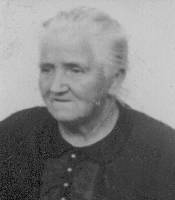
Family tree Panjer » Annechiena Panjer (1894-1968)
Personal data Annechiena Panjer
- She was born on June 1, 1894 in Oude Pekela, Groningen, Nederland.
akte 74.
- She died on October 1, 1968 in Groningen, Groningen, Nederland, she was 74 years old.
- A child of Berend Panjer and Jaantje Sterkeboer
- This information was last updated on Panjer.
Household of Annechiena Panjer
She is married to Simon Raatjes.
They got married on May 15, 1915 at Nieuwe Pekela, Groningen, Nederland, she was 20 years old.
akte 12
Child(ren):
- Rengerdina Raatjes 1916-1916
- Jantje Raatjes 1924-1926
Timeline Annechiena Panjer
This functionality is only available in Javascript supporting browsers.
Click on the names for more info.
Symbols used:  grandparents
 parents
 brothers/sisters
 children
grandparents
parents
brothers/sisters
children
Ancestors (and descendant) of Annechiena Panjer
Annechiena Panjer | ||||||||||||||||||||||||||||||||||||
1915 | ||||||||||||||||||||||||||||||||||||
Simon Raatjes | ||||||||||||||||||||||||||||||||||||

Relationship Annechiena Panjer
- Annechiena Panjer is the 3rd great granddaughter of Geert Jacobs:
The data shown has no sources.
Matches in other publications
This person also appears in the publication: View all
Historical events
Birthday June 1, 1894
- The temperature on June 1, 1894 was about 14.0 °C. The airpressure was 76 cm mercury. The atmospheric humidity was 85%. Source: KNMI
- Koningin Wilhelmina (Huis van Oranje-Nassau) was from 1890 till 1948 sovereign of the Netherlands (also known as Koninkrijk der Nederlanden)
- Regentes Emma (Huis van Oranje-Nassau) was from 1890 till 1898 sovereign of the Netherlands (also known as Koninkrijk der Nederlanden)
- In The Netherlands , there was from August 21, 1891 to May 9, 1894 the cabinet Van Tienhoven, with Mr. G. van Tienhoven (unie-liberaal) as prime minister.
- In The Netherlands , there was from May 9, 1894 to July 27, 1897 the cabinet Roëll, with Jonkheer mr. J. Roëll (oud-liberaal) as prime minister.
- In the year 1894: Source: Wikipedia
- The Netherlands had about 5.1 million citizens.
- March 25 » Coxey's Army, the first significant American protest march, departs Massillon, Ohio for Washington, D.C.
- April 21 » Norway formally adopts the Krag–Jørgensen bolt-action rifle as the main arm of its armed forces, a weapon that would remain in service for almost 50 years.
- May 11 » Four thousand Pullman Palace Car Company workers go on a wildcat strike.
- July 25 » The First Sino-Japanese War begins when the Japanese fire upon a Chinese warship.
- August 1 » The First Sino-Japanese War erupts between Japan and China over Korea.
- November 1 » Nicholas II becomes the new (and last) Tsar of Russia after his father, Alexander III, dies.
Day of marriage May 15, 1915
- The temperature on May 15, 1915 was between 0.1 °C and 12.8 °C and averaged 6.7 °C. There was 12.9 hours of sunshine (82%). The average windspeed was 3 Bft (moderate breeze) and was prevailing from the west-northwest. Source: KNMI
- Koningin Wilhelmina (Huis van Oranje-Nassau) was from 1890 till 1948 sovereign of the Netherlands (also known as Koninkrijk der Nederlanden)
- In The Netherlands , there was from August 29, 1913 to September 9, 1918 the cabinet Cort van der Linden, with Mr. P.W.A. Cort van der Linden (liberaal) as prime minister.
- In the year 1915: Source: Wikipedia
- The Netherlands had about 6.3 million citizens.
- January 13 » The 6.7 Mw Avezzano earthquake shakes the Province of L'Aquila in Italy with a maximum Mercalli intensity of XI (Extreme), killing between 29,978–32,610.
- March 18 » World War I: During the Battle of Gallipoli, three battleships are sunk during a failed British and French naval attack on the Dardanelles.
- March 27 » Typhoid Mary, the first healthy carrier of disease ever identified in the United States is put in quarantine for the second time, where she would remain for the rest of her life.
- May 17 » The last British Liberal Party government (led by H. H. Asquith) falls.
- May 22 » Three trains collide in the Quintinshill rail disaster near Gretna Green, Scotland, killing 227 people and injuring 246.
- October 14 » World War I: Bulgaria joins the Central Powers.
Day of death October 1, 1968
- The temperature on October 1, 1968 was between 7.5 °C and 14.3 °C and averaged 11.7 °C. There was 3.5 mm of rain during 7.6 hours. The heavily clouded was. The average windspeed was 2 Bft (weak wind) and was prevailing from the west-southwest. Source: KNMI
- Koningin Juliana (Huis van Oranje-Nassau) was from September 4, 1948 till April 30, 1980 sovereign of the Netherlands (also known as Koninkrijk der Nederlanden)
- In The Netherlands , there was from April 5, 1967 to Tuesday, July 6, 1971 the cabinet De Jong, with P.J.S. de Jong (KVP) as prime minister.
- In the year 1968: Source: Wikipedia
- The Netherlands had about 12.7 million citizens.
- January 21 » A B-52 bomber crashes near Thule Air Base, contaminating the area after its nuclear payload ruptures. One of the four bombs remains unaccounted for after the cleanup operation is complete.
- January 30 » Vietnam War: Tet Offensive launch by forces of the Viet Cong and North Vietnamese Army against South Vietnam, the United States, and their allies.
- February 24 » Vietnam War: The Tet Offensive is halted; South Vietnam recaptures Hué.
- March 2 » Baggeridge Colliery closes marking the end of over 300 years of coal mining in the Black Country.
- March 17 » As a result of nerve gas testing by the U.S. Army Chemical Corps in Skull Valley, Utah, over 6,000 sheep are found dead.
- August 20 » Cold War: Warsaw Pact troops invade Czechoslovakia, crushing the Prague Spring. East German participation is limited to a few specialists due to memories of the recent war. Only Albania and Romania refuse to participate.
Same birth/death day
- 1887 » Clive Brook, English actor († 1974)
- 1889 » Charles Kay Ogden, English linguist and philosopher († 1957)
- 1889 » James Daugherty, American author, illustrator, and painter († 1974)
- 1890 » Frank Morgan, American actor († 1949)
- 1892 » Amanullah Khan, sovereign of the Kingdom of Afghanistan, († 1960)
- 1899 » Edward Charles Titchmarsh, English mathematician and academic († 1963)
- 1959 » Enrico De Nicola, Italian journalist, lawyer, and politician, 1st President of Italy (b. 1877)
- 1961 » Ludwig Bemelmans, Italian-American author and illustrator (b. 1898)
- 1970 » Raúl Riganti, Argentinian race car driver (b. 1893)
- 1972 » Louis Leakey, Kenyan-English archaeologist and paleontologist (b. 1903)
- 1974 » Spyridon Marinatos, Greek archaeologist and academic (b. 1901)
- 1975 » Al Jackson, Jr., American drummer, songwriter, and producer (b. 1935)
About the surname Panjer
- View the information that Genealogie Online has about the surname Panjer.
- Check the information Open Archives has about Panjer.
- Check the Wie (onder)zoekt wie? register to see who is (re)searching Panjer.
The Family tree Panjer publication was prepared by H. Panjer.
When copying data from this family tree, please include a reference to the origin:
H. Panjer, "Family tree Panjer", database, Genealogy Online (https://www.genealogieonline.nl/stamboom_panjer/I81.php : accessed February 22, 2026), "Annechiena Panjer (1894-1968)".
H. Panjer, "Family tree Panjer", database, Genealogy Online (https://www.genealogieonline.nl/stamboom_panjer/I81.php : accessed February 22, 2026), "Annechiena Panjer (1894-1968)".