Family tree Linders » Adrianus Theodorus Pols (1876-1944)
Personal data Adrianus Theodorus Pols
- He was born on July 13, 1876 in Druten.
- Profession: Schipper op de" Eliza".
- He died on November 25, 1944, he was 68 years old.
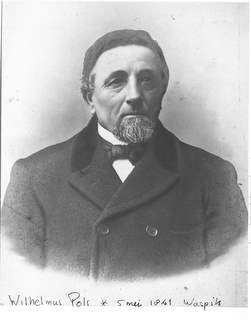
- A child of Wilhelmus (Willem) Pols and Johanna Maria van Onzenoort
- This information was last updated on June 11, 2008.
Household of Adrianus Theodorus Pols
He is married to Elisabeth Joanna van Onzenoort.
They got married on May 5, 1905 at Antwerpen (Bel), he was 28 years old.
Child(ren):
- Wilhelmus Pols 1906-
- Elisabeth (Lisa) Pols 1907-
- Johanna (Anneke) Pols 1909-
Timeline Adrianus Theodorus Pols
This functionality is only available in Javascript supporting browsers.
Click on the names for more info.
Symbols used:  grandparents
 parents
 brothers/sisters
 children
grandparents
parents
brothers/sisters
children
Ancestors (and descendant) of Adrianus Theodorus Pols
Adrianus Theodorus Pols | ||||||||||||||||||||||||||||||||||||||
1905 | ||||||||||||||||||||||||||||||||||||||
Elisabeth Joanna van Onzenoort | ||||||||||||||||||||||||||||||||||||||
The data shown has no sources.
Historical events
Birthday July 13, 1876
- The temperature on July 13, 1876 was about 20.0 °C. The airpressure was 77 cm mercury. The atmospheric humidity was 72%. Source: KNMI
- Koning Willem III (Huis van Oranje-Nassau) was from 1849 till 1890 sovereign of the Netherlands (also known as Koninkrijk der Nederlanden)
- From August 27, 1874 till November 3, 1877 the Netherlands had a cabinet Heemskerk - Van Lijnden van Sandenburg with the prime ministers Mr. J. Heemskerk Azn. (conservatief) and Mr. C.Th. baron Van Lijnden van Sandenburg (AR).
- In the year 1876: Source: Wikipedia
- The Netherlands had about 4.0 million citizens.
- March 10 » The first successful test of a telephone is made by Alexander Graham Bell.
- April 20 » The April Uprising begins. Its suppression shocks European opinion, and Bulgarian independence becomes a condition for ending the Russo-Turkish War.
- April 22 » The first game in the history of the National League was played at the Jefferson Street Grounds in Philadelphia. This game is often pointed to as the beginning of Major League Baseball.
- June 25 » Battle of the Little Bighorn and the death of Lieutenant Colonel George Armstrong Custer.
- August 1 » Colorado is admitted as the 38th U.S. state.
- October 4 » The Agricultural and Mechanical College of Texas opens as the first public college in Texas.
Day of marriage May 5, 1905
- The temperature on May 5, 1905 was between 7.0 °C and 17.0 °C and averaged 11.7 °C. There was 7.6 hours of sunshine (50%). The average windspeed was 5 Bft (very strong wind) and was prevailing from the northeast. Source: KNMI
- Koningin Wilhelmina (Huis van Oranje-Nassau) was from 1890 till 1948 sovereign of the Netherlands (also known as Koninkrijk der Nederlanden)
- In The Netherlands , there was from August 1, 1901 to August 16, 1905 the cabinet Kuijper, with Dr. A. Kuijper (AR) as prime minister.
- In The Netherlands , there was from August 17, 1905 to February 11, 1908 the cabinet De Meester, with Mr. Th. de Meester (unie-liberaal) as prime minister.
- In the year 1905: Source: Wikipedia
- The Netherlands had about 5.5 million citizens.
- February 5 » In Mexico, the General Hospital of Mexico is inaugurated, started with four basic specialties.
- February 23 » Chicago attorney Paul Harris and three other businessmen meet for lunch to form the Rotary Club, the world's first service club.
- March 23 » Eleftherios Venizelos calls for Crete's union with Greece, and begins what is to be known as the Theriso revolt.
- April 30 » Albert Einstein completes his doctoral thesis at the University of Zurich.
- September 5 » Russo-Japanese War: In New Hampshire, United States, the Treaty of Portsmouth, mediated by U.S. President Theodore Roosevelt, ends the war.
- September 8 » The 7.2 Mw Calabria earthquake shakes southern Italy with a maximum Mercalli intensity of XI (Extreme), killing between 557 and 2,500 people.
Day of death November 25, 1944
- The temperature on November 25, 1944 was between 3.5 °C and 8.6 °C and averaged 6.0 °C. There was 6.4 mm of rain during 3.3 hours. There was 1.4 hours of sunshine (17%). The average windspeed was 3 Bft (moderate breeze) and was prevailing from the west. Source: KNMI
- Koningin Wilhelmina (Huis van Oranje-Nassau) was from 1890 till 1948 sovereign of the Netherlands (also known as Koninkrijk der Nederlanden)
- In The Netherlands , there was from July 27, 1941 to February 23, 1945 the cabinet Gerbrandy II, with Prof. dr. P.S. Gerbrandy (ARP) as prime minister.
- In the year 1944: Source: Wikipedia
- The Netherlands had about 9.1 million citizens.
- April 13 » Relations between New Zealand and the Soviet Union are established.
- April 29 » World War II: British agent Nancy Wake, a leading figure in the French Resistance and the Gestapo's most wanted person, parachutes back into France to be a liaison between London and the local maquis group.
- May 18 » Deportation of Crimean Tatars by the Soviet Union government.
- June 20 » The experimental MW 18014 V-2 rocket reaches an altitude of 176km, becoming the first man-made object to reach outer space.
- September 6 » World War II: The city of Ypres, Belgium is liberated by Allied forces.
- September 17 » World War II: Allied airborne troops parachute into the Netherlands as the "Market" half of Operation Market Garden.
Same birth/death day
- 1863 » Margaret Murray, British archaeologist, anthropologist, historian, and folklorist († 1963)
- 1864 » John Jacob Astor IV, American colonel and businessman († 1912)
- 1877 » Robert Henry Mathews, Australian linguist and missionary († 1970)
- 1884 » Yrjö Saarela, Finnish wrestler and coach († 1951)
- 1889 » Emma Asson, Estonian educator and politician († 1965)
- 1889 » Stan Coveleski, American baseball player († 1984)
- 1944 » Kenesaw Mountain Landis, American lawyer and judge (b. 1866)
- 1948 » Kanbun Uechi, Japanese martial artist, founded Uechi-ryū (b. 1877)
- 1949 » Bill Robinson, American actor and dancer (b. 1878)
- 1950 » Gustaf John Ramstedt, Finnish linguist and diplomat (b. 1873)
- 1950 » Johannes V. Jensen, Danish author and playwright, Nobel Prize laureate (b. 1873)
- 1950 » Mao Anying, Chinese general (b. 1922)
About the surname Pols
- View the information that Genealogie Online has about the surname Pols.
- Check the information Open Archives has about Pols.
- Check the Wie (onder)zoekt wie? register to see who is (re)searching Pols.
The Family tree Linders publication was prepared by Jac. Linders (contact is not possible).
When copying data from this family tree, please include a reference to the origin:
Jac. Linders, "Family tree Linders", database, Genealogy Online (https://www.genealogieonline.nl/stamboom_linders/I11036.php : accessed February 14, 2026), "Adrianus Theodorus Pols (1876-1944)".
Jac. Linders, "Family tree Linders", database, Genealogy Online (https://www.genealogieonline.nl/stamboom_linders/I11036.php : accessed February 14, 2026), "Adrianus Theodorus Pols (1876-1944)".