Family tree Westerdijk » Tamme Westerdijk (1803-1876)
Personal data Tamme Westerdijk
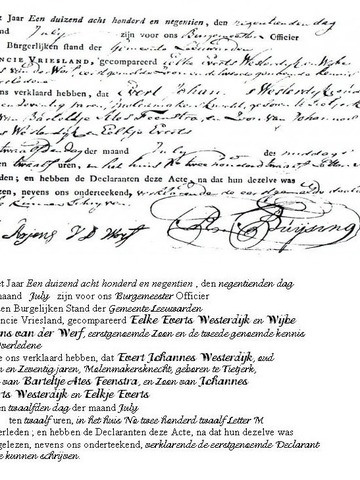
Source 1- He was born on November 14, 1803 in Irnsum.
- He died on January 19, 1876 in Leeuwarden, Nederland (Fr), he was 72 years old.
- A child of Klaas (Claas) Everts Westerdijk and Klaaske Tammes
Household of Tamme Westerdijk
He had a relationship with Jantje Hinnes.
Child(ren):
Timeline Tamme Westerdijk
This functionality is only available in Javascript supporting browsers.
Click on the names for more info.
Symbols used:  grandparents
 parents
 brothers/sisters
 children
grandparents
parents
brothers/sisters
children
Image(s) Tamme Westerdijk



Sources
- Storm(s) Web Site, Wilhelmus Gerardus (Wim) Storm, Tamme Klazes. Westerdijk, April 7, 2019
Toegevoegd door een Smart Match te bevestigen
Stambomen op MyHeritage
Familiesite: Storm(s) Web Site
Familiestamboom: 69645961-28
Matches in other publications
This person also appears in the publication: View all
Historical events
Birthday November 14, 1803
- The temperature on November 14, 1803 was about 7.0 °C. There was 26 mm of rainWind direction mainly southwest. Weather type: betrokken regen. Source: KNMI
- This page is only available in Dutch.De Republiek der Verenigde Nederlanden werd in 1794-1795 door de Fransen veroverd onder leiding van bevelhebber Charles Pichegru (geholpen door de Nederlander Herman Willem Daendels); de verovering werd vergemakkelijkt door het dichtvriezen van de Waterlinie; Willem V moest op 18 januari 1795 uitwijken naar Engeland (en van daaruit in 1801 naar Duitsland); de patriotten namen de macht over van de aristocratische regenten en proclameerden de Bataafsche Republiek; op 16 mei 1795 werd het Haags Verdrag gesloten, waarmee ons land een vazalstaat werd van Frankrijk; in 3.1796 kwam er een Nationale Vergadering; in 1798 pleegde Daendels een staatsgreep, die de unitarissen aan de macht bracht; er kwam een nieuwe grondwet, die een Vertegenwoordigend Lichaam (met een Eerste en Tweede Kamer) instelde en als regering een Directoire; in 1799 sloeg Daendels bij Castricum een Brits-Russische invasie af; in 1801 kwam er een nieuwe grondwet; bij de Vrede van Amiens (1802) kreeg ons land van Engeland zijn koloniën terug (behalve Ceylon); na de grondwetswijziging van 1805 kwam er een raadpensionaris als eenhoofdig gezag, namelijk Rutger Jan Schimmelpenninck (van 31 oktober 1761 tot 25 maart 1825).
- In the year 1803: Source: Wikipedia
- February 24 » In Marbury v. Madison, the Supreme Court of the United States establishes the principle of judicial review.
- March 1 » Ohio becomes the 17th state of The United States.
- April 26 » Thousands of meteor fragments fall from the skies of L'Aigle, France; the event convinces European scientists that meteors exist.
- April 30 » Louisiana Purchase: The United States purchases the Louisiana Territory from France for $15million, more than doubling the size of the young nation.
- May 18 » Napoleonic Wars: The United Kingdom revokes the Treaty of Amiens and declares war on France.
- July 26 » The Surrey Iron Railway, arguably the world's first public railway, opens in south London, United Kingdom.
Day of death January 19, 1876
- The temperature on January 19, 1876 was about 3.3 °C. The air pressure was 7 kgf/m2 and came mainly from the south-southwest. The airpressure was 76 cm mercury. The atmospheric humidity was 84%. Source: KNMI
- Koning Willem III (Huis van Oranje-Nassau) was from 1849 till 1890 sovereign of the Netherlands (also known as Koninkrijk der Nederlanden)
- From August 27, 1874 till November 3, 1877 the Netherlands had a cabinet Heemskerk - Van Lijnden van Sandenburg with the prime ministers Mr. J. Heemskerk Azn. (conservatief) and Mr. C.Th. baron Van Lijnden van Sandenburg (AR).
- In the year 1876: Source: Wikipedia
- The Netherlands had about 4.0 million citizens.
- February 26 » Japan and Korea sign a treaty granting Japanese citizens extraterritoriality rights, opening three ports to Japanese trade, and ending Korea's status as a tributary state of Qing dynasty China.
- March 7 » Alexander Graham Bell is granted a patent for an invention he calls the "telephone".
- March 10 » The first successful test of a telephone is made by Alexander Graham Bell.
- April 22 » The first game in the history of the National League was played at the Jefferson Street Grounds in Philadelphia. This game is often pointed to as the beginning of Major League Baseball.
- May 30 » Ottoman sultan Abdülaziz is deposed and succeeded by his nephew Murad V.
- June 4 » An express train called the Transcontinental Express arrives in San Francisco, via the First Transcontinental Railroad only 83 hours and 39 minutes after leaving New York City.
Same birth/death day
- 1797 » Charles Lyell, Scottish geologist and lawyer († 1875)
- 1803 » Jacob Abbott, American author († 1879)
- 1805 » Fanny Mendelssohn, German pianist and composer († 1847)
- 1812 » Aleardo Aleardi, Italian poet († 1878)
- 1812 » Maria Cristina of Savoy († 1836)
- 1816 » John Curwen, English minister and educator († 1880)
- 1851 » Esteban Echeverría, Argentinian poet and author (b. 1805)
- 1853 » Karl Faber, German historian and academic (b. 1773)
- 1865 » Pierre-Joseph Proudhon, French philosopher and politician (b. 1809)
- 1869 » Carl Reichenbach, German chemist and philosopher (b. 1788)
- 1874 » August Heinrich Hoffmann von Fallersleben, German poet and scholar (b. 1798)
- 1878 » Henri Victor Regnault, French physicist and chemist (b. 1810)
About the surname Westerdijk
- View the information that Genealogie Online has about the surname Westerdijk.
- Check the information Open Archives has about Westerdijk.
- Check the Wie (onder)zoekt wie? register to see who is (re)searching Westerdijk.
The Family tree Westerdijk publication was prepared by Thomas Westerdijk.
When copying data from this family tree, please include a reference to the origin:
Thomas Westerdijk, "Family tree Westerdijk", database, Genealogy Online (https://www.genealogieonline.nl/stamboom-westerdijk/I500031.php : accessed March 6, 2026), "Tamme Westerdijk (1803-1876)".
Thomas Westerdijk, "Family tree Westerdijk", database, Genealogy Online (https://www.genealogieonline.nl/stamboom-westerdijk/I500031.php : accessed March 6, 2026), "Tamme Westerdijk (1803-1876)".