Family tree van Hamond (Sint-Michielsgestel, Schijndel) » Petrus van Hamond (1869-1946)
Personal data Petrus van Hamond
- He was born on January 31, 1869 in Sint-Michielsgestel, Nederland.
- He died on September 3, 1946 in Sint-Michielsgestel, Nederland, he was 77 years old.
- A child of Theodorus van Hamond and Adriana Schellekens
Household of Petrus van Hamond
He is married to Hendrika Vissers.
They got married on June 1, 1900 at Den Dungen, Nederland, he was 31 years old.
Child(ren):
- Anna Maria van Hamond ± 1900-1902
- Adriana Maria (Sjaan) van Hamond 1923-2010
Timeline Petrus van Hamond
This functionality is only available in Javascript supporting browsers.
Click on the names for more info.
Symbols used:  grandparents
 parents
 brothers/sisters
 children
grandparents
parents
brothers/sisters
children
Ancestors (and descendant) of Petrus van Hamond
Petrus van Hamond 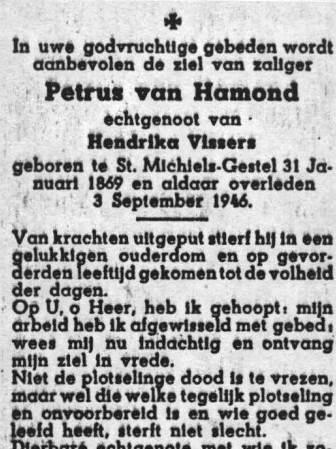 | ||||||||||||||||||||||||||||||||||||||||||||||||||||||||||||||||||||||||
1900 | ||||||||||||||||||||||||||||||||||||||||||||||||||||||||||||||||||||||||
Hendrika Vissers | ||||||||||||||||||||||||||||||||||||||||||||||||||||||||||||||||||||||||
Relationship Petrus van Hamond
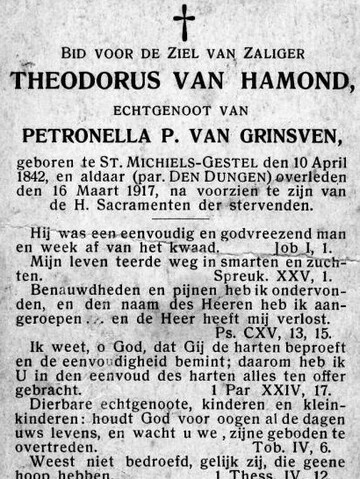
- Petrus van Hamond is the 4th great grandson of Henricus van Hamont:
The data shown has no sources.
Matches in other publications
This person also appears in the publication: View all
Historical events
Birthday January 31, 1869
- The temperature on January 31, 1869 was about 12.7 °C. There was 0.2 mm of rain. The air pressure was 35 kgf/m2 and came mainly from the southwest. The airpressure was 75 cm mercury. The atmospheric humidity was 71%. Source: KNMI
- Koning Willem III (Huis van Oranje-Nassau) was from 1849 till 1890 sovereign of the Netherlands (also known as Koninkrijk der Nederlanden)
- From June 4, 1868 till January 4, 1871 the Netherlands had a cabinet Van Bosse - Fock with the prime ministers Mr. P.P. van Bosse (liberaal) and Mr. C. Fock (liberaal).
- In the year 1869: Source: Wikipedia
- The Netherlands had about 3.6 million citizens.
- March 24 » The last of Titokowaru's forces surrendered to the New Zealand government, ending his uprising.
- April 17 » Morelos is admitted as the 27th state of Mexico.
- July 10 » Gävle, Sweden, is largely destroyed in a fire; 80% of its 10,000 residents are left homeless.
- September 24 » Gold prices plummet after President Grant orders the Treasury to sell large quantities of gold after Jay Gould and James Fisk plot to control the market.
- November 6 » In New Brunswick, New Jersey, Rutgers College defeats Princeton University (then known as the College of New Jersey), 6–4, in the first official intercollegiate American football game.
- November 22 » In Dumbarton, Scotland, the clipper Cutty Sark is launched
Day of marriage June 1, 1900
- The temperature on June 1, 1900 was about 10.7 °C. The airpressure was 76 cm mercury. The atmospheric humidity was 94%. Source: KNMI
- Koningin Wilhelmina (Huis van Oranje-Nassau) was from 1890 till 1948 sovereign of the Netherlands (also known as Koninkrijk der Nederlanden)
- In The Netherlands , there was from July 27, 1897 to August 1, 1901 the cabinet Pierson, with Mr. N.G. Pierson (unie-liberaal) as prime minister.
- In the year 1900: Source: Wikipedia
- The Netherlands had about 5.1 million citizens.
- January 24 » Second Boer War: Boers stop a British attempt to break the Siege of Ladysmith in the Battle of Spion Kop.
- March 24 » Mayor of New York City Robert Anderson Van Wyck breaks ground for a new underground "Rapid Transit Railroad" that would link Manhattan and Brooklyn.
- April 2 » The United States Congress passes the Foraker Act, giving Puerto Rico limited self-rule.
- April 5 » Archaeologists in Knossos, Crete, discover a large cache of clay tablets with hieroglyphic writing in a script they call Linear B.
- July 9 » The Governor of Shanxi province in North China orders the execution of 45 foreign Christian missionaries and local church members, including children.
- October 9 » The Cook Islands become a territory of the United Kingdom.
Day of death September 3, 1946
- The temperature on September 3, 1946 was between 7.8 °C and 19.9 °C and averaged 14.3 °C. There was 5.0 hours of sunshine (37%). The average windspeed was 4 Bft (moderate breeze) and was prevailing from the south. Source: KNMI
- Koningin Wilhelmina (Huis van Oranje-Nassau) was from 1890 till 1948 sovereign of the Netherlands (also known as Koninkrijk der Nederlanden)
- From June 24, 1945 till July 3, 1946 the Netherlands had a cabinet Schermerhorn - Drees with the prime ministers Prof. ir. W. Schermerhorn (VDB) and W. Drees (PvdA).
- In The Netherlands , there was from July 3, 1946 to August 7, 1948 the cabinet Beel I, with Dr. L.J.M. Beel (KVP) as prime minister.
- In the year 1946: Source: Wikipedia
- The Netherlands had about 9.3 million citizens.
- February 12 » African American United States Army veteran Isaac Woodard is severely beaten by a South Carolina police officer to the point where he loses his vision in both eyes. The incident later galvanizes the civil rights movement and partially inspires Orson Welles' film Touch of Evil.
- February 12 » World War II: Operation Deadlight ends after scuttling 121 of 154 captured U-boats.
- March 24 » A British Cabinet Mission arrives in India to discuss and plan for the transfer of power from the British Raj to Indian leadership.
- April 1 » The 8.6 Mw Aleutian Islands earthquake shakes the Aleutian Islands with a maximum Mercalli intensity of VI (Strong). A destructive tsunami reaches the Hawaiian Islands resulting in dozens of deaths, mostly in Hilo, Hawaii.
- May 9 » King Victor Emmanuel III of Italy abdicates and is succeeded by Umberto II.
- December 19 » Start of the First Indochina War.
Same birth/death day
- 1854 » David Emmanuel, Romanian mathematician and academic († 1941)
- 1865 » Henri Desgrange, French cyclist and journalist († 1940)
- 1865 » Shastriji Maharaj, Indian spiritual leader, founded BAPS († 1951)
- 1868 » Theodore William Richards, American chemist and academic, Nobel Prize laureate († 1928)
- 1872 » Zane Grey, American author († 1939)
- 1881 » Irving Langmuir, American chemist and physicist, Nobel Prize laureate († 1957)
- 1936 » Nikita Balieff, Armenian-Russian puppeteer and director (b. 1876)
- 1942 » Séraphine Louis, French painter (b. 1864)
- 1942 » Will James, Canadian-American author and illustrator (b. 1892)
- 1944 » John Lumsden, Irish physician, founded the St. John Ambulance Brigade of Ireland (b. 1869)
- 1948 » Edvard Beneš, Czech academic and politician, 2nd President of Czechoslovakia (b. 1884)
- 1954 » Marika Kotopouli, Greek actress (b. 1887)
About the surname Van Hamond
- View the information that Genealogie Online has about the surname Van Hamond.
- Check the information Open Archives has about Van Hamond.
- Check the Wie (onder)zoekt wie? register to see who is (re)searching Van Hamond.
The Family tree van Hamond (Sint-Michielsgestel, Schijndel) publication was prepared by Joost van Hamont.
When copying data from this family tree, please include a reference to the origin:
Joost van Hamont, "Family tree van Hamond (Sint-Michielsgestel, Schijndel)", database, Genealogy Online (https://www.genealogieonline.nl/stamboom-van-hamond/I136.php : accessed February 7, 2026), "Petrus van Hamond (1869-1946)".
Joost van Hamont, "Family tree van Hamond (Sint-Michielsgestel, Schijndel)", database, Genealogy Online (https://www.genealogieonline.nl/stamboom-van-hamond/I136.php : accessed February 7, 2026), "Petrus van Hamond (1869-1946)".