Family tree Van Dijk » Jentje van de Stege (1849-1914)
Personal data Jentje van de Stege
- She was born on October 10, 1849 in Kamperveen, Overijssel, Nederland.
- She died on January 31, 1914 in Kampen, Overijssel, Nederland, she was 64 years old.
- A child of Hendrik Jans van de Stege and Aaltjen Hendriks van Dijk
- This information was last updated on January 7, 2007.
Household of Jentje van de Stege
She is married to Dries de Leeuw.
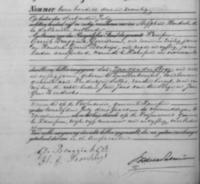
They got married on June 5, 1879 at Kampen, Overijssel, Nederland, she was 29 years old.
Timeline Jentje van de Stege
This functionality is only available in Javascript supporting browsers.
Click on the names for more info.
Symbols used:  grandparents
 parents
 brothers/sisters
 children
grandparents
parents
brothers/sisters
children
Ancestors (and descendant) of Jentje van de Stege
Jentje van de Stege | ||||||||||||||||||
1879 | ||||||||||||||||||
Dries de Leeuw | ||||||||||||||||||
The data shown has no sources.
Historical events
Birthday October 10, 1849
- The temperature on October 10, 1849 was about 8.0 °C. Wind direction mainly southwest. Weather type: betrokken. Source: KNMI
- This page is only available in Dutch.De Republiek der Verenigde Nederlanden werd in 1794-1795 door de Fransen veroverd onder leiding van bevelhebber Charles Pichegru (geholpen door de Nederlander Herman Willem Daendels); de verovering werd vergemakkelijkt door het dichtvriezen van de Waterlinie; Willem V moest op 18 januari 1795 uitwijken naar Engeland (en van daaruit in 1801 naar Duitsland); de patriotten namen de macht over van de aristocratische regenten en proclameerden de Bataafsche Republiek; op 16 mei 1795 werd het Haags Verdrag gesloten, waarmee ons land een vazalstaat werd van Frankrijk; in 3.1796 kwam er een Nationale Vergadering; in 1798 pleegde Daendels een staatsgreep, die de unitarissen aan de macht bracht; er kwam een nieuwe grondwet, die een Vertegenwoordigend Lichaam (met een Eerste en Tweede Kamer) instelde en als regering een Directoire; in 1799 sloeg Daendels bij Castricum een Brits-Russische invasie af; in 1801 kwam er een nieuwe grondwet; bij de Vrede van Amiens (1802) kreeg ons land van Engeland zijn koloniën terug (behalve Ceylon); na de grondwetswijziging van 1805 kwam er een raadpensionaris als eenhoofdig gezag, namelijk Rutger Jan Schimmelpenninck (van 31 oktober 1761 tot 25 maart 1825).
- From November 21, 1848 till November 1, 1849 the Netherlands had a cabinet De Kempenaer - Donker Curtius with the prime ministers Mr. J.M. de Kempenaer (conservatief-liberaal) and Mr. D. Donker Curtius (conservatief-liberaal).
- In The Netherlands , there was from November 1, 1849 to April 19, 1853 the cabinet Thorbecke I, with Mr. J.R. Thorbecke (liberaal) as prime minister.
- In the year 1849: Source: Wikipedia
- The Netherlands had about 3.1 million citizens.
- January 13 » Second Anglo-Sikh War – Battle of Chillianwala: British forces retreat from the Sikhs.
- May 22 » Future U.S. President Abraham Lincoln is issued a patent for an invention to lift boats, making him the only U.S. president to ever hold a patent.
- June 5 » Denmark becomes a constitutional monarchy by the signing of a new constitution.
- July 3 » France invades the Roman Republic and restores the Papal States.
- July 16 » Antonio María Claret y Clará founds the Congregation of the Missionary Sons of the Immaculate Heart of Mary, popularly known as the Claretians in Vic, in the province of Barcelona, Catalonia, Spain.
- October 12 » The city of Manizales, Colombia, is founded by 'The Expedition of the 20'.
Day of marriage June 5, 1879
- The temperature on June 5, 1879 was about 13.8 °C. The air pressure was 2 kgf/m2 and came mainly from the east-northeast. The airpressure was 76 cm mercury. The atmospheric humidity was 62%. Source: KNMI
- Koning Willem III (Huis van Oranje-Nassau) was from 1849 till 1890 sovereign of the Netherlands (also known as Koninkrijk der Nederlanden)
- In The Netherlands , there was from November 3, 1877 to August 20, 1879 the cabinet Kappeijne van de Coppello, with Mr. J. Kappeijne van de Coppello (liberaal) as prime minister.
- In The Netherlands , there was from August 20, 1879 to April 23, 1883 the cabinet Van Lijnden van Sandenburg, with Mr. C.Th. baron Van Lijnden van Sandenburg (conservatief-AR) as prime minister.
- In the year 1879: Source: Wikipedia
- The Netherlands had about 4.0 million citizens.
- January 13 » In Mozart Gardens Brooklyn Ada Anderson completed a great feat of pedestrianism - 2700 quarter miles in 2700 quarter hours, earning her $8000.
- January 22 » The Battle of Rorke's Drift, also during the Anglo-Zulu War and just some 15km away from Isandlwana, results in a British victory.
- May 31 » Gilmore's Garden in New York City is renamed Madison Square Garden by William Henry Vanderbilt and is opened to the public at 26th Street and Madison Avenue.
- September 3 » Siege of the British Residency in Kabul: British envoy Sir Louis Cavagnari and 72 men of the Guides are massacred by Afghan troops while defending the British Residency in Kabul. Their heroism and loyalty became famous and revered throughout the British Empire.
- October 22 » Using a filament of carbonized thread, Thomas Edison tests the first practical electric incandescent light bulb (it lasts 13⁄2 hours before burning out).
- December 21 » World premiere of Henrik Ibsen's A Doll's House at the Royal Theatre in Copenhagen, Denmark.
Day of death January 31, 1914
- The temperature on January 31, 1914 was between 0.8 °C and 7.7 °C and averaged 4.1 °C. There was 7.0 hours of sunshine (78%). The average windspeed was 5 Bft (very strong wind) and was prevailing from the south-southwest. Source: KNMI
- Koningin Wilhelmina (Huis van Oranje-Nassau) was from 1890 till 1948 sovereign of the Netherlands (also known as Koninkrijk der Nederlanden)
- In The Netherlands , there was from August 29, 1913 to September 9, 1918 the cabinet Cort van der Linden, with Mr. P.W.A. Cort van der Linden (liberaal) as prime minister.
- In the year 1914: Source: Wikipedia
- The Netherlands had about 6.2 million citizens.
- February 26 » HMHSBritannic, sister to the RMSTitanic, is launched at Harland and Wolff shipyard in Belfast.
- April 24 » The Franck–Hertz experiment, a pillar of quantum mechanics, is presented to the German Physical Society.
- August 12 » World War I: The Battle of Halen a.k.a. Battle of the Silver Helmets a clash between large Belgian and German cavalry formations at Halen, Belgium.
- August 15 » The Panama Canal opens to traffic with the transit of the cargo ship SSAncon.
- August 26 » World War I: The German colony of Togoland surrenders to French and British forces after a 20-day campaign.
- November 23 » Mexican Revolution: The last of U.S. forces withdraw from Veracruz, occupied seven months earlier in response to the Tampico Affair.
Same birth/death day
- 1834 » Aleksis Kivi, Finnish author and playwright († 1872)
- 1837 » Robert Gould Shaw, American colonel († 1863)
- 1842 » Emily Dobson, Australian philanthropist († 1934)
- 1858 » Maurice Prendergast, American painter and academic († 1924)
- 1861 » Fridtjof Nansen, Norwegian explorer, scientist, and humanitarian, Nobel Prize laureate († 1930)
- 1864 » T. Frank Appleby, American businessman and politician († 1924)
- 1888 » John Bosco, Italian priest and educator, founded the Salesian Society (b. 1815)
- 1892 » Charles Spurgeon, English pastor and author (b. 1834)
- 1900 » John Douglas, 9th Marquess of Queensberry, Scottish nobleman (b. 1844)
- 1907 » Timothy Eaton, Canadian businessman, founded Eaton's (b. 1834)
- 1923 » Eligiusz Niewiadomski, Polish painter and critic (b. 1869)
- 1933 » John Galsworthy, English novelist and playwright, Nobel Prize laureate (b. 1867)
About the surname Van de Stege
- View the information that Genealogie Online has about the surname Van de Stege.
- Check the information Open Archives has about Van de Stege.
- Check the Wie (onder)zoekt wie? register to see who is (re)searching Van de Stege.
The Family tree Van Dijk publication was prepared by wijlen Jan van Dijk (contact is not possible).
When copying data from this family tree, please include a reference to the origin:
wijlen Jan van Dijk, "Family tree Van Dijk", database, Genealogy Online (https://www.genealogieonline.nl/stamboom-van-dijk/I5866.php : accessed February 18, 2026), "Jentje van de Stege (1849-1914)".
wijlen Jan van Dijk, "Family tree Van Dijk", database, Genealogy Online (https://www.genealogieonline.nl/stamboom-van-dijk/I5866.php : accessed February 18, 2026), "Jentje van de Stege (1849-1914)".