Family tree Van Dijk » Berend Kluinhaar (1879-1962)
Personal data Berend Kluinhaar
- He was born on March 6, 1879 in Zwollerkerspel (Voorst), Overijssel, Nederland.
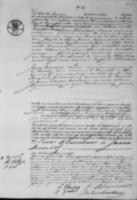
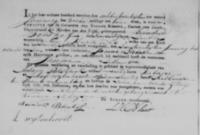
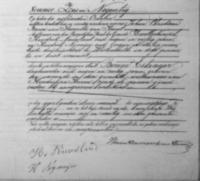
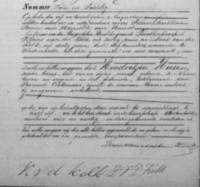
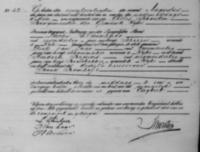
aktenr. 41
- Profession: Boerenknecht Houthandelaarsknecht.
- He died on November 1, 1962 in Zwollerkerspel, Overijssel, Nederland, he was 83 years old.
- A child of Engbert Kluinhaar and Berentdina Eikenaar
- This information was last updated on April 18, 2011.
Household of Berend Kluinhaar
He is married to Annigje Dekker.
They got married on May 9, 1902 at Grafhorst, Overijssel, Nederland, he was 23 years old.
Child(ren):
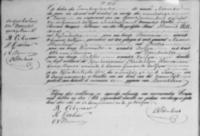
- Berentdina Kluinhaar 1902-1903
- Berentdina Kluinhaar 1903-1904
Timeline Berend Kluinhaar
This functionality is only available in Javascript supporting browsers.
Click on the names for more info.
Symbols used:  grandparents
 parents
 brothers/sisters
 children
grandparents
parents
brothers/sisters
children




The data shown has no sources.
Matches in other publications
This person also appears in the publication: View all
- Stamboom Van Weeghel, one author has confirmed this is the same person
Historical events
Birthday March 6, 1879
- The temperature on March 6, 1879 was about 9.8 °C. The air pressure was 5 kgf/m2 and came mainly from the west-northwest. The airpressure was 77 cm mercury. The atmospheric humidity was 67%. Source: KNMI
- Koning Willem III (Huis van Oranje-Nassau) was from 1849 till 1890 sovereign of the Netherlands (also known as Koninkrijk der Nederlanden)
- In The Netherlands , there was from November 3, 1877 to August 20, 1879 the cabinet Kappeijne van de Coppello, with Mr. J. Kappeijne van de Coppello (liberaal) as prime minister.
- In The Netherlands , there was from August 20, 1879 to April 23, 1883 the cabinet Van Lijnden van Sandenburg, with Mr. C.Th. baron Van Lijnden van Sandenburg (conservatief-AR) as prime minister.
- In the year 1879: Source: Wikipedia
- The Netherlands had about 4.0 million citizens.
- January 23 » Anglo-Zulu War: the Battle of Rorke's Drift ends.
- January 25 » The Bulgarian National Bank is founded.
- March 29 » Anglo-Zulu War: Battle of Kambula: British forces defeat 20,000 Zulus.
- April 23 » Fire burns down the second main building and dome of the University of Notre Dame, which prompts the construction of the third, and current, Main Building with its golden dome.
- May 31 » Gilmore's Garden in New York City is renamed Madison Square Garden by William Henry Vanderbilt and is opened to the public at 26th Street and Madison Avenue.
- October 21 » Thomas Edison applies for a patent for his design for an incandescent light bulb.
Day of marriage May 9, 1902
- The temperature on May 9, 1902 was between 4.2 °C and 11.2 °C and averaged 7.3 °C. There was 9.9 hours of sunshine (65%). Source: KNMI
- Koningin Wilhelmina (Huis van Oranje-Nassau) was from 1890 till 1948 sovereign of the Netherlands (also known as Koninkrijk der Nederlanden)
- In The Netherlands , there was from August 1, 1901 to August 16, 1905 the cabinet Kuijper, with Dr. A. Kuijper (AR) as prime minister.
- In the year 1902: Source: Wikipedia
- The Netherlands had about 5.2 million citizens.
- February 27 » Second Boer War: Australian soldiers Harry "Breaker" Morant and Peter Handcock are executed in Pretoria after being convicted of war crimes.
- April 18 » The 7.5 Mw Guatemala earthquake shakes Guatemala with a maximum Mercalli intensity of VIII (Severe), killing between 800–2,000.
- May 17 » Greek archaeologist Valerios Stais discovers the Antikythera mechanism, an ancient mechanical analog computer.
- May 31 » Second Boer War: The Treaty of Vereeniging ends the war and ensures British control of South Africa.
- December 10 » The opening of the reservoir of the Aswan Dam in Egypt.
- December 14 » The Commercial Pacific Cable Company lays the first Pacific telegraph cable, from San Francisco to Honolulu.
Day of death November 1, 1962
- The temperature on November 1, 1962 was between 1.2 °C and 9.7 °C and averaged 4.8 °C. There was 0.2 mm of rain. There was 5.1 hours of sunshine (53%). The partly clouded was. The average windspeed was 2 Bft (weak wind) and was prevailing from the south-southeast. Source: KNMI
- Koningin Juliana (Huis van Oranje-Nassau) was from September 4, 1948 till April 30, 1980 sovereign of the Netherlands (also known as Koninkrijk der Nederlanden)
- In The Netherlands , there was from May 19, 1959 to July 24, 1964 the cabinet De Quay, with Prof. dr. J.E. de Quay (KVP) as prime minister.
- In the year 1962: Source: Wikipedia
- The Netherlands had about 11.7 million citizens.
- January 11 » An avalanche on Huascarán in Peru causes around 4,000 deaths.
- May 24 » Project Mercury: American astronaut Scott Carpenter orbits the Earth three times in the Aurora 7 space capsule.
- July 13 » In an unprecedented action, British Prime Minister Harold Macmillan dismisses seven members of his Cabinet, marking the effective end of the National Liberals as a distinct force within British politics.
- August 20 » The NS Savannah, the world's first nuclear-powered civilian ship, embarks on its maiden voyage.
- August 30 » Japan conducts a test of the NAMC YS-11, its first aircraft since World War II and its only successful commercial aircraft from before or after the war.
- October 12 » The Columbus Day Storm strikes the U.S. Pacific Northwest with record wind velocities; 46 dead and at least U.S. $230 million in damages.
Same birth/death day
- 1872 » Ben Harney, American pianist and composer († 1938)
- 1879 » Jimmy Hunter, New Zealand rugby player († 1962)
- 1882 » F. Burrall Hoffman, American architect, co-designed Villa Vizcaya († 1980)
- 1882 » Guy Kibbee, American actor and singer († 1956)
- 1884 » Molla Mallory, Norwegian-American tennis player († 1959)
- 1885 » Ring Lardner, American journalist and author († 1933)
- 1952 » Dixie Lee, American singer (b. 1911)
- 1955 » Dale Carnegie, American author and educator (b. 1888)
- 1958 » Yahya Kemal Beyatlı, Turkish poet, author, and diplomat (b. 1884)
- 1962 » Ricardo Rodríguez, Mexican race car driver (b. 1942)
- 1968 » Georgios Papandreou, Greek economist and politician, 134th Prime Minister of Greece (b. 1888)
- 1970 » Robert Staughton Lynd, American sociologist and academic (b. 1892)
About the surname Kluinhaar
- View the information that Genealogie Online has about the surname Kluinhaar.
- Check the information Open Archives has about Kluinhaar.
- Check the Wie (onder)zoekt wie? register to see who is (re)searching Kluinhaar.
The Family tree Van Dijk publication was prepared by wijlen Jan van Dijk (contact is not possible).
When copying data from this family tree, please include a reference to the origin:
wijlen Jan van Dijk, "Family tree Van Dijk", database, Genealogy Online (https://www.genealogieonline.nl/stamboom-van-dijk/I3200.php : accessed February 19, 2026), "Berend Kluinhaar (1879-1962)".
wijlen Jan van Dijk, "Family tree Van Dijk", database, Genealogy Online (https://www.genealogieonline.nl/stamboom-van-dijk/I3200.php : accessed February 19, 2026), "Berend Kluinhaar (1879-1962)".