Family tree van der Padt » Nelida Broekhof (± 1857-1913)
Personal data Nelida Broekhof
- She was born about 1857.
- She died on July 30, 1913 in Venray. She was about 55-56 years old.
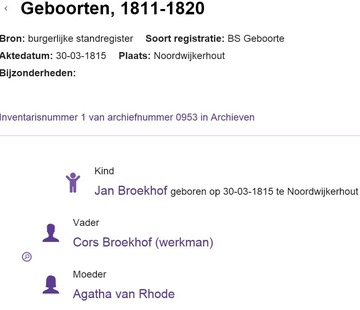
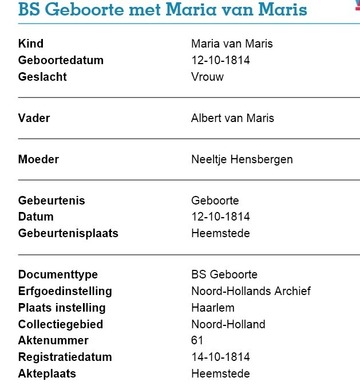
- A child of Jan Broekhof and Maria van Maris
Household of Nelida Broekhof
Timeline Nelida Broekhof
This functionality is only available in Javascript supporting browsers.
Click on the names for more info.
Symbols used:  grandparents
 parents
 brothers/sisters
 children
grandparents
parents
brothers/sisters
children
The data shown has no sources.
Historical events
Day of death July 30, 1913
- The temperature on July 30, 1913 was between 11.1 °C and 20.7 °C and averaged 16.0 °C. There was 11.6 hours of sunshine (74%). The average windspeed was 3 Bft (moderate breeze) and was prevailing from the northeast. Source: KNMI
- Koningin Wilhelmina (Huis van Oranje-Nassau) was from 1890 till 1948 sovereign of the Netherlands (also known as Koninkrijk der Nederlanden)
- In The Netherlands , there was from February 12, 1908 to August 29, 1913 the cabinet Heemskerk, with Mr. Th. Heemskerk (AR) as prime minister.
- In The Netherlands , there was from August 29, 1913 to September 9, 1918 the cabinet Cort van der Linden, with Mr. P.W.A. Cort van der Linden (liberaal) as prime minister.
- In the year 1913: Source: Wikipedia
- The Netherlands had about 6.1 million citizens.
- February 19 » Pedro Lascuráin becomes President of Mexico for 45 minutes; this is the shortest term to date of any person as president of any country.
- April 4 » First Balkan War: Greek aviator Emmanouil Argyropoulos becomes the first pilot to die in the Hellenic Air Force when his plane crashes.
- June 24 » Greece and Serbia annul their alliance with Bulgaria.
- July 4 » President Woodrow Wilson addresses American Civil War veterans at the Great Reunion of 1913.
- August 10 » Second Balkan War: Delegates from Bulgaria, Romania, Serbia, Montenegro, and Greece sign the Treaty of Bucharest, ending the war.
- November 9 » The Great Lakes Storm of 1913, the most destructive natural disaster ever to hit the lakes, reaches its greatest intensity after beginning two days earlier. The storm destroys 19 ships and kills more than 250 people.
Same birth/death day
- 1898 » Otto von Bismarck, German lawyer and politician, 1st Chancellor of Germany (b. 1815)
- 1900 » Alfred, Duke of Saxe-Coburg and Gotha (b. 1844)
- 1912 » Emperor Meiji of Japan (b. 1852)
- 1918 » Joyce Kilmer, American soldier, journalist, and poet (b. 1886)
- 1920 » Albert Gustaf Dahlman, Swedish executioner (b. 1848)
- 1930 » Joan Gamper, Swiss-Spanish footballer and businessman, founded FC Barcelona (b. 1877)
About the surname Broekhof
- View the information that Genealogie Online has about the surname Broekhof.
- Check the information Open Archives has about Broekhof.
- Check the Wie (onder)zoekt wie? register to see who is (re)searching Broekhof.
The Family tree van der Padt publication was prepared by Arjo van der Padt.
When copying data from this family tree, please include a reference to the origin:
Arjo van der Padt, "Family tree van der Padt", database, Genealogy Online (https://www.genealogieonline.nl/stamboom-van-der-padt/I554.php : accessed March 5, 2026), "Nelida Broekhof (± 1857-1913)".
Arjo van der Padt, "Family tree van der Padt", database, Genealogy Online (https://www.genealogieonline.nl/stamboom-van-der-padt/I554.php : accessed March 5, 2026), "Nelida Broekhof (± 1857-1913)".