Family tree Potten » Antoon Mathijs Hubert Beckers (1871-1954)
Personal data Antoon Mathijs Hubert Beckers
- He was born on May 18, 1871 in Venlo, Limburg, Nederland.
- He was christened.
- Profession: Boekhouder.
- Religion: Rooms Katholiek.
- He died on October 7, 1954 in Venlo, Limburg, Nederland, he was 83 years old.
- A child of Lambert Martinus Josef Beckers and Johanna Mechtildus Hendrika van Kooten
- This information was last updated on March 29, 2007.
Household of Antoon Mathijs Hubert Beckers
He is married to Petronella Theodora Potten.
They got married on October 25, 1904 at Venray, Limburg, Nederland, he was 33 years old.
Huw.akte Venray 1904 nr.36
Child(ren):
Timeline Antoon Mathijs Hubert Beckers
This functionality is only available in Javascript supporting browsers.
Click on the names for more info.
Symbols used:  grandparents
 parents
 brothers/sisters
 children
grandparents
parents
brothers/sisters
children
Image(s) Antoon Mathijs Hubert Beckers


Ancestors (and descendant) of Antoon Mathijs Hubert Beckers
Antoon Mathijs Hubert Beckers 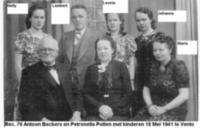 | ||||||||||||||||||||||||||||||||||||||
1904 | ||||||||||||||||||||||||||||||||||||||
Petronella Theodora Potten 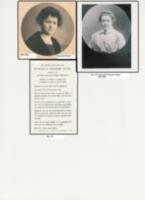 | ||||||||||||||||||||||||||||||||||||||
The data shown has no sources.
Matches in other publications
This person also appears in the publication: View all
Historical events
Birthday May 18, 1871
- The temperature on May 18, 1871 was about 9.7 °C. There was 0.7 mm of rain. The air pressure was 3 kgf/m2 and came mainly from the north-northwest. The atmospheric humidity was 62%. Source: KNMI
- Koning Willem III (Huis van Oranje-Nassau) was from 1849 till 1890 sovereign of the Netherlands (also known as Koninkrijk der Nederlanden)
- From June 4, 1868 till January 4, 1871 the Netherlands had a cabinet Van Bosse - Fock with the prime ministers Mr. P.P. van Bosse (liberaal) and Mr. C. Fock (liberaal).
- In The Netherlands , there was from January 4, 1871 to July 6, 1872 the cabinet Thorbecke III, with Mr. J.R. Thorbecke (liberaal) as prime minister.
- In the year 1871: Source: Wikipedia
- The Netherlands had about 4.0 million citizens.
- March 18 » Declaration of the Paris Commune; President of the French Republic, Adolphe Thiers, orders the evacuation of Paris.
- March 22 » In North Carolina, William Woods Holden becomes the first governor of a U.S. state to be removed from office by impeachment.
- April 30 » The Camp Grant massacre takes place in Arizona Territory.
- May 21 » French troops invade the Paris Commune and engage its residents in street fighting. By the close of "Bloody Week", some 20,000 communards have been killed and 38,000 arrested.
- July 2 » Victor Emmanuel II of Italy enters Rome after having conquered it from the Papal States.
- August 29 » Emperor Meiji orders the abolition of the han system and the establishment of prefectures as local centers of administration. (Traditional Japanese date: July 14, 1871).
Day of marriage October 25, 1904
- The temperature on October 25, 1904 was between 6.6 °C and 14.2 °C and averaged 10.1 °C. There was 7.6 hours of sunshine (75%). The average windspeed was 3 Bft (moderate breeze) and was prevailing from the west. Source: KNMI
- Koningin Wilhelmina (Huis van Oranje-Nassau) was from 1890 till 1948 sovereign of the Netherlands (also known as Koninkrijk der Nederlanden)
- In The Netherlands , there was from August 1, 1901 to August 16, 1905 the cabinet Kuijper, with Dr. A. Kuijper (AR) as prime minister.
- In the year 1904: Source: Wikipedia
- The Netherlands had about 5.4 million citizens.
- January 23 » Ålesund Fire: the Norwegian coastal town Ålesund is devastated by fire, leaving 10,000 people homeless and one person dead. Kaiser Wilhelm II funds the rebuilding of the town in Jugendstil style.
- April 30 » The Louisiana Purchase Exposition World's Fair opens in St. Louis, Missouri.
- May 21 » The Fédération Internationale de Football Association (FIFA) is founded in Paris.
- June 16 » Irish author James Joyce begins a relationship with Nora Barnacle and subsequently uses the date to set the actions for his novel Ulysses; this date is now traditionally called "Bloomsday".
- December 3 » The Jovian moon Himalia is discovered by Charles Dillon Perrine at California's Lick Observatory.
- December 7 » Comparative fuel trials begin between warships HMSSpiteful and HMSPeterel: Spiteful was the first warship powered solely by fuel oil, and the trials led to the obsolescence of coal in ships of the Royal Navy.
Day of death October 7, 1954
- The temperature on October 7, 1954 was between 9.0 °C and 11.9 °C and averaged 10.5 °C. There was 8.6 mm of rain during 5.0 hours. There was 1.0 hours of sunshine (9%). The heavily clouded was. The average windspeed was 5 Bft (very strong wind) and was prevailing from the north-northwest. Source: KNMI
- Koningin Juliana (Huis van Oranje-Nassau) was from September 4, 1948 till April 30, 1980 sovereign of the Netherlands (also known as Koninkrijk der Nederlanden)
- In The Netherlands , there was from September 2, 1952 to October 13, 1956 the cabinet Drees II, with Dr. W. Drees (PvdA) as prime minister.
- In the year 1954: Source: Wikipedia
- The Netherlands had about 10.6 million citizens.
- January 10 » BOAC Flight 781, a de Havilland DH.106 Comet 1, explodes and falls into the Tyrrhenian Sea killing 35 people.
- February 28 » The first color television sets using the NTSC standard are offered for sale to the general public.
- March 19 » Joey Giardello knocks out Willie Tory in round seven at Madison Square Garden in the first televised prize boxing fight shown in colour.
- April 7 » United States President Dwight D. Eisenhower gives his "domino theory" speech during a news conference.
- July 15 » First flight of the Boeing 367-80, prototype for both the Boeing 707 and C-135 series.
- September 8 » The Southeast Asia Treaty Organization (SEATO) is established.
Same birth/death day
- 1867 » Minakata Kumagusu, Japanese author, biologist, naturalist and ethnologist († 1941)
- 1868 » Nicholas II of Russia († 1918)
- 1869 » Lucy Beaumont, English-American actress († 1937)
- 1871 » Denis Horgan, Irish shot putter and weight thrower († 1922)
- 1872 » Bertrand Russell, British mathematician, historian, and philosopher, Nobel Prize laureate († 1970)
- 1876 » Hermann Müller, German journalist and politician, 12th Chancellor of Germany († 1931)
- 1943 » Radclyffe Hall, English author and poet (b. 1880)
- 1944 » Helmut Lent, German colonel and pilot (b. 1918)
- 1950 » Willis Haviland Carrier, American engineer (b. 1876)
- 1951 » Anton Philips, Dutch businessman, co-founded Philips (b. 1874)
- 1956 » Clarence Birdseye, American businessman, founded Birds Eye (b. 1886)
- 1959 » Mario Lanza, American tenor and actor (b. 1921)
About the surname Beckers
- View the information that Genealogie Online has about the surname Beckers.
- Check the information Open Archives has about Beckers.
- Check the Wie (onder)zoekt wie? register to see who is (re)searching Beckers.
The Family tree Potten publication was prepared by Paul Potten.
When copying data from this family tree, please include a reference to the origin:
Paul Potten, "Family tree Potten", database, Genealogy Online (https://www.genealogieonline.nl/stamboom-potten/I76.php : accessed February 26, 2026), "Antoon Mathijs Hubert Beckers (1871-1954)".
Paul Potten, "Family tree Potten", database, Genealogy Online (https://www.genealogieonline.nl/stamboom-potten/I76.php : accessed February 26, 2026), "Antoon Mathijs Hubert Beckers (1871-1954)".