Family tree Potten » Maria Johanna Petronella Jochijms (1885-1935)
Personal data Maria Johanna Petronella Jochijms
- She was born on December 28, 1885 in Beugen, Noord-Brabant, Nederland.
- She was christened.
- Religion: Rooms Katholiek.
- She died on November 22, 1935 in Groesbeek, Gelderland, Nederland, she was 49 years old.
- A child of Jacobus Jochijms and Joanna van Duijnhoven
- This information was last updated on March 29, 2007.
Household of Maria Johanna Petronella Jochijms
She is married to Petrus Antonius van Run.
They got married on July 16, 1916 at Beugen, Noord-Brabant, Nederland, she was 30 years old.
Child(ren):
- Theodora van Run 1917-1995
- (Not public)
- van Run 1921-1921
- van Run 1924-1924
Timeline Maria Johanna Petronella Jochijms
This functionality is only available in Javascript supporting browsers.
Click on the names for more info.
Symbols used:  grandparents
 parents
 brothers/sisters
 children
grandparents
parents
brothers/sisters
children
Image(s) Maria Johanna Petronella Jochijms

Ancestors (and descendant) of Maria Johanna Petronella Jochijms
Maria Johanna Petronella Jochijms 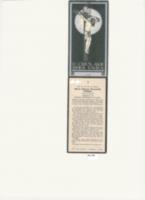 | ||||||||||||||||||||||||||||||||||||||
1916 | ||||||||||||||||||||||||||||||||||||||
Petrus Antonius van Run  | ||||||||||||||||||||||||||||||||||||||
The data shown has no sources.
Matches in other publications
This person also appears in the publication: View all
- Genealogie Bernards, one author has confirmed this is the same person
- Genealogie Teunissen, one author has confirmed this is the same person
Historical events
Birthday December 28, 1885
- The temperature on December 28, 1885 was about 3.2 °C. There was 2 mm of rain. The air pressure was 16 kgf/m2 and came mainly from the south-southwest. The airpressure was 75 cm mercury. The atmospheric humidity was 98%. Source: KNMI
- Koning Willem III (Huis van Oranje-Nassau) was from 1849 till 1890 sovereign of the Netherlands (also known as Koninkrijk der Nederlanden)
- In The Netherlands , there was from April 23, 1884 to April 21, 1888 the cabinet Heemskerk, with Mr. J. Heemskerk Azn. (conservatief) as prime minister.
- In the year 1885: Source: Wikipedia
- The Netherlands had about 4.5 million citizens.
- January 1 » Twenty-five nations adopt Sandford Fleming's proposal for standard time (and also, time zones).
- March 31 » The United Kingdom establishes the Bechuanaland Protectorate.
- April 30 » Governor of New York David B. Hill signs legislation creating the Niagara Reservation, New York's first state park, ensuring that Niagara Falls will not be devoted solely to industrial and commercial use.
- June 17 » The Statue of Liberty arrives in New York Harbor.
- November 7 » The completion of Canada's first transcontinental railway is symbolized by the Last Spike ceremony at Craigellachie, British Columbia.
- November 19 » Serbo-Bulgarian War: Bulgarian victory in the Battle of Slivnitsa solidifies the unification between the Principality of Bulgaria and Eastern Rumelia.
Day of marriage July 16, 1916
- The temperature on July 16, 1916 was between 10.3 °C and 15.9 °C and averaged 13.8 °C. There was 3.0 mm of rain. There was 0.3 hours of sunshine (2%). The average windspeed was 3 Bft (moderate breeze) and was prevailing from the west-southwest. Source: KNMI
- Koningin Wilhelmina (Huis van Oranje-Nassau) was from 1890 till 1948 sovereign of the Netherlands (also known as Koninkrijk der Nederlanden)
- In The Netherlands , there was from August 29, 1913 to September 9, 1918 the cabinet Cort van der Linden, with Mr. P.W.A. Cort van der Linden (liberaal) as prime minister.
- In the year 1916: Source: Wikipedia
- The Netherlands had about 6.4 million citizens.
- February 25 » In the Battle of Verdun, a German unit captures Fort Douaumont, keystone of the French defences, without a fight.
- March 16 » The 7th and 10th US cavalry regiments under John J. Pershing cross the US–Mexico border to join the hunt for Pancho Villa.
- May 10 » Sailing in the lifeboat James Caird, Ernest Shackleton arrives at South Georgia after a journey of 800 nautical miles from Elephant Island.
- July 19 » World War I: Battle of Fromelles: British and Australian troops attack German trenches as part of the Battle of the Somme.
- August 25 » The United States National Park Service is created.
- November 21 » Mines from SM U-73 sink the HMHS Britannic, the largest ship lost in the First World War.
Day of death November 22, 1935
- The temperature on November 22, 1935 was between 2.6 °C and 5.3 °C and averaged 4.0 °C. There was 2.4 mm of rain during 5.9 hours. The average windspeed was 2 Bft (weak wind) and was prevailing from the north-northeast. Source: KNMI
- Koningin Wilhelmina (Huis van Oranje-Nassau) was from 1890 till 1948 sovereign of the Netherlands (also known as Koninkrijk der Nederlanden)
- In The Netherlands , there was from May 26, 1933 to July 31, 1935 the cabinet Colijn II, with Dr. H. Colijn (ARP) as prime minister.
- In The Netherlands , there was from July 31, 1935 to June 24, 1937 the cabinet Colijn III, with Dr. H. Colijn (ARP) as prime minister.
- In the year 1935: Source: Wikipedia
- The Netherlands had about 8.4 million citizens.
- February 13 » A jury in Flemington, New Jersey finds Bruno Hauptmann guilty of the 1932 kidnapping and murder of the Lindbergh baby, the son of Charles Lindbergh.
- February 26 » Robert Watson-Watt carries out a demonstration near Daventry which leads directly to the development of radar in the United Kingdom.
- March 21 » Shah of Iran Reza Shah Pahlavi formally asks the international community to call Persia by its native name, Iran.
- June 18 » Police in Vancouver, British Columbia, Canada, clash with striking longshoremen, resulting in a total of 60 injuries and 24 arrests.
- September 17 » The Niagara Gorge Railroad ceases operations after a rockslide.
- December 9 » Student protests in Beiping (now Beijing)'s Tiananmen Square, dispersed by government.
Same birth/death day
- 1882 » Arthur Eddington, English astronomer, physicist, and mathematician († 1944)
- 1882 » Lili Elbe, Danish model and painter († 1931)
- 1887 » Werner Kolhörster, German physicist and academic († 1946)
- 1888 » F. W. Murnau, German-American director, producer, and screenwriter († 1931)
- 1890 » Quincy Wright, American political scientist, historian, and academic († 1970)
- 1895 » Carol Ryrie Brink, American author and playwright († 1981)
- 1926 » Darvish Khan, Iranian tar player (b. 1872)
- 1932 » William Walker Atkinson, American merchant, lawyer, and author (b. 1862)
- 1941 » Werner Mölders, German colonel and pilot (b. 1915)
- 1943 » Lorenz Hart, American playwright and composer (b. 1895)
- 1944 » Arthur Eddington, English astrophysicist and astronomer (b. 1882)
- 1946 » Otto Georg Thierack, German jurist and politician, German Minister of Justice (b. 1889)
About the surname Jochijms
- View the information that Genealogie Online has about the surname Jochijms.
- Check the information Open Archives has about Jochijms.
- Check the Wie (onder)zoekt wie? register to see who is (re)searching Jochijms.
The Family tree Potten publication was prepared by Paul Potten.
When copying data from this family tree, please include a reference to the origin:
Paul Potten, "Family tree Potten", database, Genealogy Online (https://www.genealogieonline.nl/stamboom-potten/I359.php : accessed January 13, 2026), "Maria Johanna Petronella Jochijms (1885-1935)".
Paul Potten, "Family tree Potten", database, Genealogy Online (https://www.genealogieonline.nl/stamboom-potten/I359.php : accessed January 13, 2026), "Maria Johanna Petronella Jochijms (1885-1935)".