Family tree Peterse » Johannes Franciskus Kloeg (1876-1948)
Personal data Johannes Franciskus Kloeg
- He was born on February 15, 1876 in Delft,ZH,NLD.
- Profession: winkelier in hoeden en petten.
- He died on April 21, 1948 in Delft,ZH,NLD, he was 72 years old.
- A child of Jacobus Adrianus Kloeg and Johanna Catharina Maria Peterse
- This information was last updated on November 19, 2021.
Household of Johannes Franciskus Kloeg
He is married to Maria Clasina Romijn.
They got married on August 21, 1900 at Delft,ZH,NLD, he was 24 years old.
Child(ren):
- Johanna Catharina Maria Kloeg 1904-1979
- Jacobus Adrianus Kloeg 1908-1974
- Catharina Paulina Maria Kloeg 1910-1941
- Petronella Elisabeth Cornelia Kloeg 1914-1983
Timeline Johannes Franciskus Kloeg
This functionality is only available in Javascript supporting browsers.
Click on the names for more info.
Symbols used:  grandparents
 parents
 brothers/sisters
 children
grandparents
parents
brothers/sisters
children
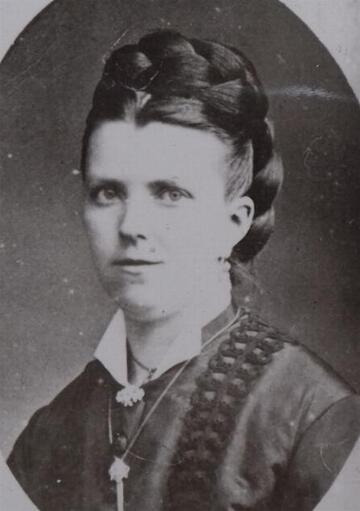
Image(s) Johannes Franciskus Kloeg

Ancestors (and descendant) of Johannes Franciskus Kloeg
Johannes Franciskus Kloeg | |||||||||||||||||||||||||||||||||||||||
1900 | |||||||||||||||||||||||||||||||||||||||
Maria Clasina Romijn | |||||||||||||||||||||||||||||||||||||||
Relationship Johannes Franciskus Kloeg
- Johannes Franciskus Kloeg is the 4th great grandson of Matthias Peterse:
The data shown has no sources.
Matches in other publications
This person also appears in the publication: View all
- Stamboom De Hooge-Piso-Snikkers en Muller, one author has confirmed this is the same person
- Geslacht Dongelmans, one author has confirmed this is the same person
- Stamboom Wim en Annelies de Leede, one author has confirmed this is the same person
Historical events
Birthday February 15, 1876
- The temperature on February 15, 1876 was about 5.5 °C. There was 2 mm of rain. The air pressure was 15 kgf/m2 and came mainly from the south-southwest. The airpressure was 75 cm mercury. The atmospheric humidity was 94%. Source: KNMI
- Koning Willem III (Huis van Oranje-Nassau) was from 1849 till 1890 sovereign of the Netherlands (also known as Koninkrijk der Nederlanden)
- From August 27, 1874 till November 3, 1877 the Netherlands had a cabinet Heemskerk - Van Lijnden van Sandenburg with the prime ministers Mr. J. Heemskerk Azn. (conservatief) and Mr. C.Th. baron Van Lijnden van Sandenburg (AR).
- In the year 1876: Source: Wikipedia
- The Netherlands had about 4.0 million citizens.
- January 15 » The first newspaper in Afrikaans, Die Afrikaanse Patriot, is published in Paarl.
- March 10 » The first successful test of a telephone is made by Alexander Graham Bell.
- May 30 » Ottoman sultan Abdülaziz is deposed and succeeded by his nephew Murad V.
- June 4 » An express train called the Transcontinental Express arrives in San Francisco, via the First Transcontinental Railroad only 83 hours and 39 minutes after leaving New York City.
- June 17 » American Indian Wars: Battle of the Rosebud: 1,500 Sioux and Cheyenne led by Crazy Horse beat back General George Crook's forces at Rosebud Creek in Montana Territory.
- August 1 » Colorado is admitted as the 38th U.S. state.
Day of marriage August 21, 1900
- The temperature on August 21, 1900 was about 17.3 °C. The airpressure was 75 cm mercury. The atmospheric humidity was 85%. Source: KNMI
- Koningin Wilhelmina (Huis van Oranje-Nassau) was from 1890 till 1948 sovereign of the Netherlands (also known as Koninkrijk der Nederlanden)
- In The Netherlands , there was from July 27, 1897 to August 1, 1901 the cabinet Pierson, with Mr. N.G. Pierson (unie-liberaal) as prime minister.
- In the year 1900: Source: Wikipedia
- The Netherlands had about 5.1 million citizens.
- March 13 » British forces occupy Bloemfontein, Orange Free State, during the Second Boer War.
- May 22 » The Associated Press is formed in New York City as a non-profit news cooperative.
- June 25 » The Taoist monk Wang Yuanlu discovers the Dunhuang manuscripts, a cache of ancient texts that are of great historical and religious significance, in the Mogao Caves of Dunhuang, China.
- July 27 » Kaiser Wilhelm II makes a speech comparing Germans to Huns; for years afterwards, "Hun" would be a disparaging name for Germans.
- July 29 » In Italy, King Umberto I of Italy is assassinated by the anarchist Gaetano Bresci.
- September 13 » Filipino insurgents defeat a small American column in the Battle of Pulang Lupa, during the Philippine–American War.
Day of death April 21, 1948
- The temperature on April 21, 1948 was between 8.7 °C and 24.0 °C and averaged 17.4 °C. There was 10.9 hours of sunshine (76%). The average windspeed was 3 Bft (moderate breeze) and was prevailing from the east. Source: KNMI
- Koningin Wilhelmina (Huis van Oranje-Nassau) was from 1890 till September 4, 1948 sovereign of the Netherlands (also known as Koninkrijk der Nederlanden)
- Koningin Juliana (Huis van Oranje-Nassau) was from September 4, 1948 till April 30, 1980 sovereign of the Netherlands (also known as Koninkrijk der Nederlanden)
- In The Netherlands , there was from July 3, 1946 to August 7, 1948 the cabinet Beel I, with Dr. L.J.M. Beel (KVP) as prime minister.
- From August 7, 1948 till March 15, 1951 the Netherlands had a cabinet Drees - Van Schaik with the prime ministers Dr. W. Drees (PvdA) and Mr. J.R.H. van Schaik (KVP).
- In the year 1948: Source: Wikipedia
- The Netherlands had about 9.7 million citizens.
- February 19 » The Conference of Youth and Students of Southeast Asia Fighting for Freedom and Independence convenes in Calcutta.
- April 9 » Fighters from the Irgun and Lehi Zionist paramilitary groups attacked Deir Yassin near Jerusalem, killing over 100.
- May 12 » Wilhelmina, Queen regnant of the Kingdom of the Netherlands, cedes the throne.
- May 26 » The U.S. Congress passes Public Law 80-557, which permanently establishes the Civil Air Patrol as an auxiliary of the United States Air Force.
- June 28 » Boxer Dick Turpin beats Vince Hawkins at Villa Park in Birmingham to become the first black British boxing champion in the modern era.
- November 1 » Athenagoras I, Ecumenical Patriarch of Constantinople, is enthroned.
Same birth/death day
- 1861 » Charles Édouard Guillaume, Swiss-French physicist and academic, Nobel Prize laureate († 1938)
- 1861 » Martin Burns, American wrestler and coach († 1937)
- 1873 » Hans von Euler-Chelpin, German-Swedish biochemist and academic, Nobel Prize laureate († 1964)
- 1874 » Ernest Shackleton, Anglo-Irish captain and explorer († 1922)
- 1883 » Sax Rohmer, English-American author († 1959)
- 1890 » Robert Ley, German politician († 1945)
- 1941 » Fritz Manteuffel, German gymnast (b. 1875)
- 1945 » Walter Model, German field marshal (b. 1891)
- 1946 » John Maynard Keynes, English economist and philosopher (b. 1883)
- 1948 » Aldo Leopold, American ecologist and author (b. 1887)
- 1952 » Leslie Banks, American actor, director and producer (b. 1890)
- 1954 » Emil Leon Post, Polish-American mathematician and logician (b. 1897)
About the surname Kloeg
- View the information that Genealogie Online has about the surname Kloeg.
- Check the information Open Archives has about Kloeg.
- Check the Wie (onder)zoekt wie? register to see who is (re)searching Kloeg.
The Family tree Peterse publication was prepared by C.M.J. Peterse.
When copying data from this family tree, please include a reference to the origin:
C.M.J. Peterse, "Family tree Peterse", database, Genealogy Online (https://www.genealogieonline.nl/stamboom-peterse/I327.php : accessed March 16, 2026), "Johannes Franciskus Kloeg (1876-1948)".
C.M.J. Peterse, "Family tree Peterse", database, Genealogy Online (https://www.genealogieonline.nl/stamboom-peterse/I327.php : accessed March 16, 2026), "Johannes Franciskus Kloeg (1876-1948)".