Family tree Wolf » Peter Faassen (1909-1940)
Personal data Peter Faassen
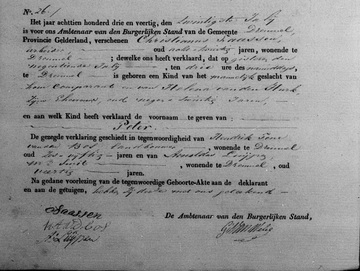
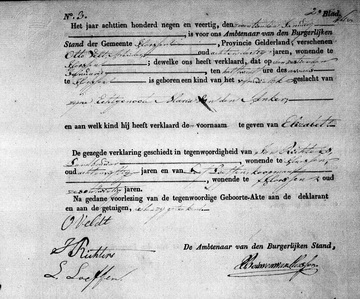
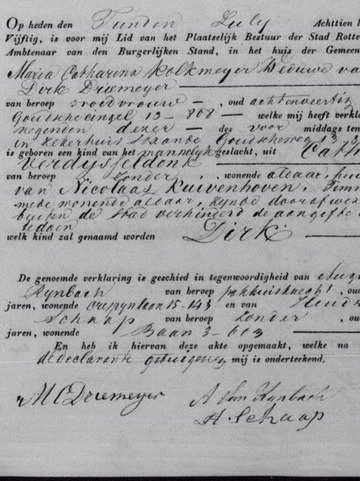
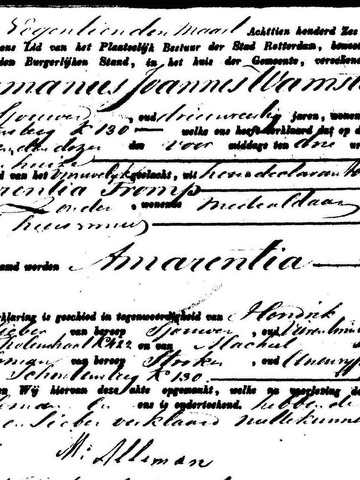
- He was born on April 20, 1909 in Rotterdam.Sources 1, 2, 3
- Profession: Broodbakker.
- He died on March 15, 1940 in Renswoude, he was 30 years old.Source 3
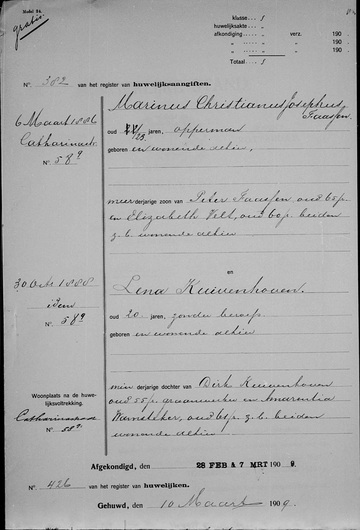
- A child of Marinus Christianus Josephus Faassen and Lena Kuivenhoven
Household of Peter Faassen
He is married to Hiltje Jans van Vliet.
They got married on January 27, 1932 at Rotterdam, he was 22 years old.Source 1
Timeline Peter Faassen
This functionality is only available in Javascript supporting browsers.
Click on the names for more info.
Symbols used:  grandparents
 parents
 brothers/sisters
 children
grandparents
parents
brothers/sisters
children
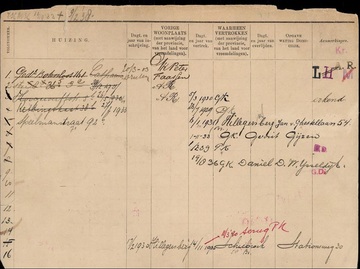
Sources
Historical events
Birthday April 20, 1909
- The temperature on April 20, 1909 was between 7.5 °C and 13.4 °C and averaged 10.5 °C. There was 6.5 mm of rain. There was 5.0 hours of sunshine (35%). The average windspeed was 5 Bft (very strong wind) and was prevailing from the southwest. Source: KNMI
- Koningin Wilhelmina (Huis van Oranje-Nassau) was from 1890 till 1948 sovereign of the Netherlands (also known as Koninkrijk der Nederlanden)
- In The Netherlands , there was from February 12, 1908 to August 29, 1913 the cabinet Heemskerk, with Mr. Th. Heemskerk (AR) as prime minister.
- In the year 1909: Source: Wikipedia
- The Netherlands had about 5.8 million citizens.
- February 12 » The National Association for the Advancement of Colored People (NAACP) is founded.
- February 23 » The AEA Silver Dart makes the first powered flight in Canada and the British Empire.
- March 23 » Theodore Roosevelt leaves New York for a post-presidency safari in Africa. The trip is sponsored by the Smithsonian Institution and National Geographic Society.
- July 16 » Persian Constitutional Revolution: Mohammad Ali Shah Qajar is forced out as Shah of Persia and is replaced by his son Ahmad Shah Qajar.
- August 7 » Alice Huyler Ramsey and three friends become the first women to complete a transcontinental auto trip, taking 59 days to travel from New York, New York to San Francisco, California.
- August 30 » Burgess Shale fossils are discovered by Charles Doolittle Walcott.
Day of marriage January 27, 1932
- The average temperature on January 27, 1932 was -1.4 °C. The average windspeed was 2 Bft (weak wind) and was prevailing from the east-southeast. Source: KNMI
- Koningin Wilhelmina (Huis van Oranje-Nassau) was from 1890 till 1948 sovereign of the Netherlands (also known as Koninkrijk der Nederlanden)
- In The Netherlands , there was from August 10, 1929 to May 26, 1933 the cabinet Ruys de Beerenbrouck III, with Jonkheer mr. Ch.J.M. Ruys de Beerenbrouck (RKSP) as prime minister.
- In the year 1932: Source: Wikipedia
- The Netherlands had about 8.1 million citizens.
- April 24 » Benny Rothman leads the mass trespass of Kinder Scout, leading to substantial legal reforms in the United Kingdom.
- June 4 » Marmaduke Grove and other Chilean military officers lead a coup d'état establishing the short-lived Socialist Republic of Chile.
- July 31 » The NSDAP (Nazi Party) wins more than 38% of the vote in German elections.
- September 24 » Gandhi and Dr. Ambedkar agree to the Poona Pact, which reserved seats in the Indian provincial legislatures for the "Depressed Classes" (Untouchables).
- November 3 » Panagis Tsaldaris becomes the 142nd Prime Minister of Greece.
- November 8 » Franklin D. Roosevelt is elected as the 32nd President of the United States, defeating incumbent president Herbert Hoover.
Day of death March 15, 1940
- The temperature on March 15, 1940 was between -2.8 °C and 6.9 °C and averaged 2.6 °C. There was 1.4 mm of rain during 1.1 hours. There was 5.5 hours of sunshine (47%). The average windspeed was 4 Bft (moderate breeze) and was prevailing from the west-southwest. Source: KNMI
- Koningin Wilhelmina (Huis van Oranje-Nassau) was from 1890 till 1948 sovereign of the Netherlands (also known as Koninkrijk der Nederlanden)
- In The Netherlands , there was from August 10, 1939 to September 3, 1940 the cabinet De Geer II, with Jonkheer mr. D.J. de Geer (CHU) as prime minister.
- In The Netherlands , there was from September 3, 1940 to July 27, 1941 the cabinet Gerbrandy I, with Prof. dr. P.S. Gerbrandy (ARP) as prime minister.
- In the year 1940: Source: Wikipedia
- The Netherlands had about 8.8 million citizens.
- February 10 » The Soviet Union begins mass deportations of Polish citizens from occupied eastern Poland to Siberia.
- May 26 » World War II: Operation Dynamo: In northern France, Allied forces begin a massive evacuation from Dunkirk, France.
- June 3 » World War II: The Battle of Dunkirk ends with a German victory and with Allied forces in full retreat.
- July 11 » World War II: Vichy France regime is formally established. Philippe Pétain becomes Chief of the French State.
- September 9 » Treznea Massacre in Transylvania.
- October 21 » The first edition of the Ernest Hemingway novel For Whom the Bell Tolls is published.
Same birth/death day
- 1907 » Augoustinos Kantiotes, Greek bishop († 2010)
- 1907 » Miran Bux, Pakistani cricketer († 1991)
- 1908 » Lionel Hampton, American vibraphone player, pianist, bandleader, and actor († 2002)
- 1910 » Fatin Rüştü Zorlu, Turkish diplomat and politician († 1961)
- 1913 » Mimis Fotopoulos, Greek actor and poet († 1986)
- 1913 » Willi Hennig, German biologist and entomologist († 1976)
- 1933 » Gustavo Jiménez, Peruvian colonel and politician, 73rd President of Peru (b. 1886)
- 1937 » H. P. Lovecraft, American short story writer, editor, and novelist (b. 1890)
- 1938 » Nikolai Bukharin, Russian journalist and politician (b. 1888)
- 1939 » Luis Barceló, Spanish colonel (b. 1896)
- 1941 » Alexej von Jawlensky, Russian-German painter (b. 1864)
- 1944 » Otto von Below, Prussian general (b. 1857)
About the surname Faassen
- View the information that Genealogie Online has about the surname Faassen.
- Check the information Open Archives has about Faassen.
- Check the Wie (onder)zoekt wie? register to see who is (re)searching Faassen.
The Family tree Wolf publication was prepared by Peter Wolf.
When copying data from this family tree, please include a reference to the origin:
Peter Wolf, "Family tree Wolf", database, Genealogy Online (https://www.genealogieonline.nl/stamboom-peter-wolf/I1163.php : accessed March 16, 2026), "Peter Faassen (1909-1940)".
Peter Wolf, "Family tree Wolf", database, Genealogy Online (https://www.genealogieonline.nl/stamboom-peter-wolf/I1163.php : accessed March 16, 2026), "Peter Faassen (1909-1940)".