Family tree Nolet » Willem Jacob Nolet (1894-1962)
Personal data Willem Jacob Nolet
- He was born on January 24, 1894 in Roswinkel (Emmen).
- Profession: ambtenaar secretarie.
- He died on June 7, 1962 in Zaandam, Noord-Holland, Nederland, he was 68 years old.
- A child of Pieter Nolet and Metje Deinema
- This information was last updated on October 2, 2023.
Household of Willem Jacob Nolet
He is married to Willemina Maria Bekman.
They got married on October 9, 1922 at Schoten, he was 28 years old.
Timeline Willem Jacob Nolet
This functionality is only available in Javascript supporting browsers.
Click on the names for more info.
Symbols used:  grandparents
 parents
 brothers/sisters
 children
grandparents
parents
brothers/sisters
children
Ancestors (and descendant) of Willem Jacob Nolet
Willem Jacob Nolet | ||||||||||||||||||
1922 | ||||||||||||||||||
Willemina Maria Bekman | ||||||||||||||||||
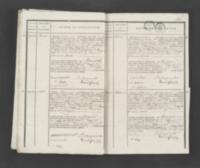
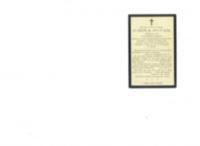
The data shown has no sources.
Historical events
Birthday January 24, 1894
- The temperature on January 24, 1894 was about -1.9 °C. There was 0.3 mm of rain. The airpressure was 76 cm mercury. The atmospheric humidity was 96%. Source: KNMI
- Koningin Wilhelmina (Huis van Oranje-Nassau) was from 1890 till 1948 sovereign of the Netherlands (also known as Koninkrijk der Nederlanden)
- Regentes Emma (Huis van Oranje-Nassau) was from 1890 till 1898 sovereign of the Netherlands (also known as Koninkrijk der Nederlanden)
- In The Netherlands , there was from August 21, 1891 to May 9, 1894 the cabinet Van Tienhoven, with Mr. G. van Tienhoven (unie-liberaal) as prime minister.
- In The Netherlands , there was from May 9, 1894 to July 27, 1897 the cabinet Roëll, with Jonkheer mr. J. Roëll (oud-liberaal) as prime minister.
- In the year 1894: Source: Wikipedia
- The Netherlands had about 5.1 million citizens.
- January 7 » Thomas Edison makes a kinetoscopic film of someone sneezing. On the same day, his employee, William Kennedy Dickson, receives a patent for motion picture film.
- March 22 » The first playoff game for the Stanley Cup starts.
- March 25 » Coxey's Army, the first significant American protest march, departs Massillon, Ohio for Washington, D.C.
- April 21 » Norway formally adopts the Krag–Jørgensen bolt-action rifle as the main arm of its armed forces, a weapon that would remain in service for almost 50 years.
- July 25 » The First Sino-Japanese War begins when the Japanese fire upon a Chinese warship.
- September 1 » Over 400 people die in the Great Hinckley Fire, a forest fire in Hinckley, Minnesota.
Day of marriage October 9, 1922
- The temperature on October 9, 1922 was between 3.5 °C and 12.5 °C and averaged 8.1 °C. There was 6.5 hours of sunshine (58%). The average windspeed was 3 Bft (moderate breeze) and was prevailing from the northeast. Source: KNMI
- Koningin Wilhelmina (Huis van Oranje-Nassau) was from 1890 till 1948 sovereign of the Netherlands (also known as Koninkrijk der Nederlanden)
- In The Netherlands , there was from September 9, 1918 to September 18, 1922 the cabinet Ruys de Beerenbrouck I, with Jonkheer mr. Ch.J.M. Ruys de Beerenbrouck (RKSP) as prime minister.
- In The Netherlands , there was from September 19, 1922 to August 4, 1925 the cabinet Ruys de Beerenbrouck II, with Jonkheer mr. Ch.J.M. Ruys de Beerenbrouck (RKSP) as prime minister.
- In the year 1922: Source: Wikipedia
- The Netherlands had about 7.0 million citizens.
- February 2 » Ulysses by James Joyce is published.
- March 15 » After Egypt gains nominal independence from the United Kingdom, Fuad I becomes King of Egypt.
- August 26 » Greco-Turkish War (1919–22): Turkish army launched what has come to be known to the Turks as the "Great Offensive" (Büyük Taarruz). The major Greek defense positions were overrun.
- September 11 » The Treaty of Kars is ratified in Yerevan, Armenia.
- October 18 » The British Broadcasting Company (later Corporation) is founded by a consortium, to establish a nationwide network of radio transmitters to provide a national broadcasting service.
- October 28 » Italian fascists led by Benito Mussolini march on Rome and take over the Italian government.
Day of death June 7, 1962
- The temperature on June 7, 1962 was between 8.3 °C and 20.7 °C and averaged 15.4 °C. There was 15.2 hours of sunshine (92%). The almost cloudless was. The average windspeed was 3 Bft (moderate breeze) and was prevailing from the north-northeast. Source: KNMI
- Koningin Juliana (Huis van Oranje-Nassau) was from September 4, 1948 till April 30, 1980 sovereign of the Netherlands (also known as Koninkrijk der Nederlanden)
- In The Netherlands , there was from May 19, 1959 to July 24, 1964 the cabinet De Quay, with Prof. dr. J.E. de Quay (KVP) as prime minister.
- In the year 1962: Source: Wikipedia
- The Netherlands had about 11.7 million citizens.
- March 4 » A Caledonian Airways Douglas DC-7 crashes shortly after takeoff from Cameroon, killing 111 - the worst crash of a DC-7.
- July 6 » The Late Late Show, the world's longest-running chat show by the same broadcaster, airs on RTÉ One for the first time.
- July 23 » Telstar relays the first publicly transmitted, live trans-Atlantic television program, featuring Walter Cronkite.
- August 16 » Pete Best is discharged from The Beatles, to be replaced two days later by Ringo Starr.
- October 25 » Cuban Missile Crisis: Adlai Stevenson shows the United Nations Security Council reconnaissance photographs of Soviet ballistic missiles in Cuba.
- December 7 » Prince Rainier III of Monaco revises the principality's constitution, devolving some of his power to advisory and legislative councils.
Same birth/death day
- 1889 » Charles Hawes, American historian and author († 1923)
- 1889 » Victor Eftimiu, Romanian poet and playwright († 1972)
- 1891 » Walter Model, German field marshal († 1945)
- 1892 » Franz Aigner, Austrian weightlifter († 1970)
- 1895 » Eugen Roth, German poet and songwriter († 1976)
- 1897 » Paul Fejos, Hungarian-born American director († 1963)
- 1961 » Reginald Fletcher, 1st Baron Winster, English navy officer and politician, Secretary of State for Transport (b. 1885)
- 1963 » ZaSu Pitts, American actress (b. 1894)
- 1965 » Judy Holliday, American actress and singer (b. 1921)
- 1966 » Jean Arp, German-French sculptor, painter, and poet (b. 1886)
- 1967 » Anatoly Maltsev, Russian mathematician and academic (b. 1909)
- 1967 » Dorothy Parker, American poet, short story writer, critic, and satirist (b. 1893)
About the surname Nolet
- View the information that Genealogie Online has about the surname Nolet.
- Check the information Open Archives has about Nolet.
- Check the Wie (onder)zoekt wie? register to see who is (re)searching Nolet.
The Family tree Nolet publication was prepared by T. Nolet.
When copying data from this family tree, please include a reference to the origin:
T. Nolet, "Family tree Nolet", database, Genealogy Online (https://www.genealogieonline.nl/stamboom-nolet/I1337.php : accessed February 17, 2026), "Willem Jacob Nolet (1894-1962)".
T. Nolet, "Family tree Nolet", database, Genealogy Online (https://www.genealogieonline.nl/stamboom-nolet/I1337.php : accessed February 17, 2026), "Willem Jacob Nolet (1894-1962)".