Family tree Nijborg » Geertruida Jantina van der Laan (1925-1947)
Personal data Geertruida Jantina van der Laan
- She was born on September 16, 1925 in Anloo, Aa en Hunze, Drenthe, Nederland.Source 1
- She died on December 12, 1947 in Anloo, Aa en Hunze, Drenthe, Nederland, she was 22 years old.Source 2
- This information was last updated on February 11, 2021.
Household of Geertruida Jantina van der Laan
She is married to Tjerk (Sjirk) Nijborg.
They got married on June 24, 1944 at Anloo, Aa en Hunze, Drenthe, Nederland, she was 18 years old.Source 3
Child(ren):
- Arend Nijborg 1944-1949
- (Not public)
Image(s) Geertruida Jantina van der Laan

Ancestors (and descendant) of Geertruida Jantina van der Laan
Geertruida Jantina van der Laan | |||||||||||||||||||||||||||||||||||
1944 | |||||||||||||||||||||||||||||||||||
Tjerk (Sjirk) Nijborg 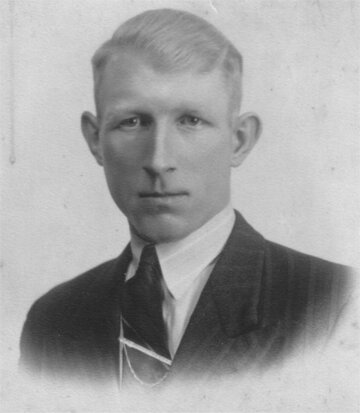 | |||||||||||||||||||||||||||||||||||
Sources
Historical events
Birthday September 16, 1925
- The temperature on September 16, 1925 was between 5.0 °C and 19.2 °C and averaged 12.6 °C. There was 1.1 mm of rain. There was 6.1 hours of sunshine (48%). The average windspeed was 4 Bft (moderate breeze) and was prevailing from the south. Source: KNMI
- Koningin Wilhelmina (Huis van Oranje-Nassau) was from 1890 till 1948 sovereign of the Netherlands (also known as Koninkrijk der Nederlanden)
- In The Netherlands , there was from September 19, 1922 to August 4, 1925 the cabinet Ruys de Beerenbrouck II, with Jonkheer mr. Ch.J.M. Ruys de Beerenbrouck (RKSP) as prime minister.
- In The Netherlands , there was from August 4, 1925 to March 8, 1926 the cabinet Colijn I, with Dr. H. Colijn (ARP) as prime minister.
- In the year 1925: Source: Wikipedia
- The Netherlands had about 7.3 million citizens.
- January 3 » Benito Mussolini announces he is taking dictatorial powers over Italy.
- April 4 » The Schutzstaffel (SS) is founded under Adolf Hitler's Nazi party in Germany.
- April 10 » The Great Gatsby by F. Scott Fitzgerald is first published in New York City, by Charles Scribner's Sons.
- July 10 » Scopes Trial: In Dayton, Tennessee, the so-called "Monkey Trial" begins of John T. Scopes, a young high school science teacher accused of teaching evolution in violation of the Butler Act.
- July 25 » Telegraph Agency of the Soviet Union (TASS) is established.
- October 30 » John Logie Baird creates Britain's first television transmitter.
Day of marriage June 24, 1944
- The temperature on June 24, 1944 was between 6.8 °C and 16.6 °C and averaged 11.8 °C. There was 7.8 hours of sunshine (47%). The average windspeed was 2 Bft (weak wind) and was prevailing from the west-northwest. Source: KNMI
- Koningin Wilhelmina (Huis van Oranje-Nassau) was from 1890 till 1948 sovereign of the Netherlands (also known as Koninkrijk der Nederlanden)
- In The Netherlands , there was from July 27, 1941 to February 23, 1945 the cabinet Gerbrandy II, with Prof. dr. P.S. Gerbrandy (ARP) as prime minister.
- In the year 1944: Source: Wikipedia
- The Netherlands had about 9.1 million citizens.
- January 22 » World War II: The Allies commence Operation Shingle, an assault on Anzio and Nettuno, Italy.
- February 20 » World War II: The United States takes Eniwetok Island.
- June 20 » Continuation War: The Soviet Union demands an unconditional surrender from Finland during the beginning of partially successful Vyborg-Petrozavodsk Offensive. The Finnish government refuses.
- July 9 » World War II: Continuation War: Finland wins the Battle of Tali-Ihantala, the largest battle ever fought in northern Europe. The Red Army withdraws its troops from Ihantala and digs into a defensive position, thus ending the Vyborg–Petrozavodsk Offensive.
- October 13 » World War II: The Soviet Riga Offensive captures the city.
- December 3 » Greek Civil War: Fighting breaks out in Athens between the ELAS and government forces supported by the British Army.
Day of death December 12, 1947
- The temperature on December 12, 1947 was between 3.8 °C and 8.9 °C and averaged 7.1 °C. There was 0.8 mm of rain during 1.3 hours. The average windspeed was 3 Bft (moderate breeze) and was prevailing from the northwest. Source: KNMI
- Koningin Wilhelmina (Huis van Oranje-Nassau) was from 1890 till 1948 sovereign of the Netherlands (also known as Koninkrijk der Nederlanden)
- In The Netherlands , there was from July 3, 1946 to August 7, 1948 the cabinet Beel I, with Dr. L.J.M. Beel (KVP) as prime minister.
- In the year 1947: Source: Wikipedia
- The Netherlands had about 9.5 million citizens.
- March 8 » Thirteen thousand troops of the Republic of China Army arrive in Taiwan after the February 28 Incident and launch crackdowns which kill thousands of people, including many elites. This turns into a major root of the Taiwan independence movement.
- March 29 » Malagasy Uprising against French colonial rule in Madagascar.
- June 5 » Cold War: Marshall Plan: In a speech at Harvard University, the United States Secretary of State George Marshall calls for economic aid to war-torn Europe.
- July 6 » Referendum held in Sylhet to decide its fate in the Partition of India.
- September 30 » Pakistan joins the United Nations.
- October 14 » Chuck Yeager becomes the first person to exceed the speed of sound.
Same birth/death day
- 1924 » Lauren Bacall, American actress († 2014)
- 1925 » B.B. King, American singer-songwriter, guitarist, and producer († 2015)
- 1925 » Charles Haughey, Irish accountant, lawyer, and politician, 7th Taoiseach of Ireland († 2006)
- 1925 » Charlie Byrd, American singer and guitarist († 1999)
- 1926 » Eric Gross, Austrian-Australian pianist and composer († 2011)
- 1926 » John Knowles, American novelist († 2001)
- 1934 » Thorleif Haug, Norwegian skier (b. 1894)
- 1939 » Douglas Fairbanks, Sr., American actor, producer, and screenwriter (b. 1883)
- 1941 » César Basa, Filipino lieutenant and pilot (b. 1915)
- 1951 » Mildred Bailey, American singer (b. 1907)
- 1952 » Bedřich Hrozný, Czech orientalist and linguist (b. 1879)
- 1958 » Albert Walsh, Canadian lawyer and politician, 1st Lieutenant Governor of Newfoundland (b. 1900)
About the surname Laan
- View the information that Genealogie Online has about the surname Laan.
- Check the information Open Archives has about Laan.
- Check the Wie (onder)zoekt wie? register to see who is (re)searching Laan.
The Family tree Nijborg publication was prepared by Dick Nijborg.
When copying data from this family tree, please include a reference to the origin:
Dick Nijborg, "Family tree Nijborg", database, Genealogy Online (https://www.genealogieonline.nl/stamboom-nijborg/I435.php : accessed February 14, 2026), "Geertruida Jantina van der Laan (1925-1947)".
Dick Nijborg, "Family tree Nijborg", database, Genealogy Online (https://www.genealogieonline.nl/stamboom-nijborg/I435.php : accessed February 14, 2026), "Geertruida Jantina van der Laan (1925-1947)".