Family tree Menting » Antonius Gerardus Menting (1950-1956)
Personal data Antonius Gerardus Menting
- He was born on March 6, 1950 in Nijmegen.
- Fact: Overlijden.
Verdronken bij een zwempartij te Nijmegen in een grindgat.
- He died on June 2, 1956 in Nijmegen, he was 6 years old.Source 1
Begraven op het RK kerkhof 'Jonkerbos'.
Oorzaak: Verdrinking
- He is buried on June 5, 1956 in Nijmegen.
- The birth parents are Lambertus Wilhelmus Menting and Everdina Johanna Maria Hurenkamp
- This information was last updated on March 16, 2008.
Household of Antonius Gerardus Menting
Timeline Antonius Gerardus Menting
This functionality is only available in Javascript supporting browsers.
Click on the names for more info.
Symbols used:  grandparents
 parents
 brothers/sisters
 children
grandparents
parents
brothers/sisters
children
Image(s) Antonius Gerardus Menting

Ancestors (and descendant) of Antonius Gerardus Menting
Antonius Gerardus Menting 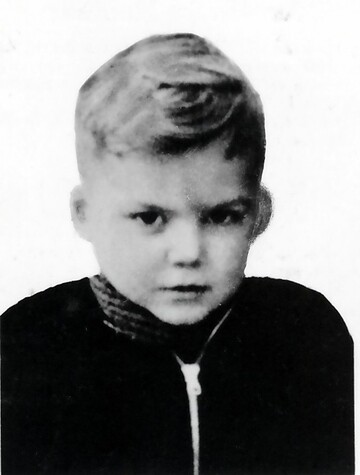 | ||||||||||||||||||
Sources
Historical events
Birthday March 6, 1950
- The temperature on March 6, 1950 was between 1.6 °C and 11.2 °C and averaged 7.8 °C. The average windspeed was 2 Bft (weak wind) and was prevailing from the east-northeast. Source: KNMI
- Koningin Juliana (Huis van Oranje-Nassau) was from September 4, 1948 till April 30, 1980 sovereign of the Netherlands (also known as Koninkrijk der Nederlanden)
- From August 7, 1948 till March 15, 1951 the Netherlands had a cabinet Drees - Van Schaik with the prime ministers Dr. W. Drees (PvdA) and Mr. J.R.H. van Schaik (KVP).
- In the year 1950: Source: Wikipedia
- The Netherlands had about 10.0 million citizens.
- January 6 » The United Kingdom recognizes the People's Republic of China. The Republic of China severs diplomatic relations with the UK in response.
- January 13 » British submarine HMSTruculent collides with an oil tanker in the Thames Estuary, killing 64 men.
- October 11 » CBS's field-sequential color system for television is the first to be licensed for broadcast by the U.S. Federal Communications Commission.
- October 21 » Korean War: Heavy fighting begins between British and Australian forces against the North Koreans during the Battle of Yongju.
- November 19 » US General Dwight D. Eisenhower becomes Supreme Commander of NATO-Europe.
- November 25 » The Great Appalachian Storm of November 1950 impacts 22 American states, killing 353 people, injuring over 160, and causing US$66.7 million in damages (1950 dollars).
Day of death June 2, 1956
- The temperature on June 2, 1956 was between 6.5 °C and 20.9 °C and averaged 14.4 °C. There was 12.8 hours of sunshine (78%). The partly clouded was. The average windspeed was 4 Bft (moderate breeze) and was prevailing from the southwest. Source: KNMI
- Koningin Juliana (Huis van Oranje-Nassau) was from September 4, 1948 till April 30, 1980 sovereign of the Netherlands (also known as Koninkrijk der Nederlanden)
- In The Netherlands , there was from September 2, 1952 to October 13, 1956 the cabinet Drees II, with Dr. W. Drees (PvdA) as prime minister.
- In The Netherlands , there was from October 13, 1956 to December 22, 1957 the cabinet Drees III, with Dr. W. Drees (PvdA) as prime minister.
- In the year 1956: Source: Wikipedia
- The Netherlands had about 10.8 million citizens.
- March 1 » The International Air Transport Association finalizes a draft of the Radiotelephony spelling alphabet for the International Civil Aviation Organization.
- June 11 » Start of Gal Oya riots, the first reported ethnic riots that target minority Sri Lankan Tamils in the Eastern Province. The total number of deaths is reportedly 150.
- October 15 » FORTRAN, the first modern computer language, is first shared with the coding community.
- October 19 » The Soviet Union and Japan sign a Joint Declaration, officially ending the state of war between the two countries that had existed since August 1945.
- October 28 » Hungarian Revolution: A de facto ceasefire comes into effect between armed revolutionaries and Soviet troops, who begin to withdraw from Budapest. Communist officials and facilities come under attack by revolutionaries.
- November 1 » The Indian states Kerala, Andhra Pradesh, and Mysore are formally created under the States Reorganisation Act; Kanyakumari district is joined to Tamil Nadu from Kerala.
Day of burial June 5, 1956
- The temperature on June 5, 1956 was between 5.0 °C and 17.5 °C and averaged 12.6 °C. There was 0.3 mm of rain during 0.7 hours. There was 13.7 hours of sunshine (83%). The partly clouded was. The average windspeed was 4 Bft (moderate breeze) and was prevailing from the southwest. Source: KNMI
- Koningin Juliana (Huis van Oranje-Nassau) was from September 4, 1948 till April 30, 1980 sovereign of the Netherlands (also known as Koninkrijk der Nederlanden)
- In The Netherlands , there was from September 2, 1952 to October 13, 1956 the cabinet Drees II, with Dr. W. Drees (PvdA) as prime minister.
- In The Netherlands , there was from October 13, 1956 to December 22, 1957 the cabinet Drees III, with Dr. W. Drees (PvdA) as prime minister.
- In the year 1956: Source: Wikipedia
- The Netherlands had about 10.8 million citizens.
- April 26 » SSIdeal X, the world's first successful container ship, leaves Port Newark, New Jersey, for Houston, Texas.
- May 1 » The polio vaccine developed by Jonas Salk is made available to the public.
- October 28 » Hungarian Revolution: A de facto ceasefire comes into effect between armed revolutionaries and Soviet troops, who begin to withdraw from Budapest. Communist officials and facilities come under attack by revolutionaries.
- November 4 » Soviet troops enter Hungary to end the Hungarian revolution against the Soviet Union that started on October 23. Thousands are killed, more are wounded, and nearly a quarter million leave the country.
- November 7 » Hungarian Revolution: János Kádár returns to Budapest in a Soviet armored convoy, officially taking office as the next Hungarian leader. By this point, most armed resistance has been defeated.
- November 13 » The Supreme Court of the United States declares Alabama laws requiring segregated buses illegal, thus ending the Montgomery Bus Boycott.
Same birth/death day
- 1948 » Stephen Schwartz, American composer and producer
- 1949 » Martin Buchan, Scottish footballer and manager
- 1949 » Shaukat Aziz, Pakistani economist and politician, 15th Prime Minister of Pakistan
- 1950 » Arthur Roche, English archbishop
- 1951 » Gerrie Knetemann, Dutch cyclist († 2004)
- 1952 » Denis Napthine, Australian politician, 47th Premier of Victoria
- 1948 » Viktor Brack, German physician (b. 1904)
- 1952 » Naum Torbov, Bulgarian architect, designed the Central Sofia Market Hall (b. 1880)
- 1956 » Jean Hersholt, Danish-American actor and director (b. 1886)
- 1959 » Lyda Borelli, Italian actress (b. 1884)
- 1961 » George S. Kaufman, American director, producer, and playwright (b. 1889)
- 1962 » Vita Sackville-West, English author and poet (b. 1892)
About the surname Menting
- View the information that Genealogie Online has about the surname Menting.
- Check the information Open Archives has about Menting.
- Check the Wie (onder)zoekt wie? register to see who is (re)searching Menting.
The Family tree Menting publication was prepared by Peter Menting.
When copying data from this family tree, please include a reference to the origin:
Peter Menting, "Family tree Menting", database, Genealogy Online (https://www.genealogieonline.nl/stamboom-menting/I813.php : accessed February 19, 2026), "Antonius Gerardus Menting (1950-1956)".
Peter Menting, "Family tree Menting", database, Genealogy Online (https://www.genealogieonline.nl/stamboom-menting/I813.php : accessed February 19, 2026), "Antonius Gerardus Menting (1950-1956)".