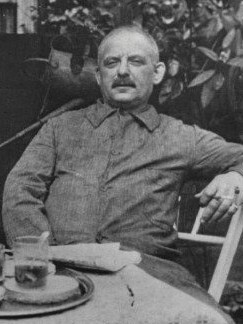
Family tree Lobé en verwanten. » Hartog Lobe (1885-1942)
Personal data Hartog Lobe
- He was born on February 27, 1885 in Amsterdam.
- He died (WAR) on August 28, 1942 in Auschwiz (Polen), he was 57 years old.
Oorzaak: Oorlogsslachtoffer
- A child of Daniel Lobé OR Lobe and Rachel de Hoop
Household of Hartog Lobe
He is married to Marianne Lelie.
They got married on August 1, 1907 at Amsterdam, he was 22 years old.
Timeline Hartog Lobe
This functionality is only available in Javascript supporting browsers.
Click on the names for more info.
Symbols used:  grandparents
 parents
 brothers/sisters
 children
grandparents
parents
brothers/sisters
children
Ancestors (and descendant) of Hartog Lobe
Hartog Lobe | ||||||||||||||||||
1907 | ||||||||||||||||||
Marianne Lelie | ||||||||||||||||||

The data shown has no sources.
Matches in other publications
This person also appears in the publication: View all
Historical events
Birthday February 27, 1885
- The temperature on February 27, 1885 was about 8.3 °C. The air pressure was 2 kgf/m2 and came mainly from the south-southwest. The airpressure was 76 cm mercury. The atmospheric humidity was 92%. Source: KNMI
- Koning Willem III (Huis van Oranje-Nassau) was from 1849 till 1890 sovereign of the Netherlands (also known as Koninkrijk der Nederlanden)
- In The Netherlands , there was from April 23, 1884 to April 21, 1888 the cabinet Heemskerk, with Mr. J. Heemskerk Azn. (conservatief) as prime minister.
- In the year 1885: Source: Wikipedia
- The Netherlands had about 4.5 million citizens.
- February 5 » King Leopold II of Belgium establishes the Congo as a personal possession.
- May 2 » Cree and Assiniboine warriors win the Battle of Cut Knife, their largest victory over Canadian forces during the North-West Rebellion.
- June 3 » In the last military engagement fought on Canadian soil, the Cree leader, Big Bear, escapes the North-West Mounted Police.
- June 9 » Treaty of Tientsin is signed to end the Sino-French War, with China eventually giving up Tonkin and Annam – most of present-day Vietnam – to France.
- September 12 » Arbroath 36–0 Bon Accord, a world record scoreline in professional Association football.
- September 29 » The first practical public electric tramway in the world is opened in Blackpool, England.
Day of marriage August 1, 1907
- The temperature on August 1, 1907 was between 7.7 °C and 17.0 °C and averaged 12.8 °C. There was 7.4 hours of sunshine (48%). The average windspeed was 4 Bft (moderate breeze) and was prevailing from the west-northwest. Source: KNMI
- Koningin Wilhelmina (Huis van Oranje-Nassau) was from 1890 till 1948 sovereign of the Netherlands (also known as Koninkrijk der Nederlanden)
- In The Netherlands , there was from August 17, 1905 to February 11, 1908 the cabinet De Meester, with Mr. Th. de Meester (unie-liberaal) as prime minister.
- In the year 1907: Source: Wikipedia
- The Netherlands had about 5.6 million citizens.
- May 23 » The unicameral Parliament of Finland gathers for its first plenary session.
- June 14 » The National Association for Women's Suffrage succeeds in getting Norwegian women the right to vote in parliamentary elections.
- July 7 » Florenz Ziegfeld Jr. staged his first Follies on the roof of the New York Theater in New York City.
- August 3 » Judge Kenesaw Mountain Landis fines Standard Oil of Indiana a record $29.4million for illegal rebating to freight carriers; the conviction and fine are later reversed on appeal.
- December 16 » The American Great White Fleet begins its circumnavigation of the world.
- December 17 » Ugyen Wangchuck is crowned first King of Bhutan.
Day of death August 28, 1942
- The temperature on August 28, 1942 was between 17.5 °C and 28.5 °C and averaged 22.7 °C. There was 12.4 hours of sunshine (89%). The average windspeed was 2 Bft (weak wind) and was prevailing from the south east. Source: KNMI
- Koningin Wilhelmina (Huis van Oranje-Nassau) was from 1890 till 1948 sovereign of the Netherlands (also known as Koninkrijk der Nederlanden)
- In The Netherlands , there was from July 27, 1941 to February 23, 1945 the cabinet Gerbrandy II, with Prof. dr. P.S. Gerbrandy (ARP) as prime minister.
- In the year 1942: Source: Wikipedia
- The Netherlands had about 9.0 million citizens.
- January 30 » World War II: Battle of Ambon. Japanese forces invade the island of Ambon in the Dutch East Indies. Some 300 captured Allied troops are massacred at Laha airfield. Three-fourths of remaining POWs will not have survived by the end of the war, including 250 men who will be shipped to Hainan Island in South China Sea and never returned.
- February 19 » World War II: United States President Franklin D. Roosevelt signs executive order 9066, allowing the United States military to relocate Japanese Americans to internment camps.
- March 8 » World War II: Imperial Japanese Army forces gave ultimatum to Dutch East Indies Governor General Jonkheer Tjarda van Starkenborgh Stachouwer and KNIL Commander in Chief Lieutenant General Hein Ter Poorten, to unconditionally surrender.
- April 23 » World War II: Baedeker Blitz: German bombers hit Exeter, Bath and York in retaliation for the British raid on Lübeck.
- November 26 » Casablanca, the movie starring Humphrey Bogart and Ingrid Bergman, premieres in New York City.
- December 24 » World War II: French monarchist, Fernand Bonnier de La Chapelle, assassinates Vichy French Admiral François Darlan in Algiers, Algeria.
Same birth/death day
- 1881 » L. E. J. Brouwer, Dutch mathematician, philosopher, and academic († 1966)
- 1881 » Sveinn Björnsson, Danish-Icelandic lawyer and politician, 1st President of Iceland († 1952)
- 1886 » Hugo Black, American captain, jurist, and politician († 1971)
- 1887 » Pyotr Nesterov, Russian captain, pilot, and engineer († 1914)
- 1888 » Lotte Lehmann, German-American soprano and actress († 1976)
- 1888 » Roberto Assagioli, Italian psychiatrist and psychologist († 1974)
- 1934 » Edgeworth David, Welsh-Australian geologist and explorer (b. 1858)
- 1937 » George Prendergast, Australian politician, 28th Premier of Victoria (b. 1854)
- 1943 » Boris III of Bulgaria (b. 1894)
- 1943 » Georg Hellat, Estonian architect (b. 1870)
- 1955 » Emmett Till, American murder victim (b. 1941)
- 1959 » Bohuslav Martinů, Czech-American composer and educator (b. 1890)
About the surname Lobe
- View the information that Genealogie Online has about the surname Lobe.
- Check the information Open Archives has about Lobe.
- Check the Wie (onder)zoekt wie? register to see who is (re)searching Lobe.
The Family tree Lobé en verwanten. publication was prepared by Gé Lobé.
When copying data from this family tree, please include a reference to the origin:
Gé Lobé, "Family tree Lobé en verwanten.", database, Genealogy Online (https://www.genealogieonline.nl/stamboom-lobe/I85586.php : accessed February 14, 2026), "Hartog Lobe (1885-1942)".
Gé Lobé, "Family tree Lobé en verwanten.", database, Genealogy Online (https://www.genealogieonline.nl/stamboom-lobe/I85586.php : accessed February 14, 2026), "Hartog Lobe (1885-1942)".