Family tree Harpman » Bloeme Trompetter (1878-1922)
Personal data Bloeme Trompetter
Source 1- She was born on March 22, 1878 in Amsterdam, Noord-Holland, Nederland.Source 2
- She died on February 3, 1922 in Amsterdam, Noord-Holland, Nederland, she was 43 years old.Source 3
- This information was last updated on November 21, 2010.
Household of Bloeme Trompetter
She is married to Josua Harpman.
They got married on May 12, 1897 at Amsterdam, she was 19 years old.Source 4
Child(ren):
- Judith Harpman 1900-1943
- Maurits Harpman 1901-1944
- Elisabeth Harpman 1903-1943
- Willem Harpman 1905-1944
Ancestors (and descendant) of Bloeme Trompetter
Bloeme Trompetter | |||||||||||||||||||||||||||||||||||||||
1897 | |||||||||||||||||||||||||||||||||||||||
Josua Harpman 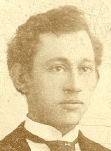 | |||||||||||||||||||||||||||||||||||||||
Sources
Matches in other publications
This person also appears in the publication: View all
Historical events
Birthday March 22, 1878
- The temperature on March 22, 1878 was about 7.4 °C. There was 0.6 mm of rain. The air pressure was 6 kgf/m2 and came mainly from the west-northwest. The airpressure was 76 cm mercury. The atmospheric humidity was 67%. Source: KNMI
- Koning Willem III (Huis van Oranje-Nassau) was from 1849 till 1890 sovereign of the Netherlands (also known as Koninkrijk der Nederlanden)
- In The Netherlands , there was from November 3, 1877 to August 20, 1879 the cabinet Kappeijne van de Coppello, with Mr. J. Kappeijne van de Coppello (liberaal) as prime minister.
- In the year 1878: Source: Wikipedia
- The Netherlands had about 4.0 million citizens.
- January 16 » Russo-Turkish War (1877–78): Battle of Philippopolis: Captain Aleksandr Burago with a squadron of Russian Imperial army dragoons liberates Plovdiv from Ottoman rule.
- February 19 » Thomas Edison patents the phonograph.
- March 3 » The Russo-Turkish War ends with Bulgaria regaining its independence from the Ottoman Empire according to the Treaty of San Stefano.
- May 25 » Gilbert and Sullivan's comic opera H.M.S. Pinafore opens at the Opera Comique in London.
- June 15 » Eadweard Muybridge takes a series of photographs to prove that all four feet of a horse leave the ground when it runs; the study becomes the basis of motion pictures.
- September 1 » Emma Nutt becomes the world's first female telephone operator when she is recruited by Alexander Graham Bell to the Boston Telephone Dispatch Company.
Day of marriage May 12, 1897
- The temperature on May 12, 1897 was about 5.1 °C. The airpressure was 76 cm mercury. The atmospheric humidity was 94%. Source: KNMI
- Koningin Wilhelmina (Huis van Oranje-Nassau) was from 1890 till 1948 sovereign of the Netherlands (also known as Koninkrijk der Nederlanden)
- Regentes Emma (Huis van Oranje-Nassau) was from 1890 till 1898 sovereign of the Netherlands (also known as Koninkrijk der Nederlanden)
- In The Netherlands , there was from May 9, 1894 to July 27, 1897 the cabinet Roëll, with Jonkheer mr. J. Roëll (oud-liberaal) as prime minister.
- In The Netherlands , there was from July 27, 1897 to August 1, 1901 the cabinet Pierson, with Mr. N.G. Pierson (unie-liberaal) as prime minister.
- In the year 1897: Source: Wikipedia
- The Netherlands had about 5.1 million citizens.
- January 31 » Czechoslav Trade Union Association is founded in Prague.
- April 18 » The Greco-Turkish War is declared between Greece and the Ottoman Empire.
- July 26 » Anglo-Afghan War: The Pashtun fakir Saidullah leads an army of more than 10,000 to begin a siege of the British garrison in the Malakand Agency of the North West Frontier Province of India.
- August 31 » Thomas Edison patents the Kinetoscope, the first movie projector.
- December 6 » London becomes the world's first city to host licensed taxicabs.
- December 9 » Activist Marguerite Durand founds the feminist daily newspaper La Fronde in Paris.
Day of death February 3, 1922
- The temperature on February 3, 1922 was between -5.6 °C and 8.1 °C and averaged 3.3 °C. There was 24.0 mm of rain. The average windspeed was 3 Bft (moderate breeze) and was prevailing from the west. Source: KNMI
- Koningin Wilhelmina (Huis van Oranje-Nassau) was from 1890 till 1948 sovereign of the Netherlands (also known as Koninkrijk der Nederlanden)
- In The Netherlands , there was from September 9, 1918 to September 18, 1922 the cabinet Ruys de Beerenbrouck I, with Jonkheer mr. Ch.J.M. Ruys de Beerenbrouck (RKSP) as prime minister.
- In The Netherlands , there was from September 19, 1922 to August 4, 1925 the cabinet Ruys de Beerenbrouck II, with Jonkheer mr. Ch.J.M. Ruys de Beerenbrouck (RKSP) as prime minister.
- In the year 1922: Source: Wikipedia
- The Netherlands had about 7.0 million citizens.
- February 6 » The Washington Naval Treaty is signed in Washington, D.C., limiting the naval armaments of United States, Britain, Japan, France, and Italy.
- April 15 » U.S. Senator John B. Kendrick of Wyoming introduces a resolution calling for an investigation of a secret land deal, which leads to the discovery of the Teapot Dome scandal.
- September 9 » The Greco-Turkish War effectively ends with Turkish victory over the Greeks in Smyrna.
- September 18 » The Kingdom of Hungary is admitted to the League of Nations.
- December 6 » One year to the day after the signing of the Anglo-Irish Treaty, the Irish Free State comes into existence.
- December 7 » The Parliament of Northern Ireland votes to remain a part of the United Kingdom and not unify with Southern Ireland.
Same birth/death day
- 1873 » Ernest Lawson, Canadian-American painter († 1939)
- 1880 » Ernest C. Quigley, Canadian-American football player and coach († 1960)
- 1884 » Arthur H. Vandenberg, American journalist and politician († 1951)
- 1884 » Lyda Borelli, Italian actress († 1959)
- 1885 » Aryeh Levin, Polish-Lithuanian rabbi and educator († 1969)
- 1886 » August Rei, Estonian lawyer and politician, Head of State of Estonia († 1963)
- 1922 » John Butler Yeats, Irish painter and illustrator (b. 1839)
- 1924 » Woodrow Wilson, American historian, academic, and politician, 28th President of the United States, Nobel Prize laureate (b. 1856)
- 1929 » Agner Krarup Erlang, Danish mathematician and engineer (b. 1878)
- 1935 » Hugo Junkers, German engineer, designed the Junkers J 1 (b. 1859)
- 1944 » Yvette Guilbert, French singer and actress (b. 1865)
- 1945 » Roland Freisler, German lawyer and judge (b. 1893)
About the surname Trompetter
- View the information that Genealogie Online has about the surname Trompetter.
- Check the information Open Archives has about Trompetter.
- Check the Wie (onder)zoekt wie? register to see who is (re)searching Trompetter.
The Family tree Harpman publication was prepared by J. Harpman.
When copying data from this family tree, please include a reference to the origin:
J. Harpman, "Family tree Harpman", database, Genealogy Online (https://www.genealogieonline.nl/stamboom-harpman/I124.php : accessed March 3, 2026), "Bloeme Trompetter (1878-1922)".
J. Harpman, "Family tree Harpman", database, Genealogy Online (https://www.genealogieonline.nl/stamboom-harpman/I124.php : accessed March 3, 2026), "Bloeme Trompetter (1878-1922)".