Family tree Eijskoot » Simon Isaac Elze (1870-1937)
Personal data Simon Isaac Elze
- He was born on October 27, 1870 in Rotterdam.
- He died on October 21, 1937 in Rotterdam, he was 66 years old.
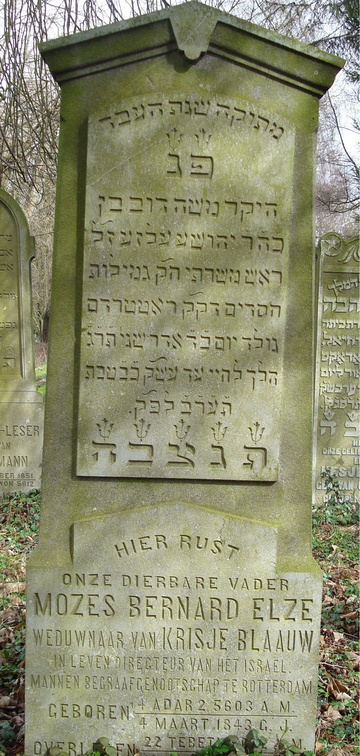
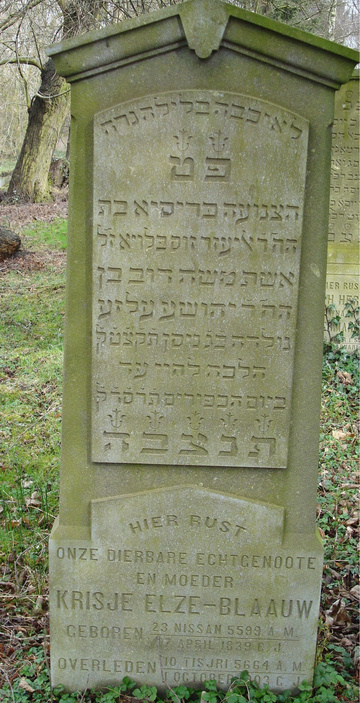
- A child of Mozes Bernard Elze and Krisje Blaauw
Household of Simon Isaac Elze
He is married to Sebilla de Wied.
They got married.
Child(ren):
- Christine Mietje Elze 1898-1942
- Mozes Bernard Elze 1901-1943
- Mariëtte Elze 1907-1982
Timeline Simon Isaac Elze
This functionality is only available in Javascript supporting browsers.
Click on the names for more info.
Symbols used:  grandparents
 parents
 brothers/sisters
 children
grandparents
parents
brothers/sisters
children


The data shown has no sources.
Historical events
Birthday October 27, 1870
- The temperature on October 27, 1870 was about 10.3 °C. There was 2 mm of rain. The air pressure was 10 kgf/m2 and came mainly from the west-southwest. The airpressure was 75 cm mercury. The atmospheric humidity was 79%. Source: KNMI
- Koning Willem III (Huis van Oranje-Nassau) was from 1849 till 1890 sovereign of the Netherlands (also known as Koninkrijk der Nederlanden)
- From June 4, 1868 till January 4, 1871 the Netherlands had a cabinet Van Bosse - Fock with the prime ministers Mr. P.P. van Bosse (liberaal) and Mr. C. Fock (liberaal).
- In the year 1870: Source: Wikipedia
- The Netherlands had about 3.6 million citizens.
- February 9 » US president Ulysses S. Grant signs a joint resolution of Congress establishing the U.S. Weather Bureau.
- February 28 » The Bulgarian Exarchate is established by decree of Sultan Abdülaziz of the Ottoman Empire.
- March 30 » Texas is readmitted to the United States Congress following Reconstruction.
- July 18 » The First Vatican Council decrees the dogma of papal infallibility.
- September 4 » Emperor Napoleon III of France is deposed and the Third Republic is declared.
- September 20 » The Bersaglieri corps enter Rome through the Porta Pia, and complete the unification of Italy.
Day of death October 21, 1937
- The temperature on October 21, 1937 was between 2.1 °C and 13.4 °C and averaged 8.1 °C. There was 0.2 mm of rain. There was 3.3 hours of sunshine (32%). The average windspeed was 3 Bft (moderate breeze) and was prevailing from the south east. Source: KNMI
- Koningin Wilhelmina (Huis van Oranje-Nassau) was from 1890 till 1948 sovereign of the Netherlands (also known as Koninkrijk der Nederlanden)
- In The Netherlands , there was from July 31, 1935 to June 24, 1937 the cabinet Colijn III, with Dr. H. Colijn (ARP) as prime minister.
- In The Netherlands , there was from June 24, 1937 to July 25, 1939 the cabinet Colijn IV, with Dr. H. Colijn (ARP) as prime minister.
- In the year 1937: Source: Wikipedia
- The Netherlands had about 8.6 million citizens.
- January 19 » Howard Hughes sets a new air record by flying from Los Angeles to New York City in 7 hours, 28 minutes, 25 seconds.
- April 1 » The Royal New Zealand Air Force is formed as an independent service.
- June 14 » Pennsylvania becomes the first (and only) state of the United States to celebrate Flag Day officially as a state holiday.
- July 2 » Amelia Earhart and navigator Fred Noonan are last heard from over the Pacific Ocean while attempting to make the first equatorial round-the-world flight.
- July 29 » Tōngzhōu Incident: In Tōngzhōu, China, the East Hopei Army attacks Japanese troops and civilians.
- September 25 » Second Sino-Japanese War: The Chinese Eighth Route Army gains a minor, but morale-boosting victory in the Battle of Pingxingguan.
Same birth/death day
- 1858 » Elliott Lewis, Australian politician, 19th Premier of Tasmania († 1935)
- 1858 » Saitō Makoto, Japanese admiral and politician, 30th Prime Minister of Japan († 1936)
- 1865 » Charles Spencelayh, English painter and academic († 1958)
- 1868 » William Gillies, Australian politician, 21st Premier of Queensland († 1928)
- 1877 » George Thompson, English cricketer and umpire († 1943)
- 1877 » Walt Kuhn, American painter and academic († 1949)
- 1931 » Arthur Schnitzler, Austrian author and playwright (b. 1862)
- 1938 » Dorothy Hale, American actress (b. 1905)
- 1940 » William G. Conley, American journalist, lawyer, and politician, 18th Governor of West Virginia (b. 1866)
- 1941 » Alexander Greenlaw Hamilton, Australian biologist (b. 1852)
- 1944 » Alois Kayser, German-French missionary (b. 1877)
- 1952 » Hans Merensky, South African geologist and philanthropist (b. 1871)
About the surname Elze
- View the information that Genealogie Online has about the surname Elze.
- Check the information Open Archives has about Elze.
- Check the Wie (onder)zoekt wie? register to see who is (re)searching Elze.
The Family tree Eijskoot publication was prepared by Leo Eijskoot.
When copying data from this family tree, please include a reference to the origin:
Leo Eijskoot, "Family tree Eijskoot", database, Genealogy Online (https://www.genealogieonline.nl/stamboom-eijskoot/I505312.php : accessed March 10, 2026), "Simon Isaac Elze (1870-1937)".
Leo Eijskoot, "Family tree Eijskoot", database, Genealogy Online (https://www.genealogieonline.nl/stamboom-eijskoot/I505312.php : accessed March 10, 2026), "Simon Isaac Elze (1870-1937)".