Family tree Eijskoot » Marrigje van der Tak (1871-1910)
Personal data Marrigje van der Tak
- She was born on November 22, 1871.
- She died on April 6, 1910, she was 38 years old.
- A child of Johannes van der Tak and Aaltje Zwijnenburg
Household of Marrigje van der Tak
She is married to Evert Romijn.
They got married on April 16, 1892 at Sliedrecht, she was 20 years old.
Child(ren):
- Aartje Romijn 1893-1894
- Gerrigje Romijn 1896-1903
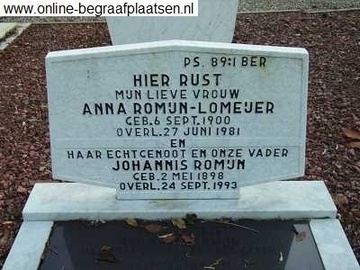
- Johannes Romijn 1898-1993
- Evert Romijn 1900-1902
- Evert Romijn 1903-
- Gerrigje Romijn 1907-1995
- Willem Romijn 1910-
Timeline Marrigje van der Tak
This functionality is only available in Javascript supporting browsers.
Click on the names for more info.
Symbols used:  grandparents
 parents
 brothers/sisters
 children
grandparents
parents
brothers/sisters
children
Ancestors (and descendant) of Marrigje van der Tak
Marrigje van der Tak | ||||||||||||||||||||||||||||||||||||||||||||||||||||||||||||||||||||||||
1892 | ||||||||||||||||||||||||||||||||||||||||||||||||||||||||||||||||||||||||
Evert Romijn | ||||||||||||||||||||||||||||||||||||||||||||||||||||||||||||||||||||||||
The data shown has no sources.
Historical events
Birthday November 22, 1871
- The temperature on November 22, 1871 was about -1.0 °C. The atmospheric humidity was 88%. Source: KNMI
- Koning Willem III (Huis van Oranje-Nassau) was from 1849 till 1890 sovereign of the Netherlands (also known as Koninkrijk der Nederlanden)
- From June 4, 1868 till January 4, 1871 the Netherlands had a cabinet Van Bosse - Fock with the prime ministers Mr. P.P. van Bosse (liberaal) and Mr. C. Fock (liberaal).
- In The Netherlands , there was from January 4, 1871 to July 6, 1872 the cabinet Thorbecke III, with Mr. J.R. Thorbecke (liberaal) as prime minister.
- In the year 1871: Source: Wikipedia
- The Netherlands had about 4.0 million citizens.
- January 28 » Franco-Prussian War: The Siege of Paris ends in French defeat and an armistice.
- March 22 » In North Carolina, William Woods Holden becomes the first governor of a U.S. state to be removed from office by impeachment.
- March 28 » The Paris Commune is formally established in Paris.
- April 30 » The Camp Grant massacre takes place in Arizona Territory.
- May 21 » French troops invade the Paris Commune and engage its residents in street fighting. By the close of "Bloody Week", some 20,000 communards have been killed and 38,000 arrested.
- July 29 » The Connecticut Valley Railroad opens between Old Saybrook, Connecticut and Hartford, Connecticut in the United States.
Day of marriage April 16, 1892
- The temperature on April 16, 1892 was about 2.3 °C. There was 0.9 mm of rain. The airpressure was 75 cm mercury. The atmospheric humidity was 96%. Source: KNMI
- Koningin Wilhelmina (Huis van Oranje-Nassau) was from 1890 till 1948 sovereign of the Netherlands (also known as Koninkrijk der Nederlanden)
- Regentes Emma (Huis van Oranje-Nassau) was from 1890 till 1898 sovereign of the Netherlands (also known as Koninkrijk der Nederlanden)
- In The Netherlands , there was from August 21, 1891 to May 9, 1894 the cabinet Van Tienhoven, with Mr. G. van Tienhoven (unie-liberaal) as prime minister.
- In the year 1892: Source: Wikipedia
- The Netherlands had about 5.1 million citizens.
- January 1 » Ellis Island begins processing immigrants into the United States.
- January 15 » James Naismith publishes the rules of basketball.
- July 6 » Three thousand eight hundred striking steelworkers engage in a day-long battle with Pinkerton agents during the Homestead Strike, leaving ten dead and dozens wounded.
- September 8 » The Pledge of Allegiance is first recited.
- September 22 » Lindal Railway Incident, providing inspiration for "The Lost Special" by A.C. Doyle and the TV serial Lost.
- October 13 » Edward Emerson Barnard discovers first comet discovered by photographic means.
Day of death April 6, 1910
- The temperature on April 6, 1910 was between 5.3 °C and 14.0 °C and averaged 8.7 °C. There was 4.5 hours of sunshine (34%). The average windspeed was 4 Bft (moderate breeze) and was prevailing from the northeast. Source: KNMI
- Koningin Wilhelmina (Huis van Oranje-Nassau) was from 1890 till 1948 sovereign of the Netherlands (also known as Koninkrijk der Nederlanden)
- In The Netherlands , there was from February 12, 1908 to August 29, 1913 the cabinet Heemskerk, with Mr. Th. Heemskerk (AR) as prime minister.
- In the year 1910: Source: Wikipedia
- The Netherlands had about 5.9 million citizens.
- January 13 » The first public radio broadcast takes place; a live performance of the operas Cavalleria rusticana and Pagliacci are sent out over the airwaves from the Metropolitan Opera House in New York.
- June 25 » The United States Congress passes the Mann Act, which prohibits interstate transport of women or girls for “immoral purposes”; the ambiguous language would be used to selectively prosecute people for years to come.
- July 24 » The Ottoman Empire captures the city of Shkodër, putting down the Albanian Revolt of 1910.
- October 20 » The hull of the RMSOlympic, sister-ship to the ill-fated RMS Titanic, is launched from the Harland and Wolff shipyard in Belfast.
- November 14 » Aviator Eugene Burton Ely performs the first takeoff from a ship in Hampton Roads, Virginia, taking off from a makeshift deck on the USS Birmingham in a Curtiss pusher.
- November 20 » Mexican Revolution: Francisco I. Madero issues the Plan de San Luis Potosí, denouncing Mexican President Porfirio Díaz, calling for a revolution to overthrow the government of Mexico, effectively starting the Mexican Revolution.
Same birth/death day
- 1868 » John Nance Garner, American lawyer and politician, 32nd Vice President of the United States († 1967)
- 1869 » André Gide, French novelist, essayist, and dramatist, Nobel Prize laureate († 1951)
- 1870 » Harry Graham, Australian cricketer († 1911)
- 1870 » Howard Brockway, American pianist, composer, and educator († 1951)
- 1873 » Johnny Tyldesley, English cricketer († 1930)
- 1873 » Leo Amery, Indian-English journalist and politician, Secretary of State for the Colonies († 1955)
- 1886 » William Edward Forster, English businessman, philanthropist, and politician, Chief Secretary for Ireland (b. 1818)
- 1899 » Alvan Wentworth Chapman, American physician and botanist (b. 1809)
- 1906 » Alexander Kielland, Norwegian author, playwright, and politician, 6th County Governor of Møre og Romsdal (b. 1849)
- 1913 » Somerset Lowry-Corry, 4th Earl Belmore (b. 1835)
- 1923 » Kabalega, King of Bunyoro (b.1853)
- 1927 » Florence Earle Coates, American poet (b. 1850)
About the surname Van der Tak
- View the information that Genealogie Online has about the surname Van der Tak.
- Check the information Open Archives has about Van der Tak.
- Check the Wie (onder)zoekt wie? register to see who is (re)searching Van der Tak.
The Family tree Eijskoot publication was prepared by Leo Eijskoot.
When copying data from this family tree, please include a reference to the origin:
Leo Eijskoot, "Family tree Eijskoot", database, Genealogy Online (https://www.genealogieonline.nl/stamboom-eijskoot/I501538.php : accessed March 4, 2026), "Marrigje van der Tak (1871-1910)".
Leo Eijskoot, "Family tree Eijskoot", database, Genealogy Online (https://www.genealogieonline.nl/stamboom-eijskoot/I501538.php : accessed March 4, 2026), "Marrigje van der Tak (1871-1910)".