Family tree Eijskoot » Cornelia Petronella Busker (1892-1919)
Personal data Cornelia Petronella Busker
- She was born on May 6, 1892 in Uithoorn.
- She died on January 19, 1919 in 's-Gravenhage, she was 26 years old.
- A child of Martinus Busker and Pieternella Butot
Household of Cornelia Petronella Busker
She is married to Gerardus Cornelis Knijf.
They got married
Child(ren):
- Martinus Anthonius Knijf 1919-1919
Timeline Cornelia Petronella Busker
This functionality is only available in Javascript supporting browsers.
Click on the names for more info.
Symbols used:  grandparents
 parents
 brothers/sisters
 children
grandparents
parents
brothers/sisters
children
Ancestors (and descendant) of Cornelia Petronella Busker
Cornelia Petronella Busker 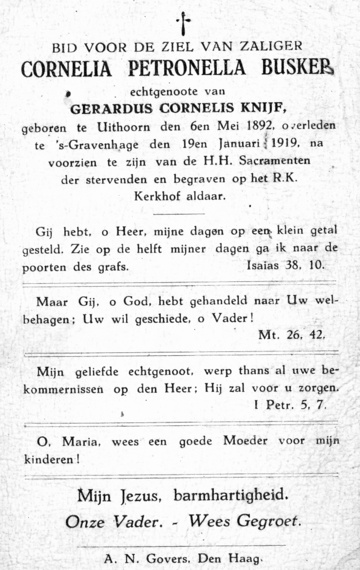 | ||||||||||||||||||||||||||||||||||
Gerardus Cornelis Knijf | ||||||||||||||||||||||||||||||||||
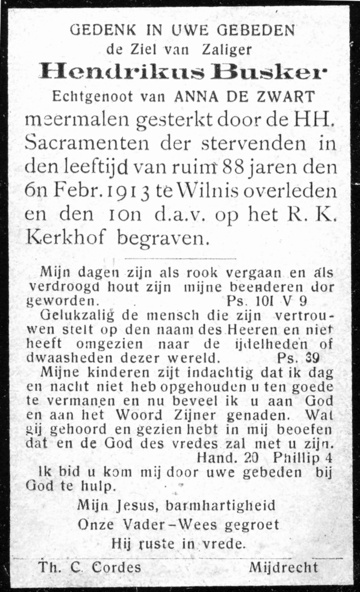
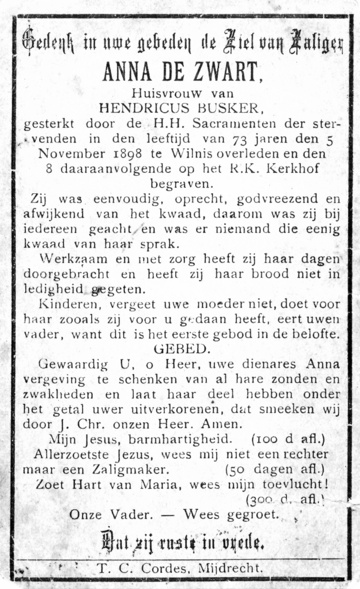
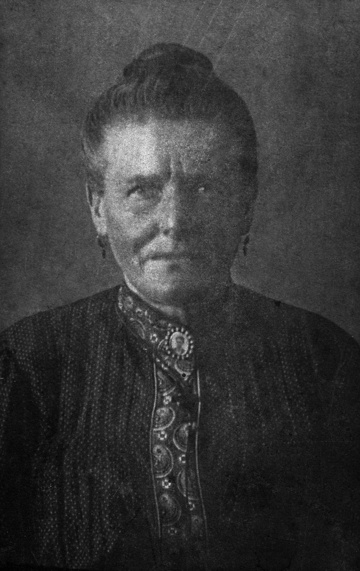
The data shown has no sources.
Matches in other publications
This person also appears in the publication: View all
Historical events
Birthday May 6, 1892
- The temperature on May 6, 1892 was about 5.2 °C. There was 0.4 mm of rain. The airpressure was 76 cm mercury. The atmospheric humidity was 77%. Source: KNMI
- Koningin Wilhelmina (Huis van Oranje-Nassau) was from 1890 till 1948 sovereign of the Netherlands (also known as Koninkrijk der Nederlanden)
- Regentes Emma (Huis van Oranje-Nassau) was from 1890 till 1898 sovereign of the Netherlands (also known as Koninkrijk der Nederlanden)
- In The Netherlands , there was from August 21, 1891 to May 9, 1894 the cabinet Van Tienhoven, with Mr. G. van Tienhoven (unie-liberaal) as prime minister.
- In the year 1892: Source: Wikipedia
- The Netherlands had about 5.1 million citizens.
- March 18 » Former Governor General Lord Stanley pledges to donate a silver challenge cup as an award for the best hockey team in Canada; it was later named after him as the Stanley Cup.
- June 7 » Homer Plessy is arrested for refusing to leave his seat in the "whites-only" car of a train; he lost the resulting court case, Plessy v. Ferguson.
- August 4 » The father and stepmother of Lizzie Borden are found murdered in their Fall River, Massachusetts home. She was tried and acquitted for the crimes a year later.
- August 9 » Thomas Edison receives a patent for a two-way telegraph.
- October 21 » Opening ceremonies for the World's Columbian Exposition are held in Chicago, though because construction was behind schedule, the exposition did not open until May 1, 1893.
- November 12 » Pudge Heffelfinger becomes the first professional American football player on record, participating in his first paid game for the Allegheny Athletic Association.
Day of death January 19, 1919
- The temperature on January 19, 1919 was between -1.5 °C and 6.8 °C and averaged 1.0 °C. There was 0.3 mm of rain. There was 3.1 hours of sunshine (37%). The average windspeed was 2 Bft (weak wind) and was prevailing from the west-southwest. Source: KNMI
- Koningin Wilhelmina (Huis van Oranje-Nassau) was from 1890 till 1948 sovereign of the Netherlands (also known as Koninkrijk der Nederlanden)
- In The Netherlands , there was from September 9, 1918 to September 18, 1922 the cabinet Ruys de Beerenbrouck I, with Jonkheer mr. Ch.J.M. Ruys de Beerenbrouck (RKSP) as prime minister.
- In the year 1919: Source: Wikipedia
- The Netherlands had about 6.7 million citizens.
- January 21 » A revolutionary Irish parliament is founded and declares the independence of the Irish Republic. One of the first engagements of the Irish War of Independence takes place.
- June 2 » Anarchists simultaneously set off bombs in eight separate U.S. cities.
- September 18 » Fritz Pollard becomes the first African American to play professional football for a major team, the Akron Pros.
- October 17 » RCA is incorporated as the Radio Corporation of America.
- November 28 » Lady Astor is elected as a Member of the Parliament of the United Kingdom. She is the first woman to sit in the House of Commons. (Countess Markievicz, the first to be elected, refused to sit.)
- December 21 » American anarchist Emma Goldman is deported to Russia.
Same birth/death day
- 1895 » Fidél Pálffy, Hungarian soldier and politician, Hungarian Minister of Agriculture († 1946)
- 1895 » Júlio César de Mello e Souza, Brazilian mathematician and author († 1974)
- 1895 » Rudolph Valentino, Italian actor († 1926)
- 1896 » Rolf Maximilian Sievert, Swedish physicist and academic († 1966)
- 1897 » Paul Alverdes, German author and poet († 1979)
- 1898 » Konrad Henlein, Czech soldier and politician († 1945)
- 1905 » Debendranath Tagore, Indian philosopher and author (b. 1817)
- 1906 » Bartolomé Mitre, Argentinian historian and politician, 6th President of Argentina (b. 1821)
- 1908 » Roberto Bompiani, Italian painter and sculptor (b. 1821)
- 1929 » Liang Qichao, Chinese journalist, philosopher, and scholar (b. 1873)
- 1930 » Frank P. Ramsey, British mathematician, philosopher and economist (b. 1903)
- 1938 » Branislav Nušić, Serbian author, playwright, and journalist (b. 1864)
About the surname Busker
- View the information that Genealogie Online has about the surname Busker.
- Check the information Open Archives has about Busker.
- Check the Wie (onder)zoekt wie? register to see who is (re)searching Busker.
The Family tree Eijskoot publication was prepared by Leo Eijskoot.
When copying data from this family tree, please include a reference to the origin:
Leo Eijskoot, "Family tree Eijskoot", database, Genealogy Online (https://www.genealogieonline.nl/stamboom-eijskoot/I3635.php : accessed January 17, 2026), "Cornelia Petronella Busker (1892-1919)".
Leo Eijskoot, "Family tree Eijskoot", database, Genealogy Online (https://www.genealogieonline.nl/stamboom-eijskoot/I3635.php : accessed January 17, 2026), "Cornelia Petronella Busker (1892-1919)".