Family tree Eijskoot » Hendrik Hansler (1876-1963)
Personal data Hendrik Hansler
- He was born on November 12, 1876 in Schiedam.
- He died on June 19, 1963, he was 86 years old.
Household of Hendrik Hansler
He is married to Martina Vrijenhoek.
They got married on February 10, 1897 at Schiedam, he was 20 years old.
Child(ren):
- Johanna Geertruida Hansler 1898-????
- Johannes Hansler 1899-????
- Helena Hansler 1901-
- Johann Diedrich Hansler 1903-
- Martina Hendrika Hansler 1904-1908
- Jansje Hansler 1906-1908
Ancestors (and descendant) of Hendrik Hansler
Hendrik Hansler 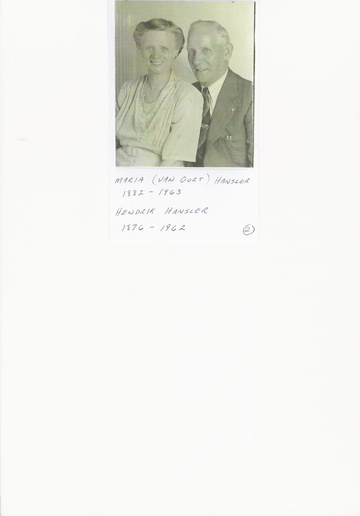 | |||||||||||||||||||||||||||||||||||||||
1897 | |||||||||||||||||||||||||||||||||||||||
Martina Vrijenhoek | |||||||||||||||||||||||||||||||||||||||
The data shown has no sources.
Matches in other publications
This person also appears in the publication: View all
Historical events
Birthday November 12, 1876
- The temperature on November 12, 1876 was about -1.0 °C. There was 0.4 mm of rain. The air pressure was 28 kgf/m2 and came mainly from the east-southeast. The airpressure was 75 cm mercury. The atmospheric humidity was 89%. Source: KNMI
- Koning Willem III (Huis van Oranje-Nassau) was from 1849 till 1890 sovereign of the Netherlands (also known as Koninkrijk der Nederlanden)
- From August 27, 1874 till November 3, 1877 the Netherlands had a cabinet Heemskerk - Van Lijnden van Sandenburg with the prime ministers Mr. J. Heemskerk Azn. (conservatief) and Mr. C.Th. baron Van Lijnden van Sandenburg (AR).
- In the year 1876: Source: Wikipedia
- The Netherlands had about 4.0 million citizens.
- February 14 » Alexander Graham Bell applies for a patent for the telephone, as does Elisha Gray.
- June 4 » An express train called the Transcontinental Express arrives in San Francisco, via the First Transcontinental Railroad only 83 hours and 39 minutes after leaving New York City.
- August 1 » Colorado is admitted as the 38th U.S. state.
- August 8 » Thomas Edison receives a patent for his mimeograph.
- November 23 » Corrupt Tammany Hall leader William Magear Tweed (better known as Boss Tweed) is delivered to authorities in New York City after being captured in Spain.
- December 29 » The Ashtabula River railroad disaster occurs, leaving 64 injured and 92 dead at Ashtabula, Ohio.
Day of marriage February 10, 1897
- The temperature on February 10, 1897 was about 2.4 °C. The airpressure was 76 cm mercury. The atmospheric humidity was 91%. Source: KNMI
- Koningin Wilhelmina (Huis van Oranje-Nassau) was from 1890 till 1948 sovereign of the Netherlands (also known as Koninkrijk der Nederlanden)
- Regentes Emma (Huis van Oranje-Nassau) was from 1890 till 1898 sovereign of the Netherlands (also known as Koninkrijk der Nederlanden)
- In The Netherlands , there was from May 9, 1894 to July 27, 1897 the cabinet Roëll, with Jonkheer mr. J. Roëll (oud-liberaal) as prime minister.
- In The Netherlands , there was from July 27, 1897 to August 1, 1901 the cabinet Pierson, with Mr. N.G. Pierson (unie-liberaal) as prime minister.
- In the year 1897: Source: Wikipedia
- The Netherlands had about 5.1 million citizens.
- February 1 » Shinhan Bank, the oldest bank in South Korea, opens in Seoul.
- April 30 » J. J. Thomson of the Cavendish Laboratory announces his discovery of the electron as a subatomic particle, over 1,800 times smaller than a proton (in the atomic nucleus), at a lecture at the Royal Institution in London.
- July 2 » British-Italian engineer Guglielmo Marconi obtains a patent for radio in London.
- August 21 » Oldsmobile, an American automobile manufacturer and marque, is founded.
- August 31 » Thomas Edison patents the Kinetoscope, the first movie projector.
- December 9 » Activist Marguerite Durand founds the feminist daily newspaper La Fronde in Paris.
Day of death June 19, 1963
- The temperature on June 19, 1963 was between 10.0 °C and 16.2 °C and averaged 12.6 °C. There was 0.8 mm of rain during 2.0 hours. There was 8.7 hours of sunshine (52%). The partly or heavily clouded was. The average windspeed was 4 Bft (moderate breeze) and was prevailing from the west-southwest. Source: KNMI
- Koningin Juliana (Huis van Oranje-Nassau) was from September 4, 1948 till April 30, 1980 sovereign of the Netherlands (also known as Koninkrijk der Nederlanden)
- In The Netherlands , there was from May 19, 1959 to July 24, 1964 the cabinet De Quay, with Prof. dr. J.E. de Quay (KVP) as prime minister.
- In The Netherlands , there was from July 24, 1963 to April 14, 1965 the cabinet Marijnen, with Mr. V.G.M. Marijnen (KVP) as prime minister.
- In the year 1963: Source: Wikipedia
- The Netherlands had about 11.9 million citizens.
- February 8 » Travel, financial and commercial transactions by United States citizens to Cuba are made illegal by the John F. Kennedy administration.
- July 24 » The ship Bluenose II was launched in Lunenburg, Nova Scotia. The schooner is a major Canadian symbol.
- September 25 » Lord Denning releases the UK government's official report on the Profumo affair.
- October 7 » President Kennedy signs the ratification of the Partial Nuclear Test Ban Treaty.
- November 25 » President John F. Kennedy is buried at Arlington National Cemetery in Arlington County, Virginia, across the Potomac River from Washington, D.C.; his assassin, Lee Harvey Oswald, is buried on the same day in Fort Worth, Texas.
- December 25 » Turkish Cypriot Bayrak Radio begins transmitting in Cyprus after Turkish Cypriots are forcibly excluded from Cyprus Broadcasting Corporation.
Same birth/death day
- 1866 » Sun Yat-sen, Chinese physician and politician, 1st President of the Republic of China († 1925)
- 1872 » William Fay, Irish actor and producer († 1947)
- 1881 » Maximilian von Weichs, German field marshal († 1954)
- 1881 » Olev Siinmaa, Estonian-Swedish architect († 1948)
- 1886 » Ben Travers, English author and playwright († 1980)
- 1886 » Günther Dyhrenfurth, German geologist and mountaineer († 1975)
- 1953 » Ethel Rosenberg, American spy (b. 1915)
- 1953 » Julius Rosenberg, American spy (b. 1918)
- 1956 » Thomas J. Watson, American businessman (b. 1874)
- 1962 » Frank Borzage, American film director and actor (b. 1894)
- 1966 » Ed Wynn, American actor and comedian (b. 1886)
- 1968 » James Joseph Sweeney, American bishop (b. 1898)
About the surname Hansler
- View the information that Genealogie Online has about the surname Hansler.
- Check the information Open Archives has about Hansler.
- Check the Wie (onder)zoekt wie? register to see who is (re)searching Hansler.
The Family tree Eijskoot publication was prepared by Leo Eijskoot.
When copying data from this family tree, please include a reference to the origin:
Leo Eijskoot, "Family tree Eijskoot", database, Genealogy Online (https://www.genealogieonline.nl/stamboom-eijskoot/I2029.php : accessed March 13, 2026), "Hendrik Hansler (1876-1963)".
Leo Eijskoot, "Family tree Eijskoot", database, Genealogy Online (https://www.genealogieonline.nl/stamboom-eijskoot/I2029.php : accessed March 13, 2026), "Hendrik Hansler (1876-1963)".