Family tree De Wit/Van der Loo » Willem de Wit (1924-1996)
Personal data Willem de Wit
- He was born on December 11, 1924 in Leiden.
Tijdstip: 22:00
- He died on August 7, 1996 in Den Helder, he was 71 years old.
- A child of Jacobus de Wit and Jacoba Bavelaar
- This information was last updated on January 20, 2024.
Household of Willem de Wit
He is married to Cornelisje (Corrie) Dienaar.
They got married on May 19, 1950 at Den Helder, he was 25 years old.
Child(ren):
- (Not public)
- (Not public)
- (Not public)
Timeline Willem de Wit
This functionality is only available in Javascript supporting browsers.
Click on the names for more info.
Symbols used:  grandparents
 parents
 brothers/sisters
 children
grandparents
parents
brothers/sisters
children
Image(s) Willem de Wit

Ancestors (and descendant) of Willem de Wit
Willem de Wit 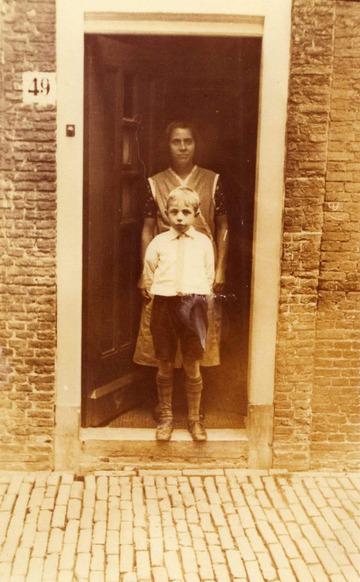 | ||||||||||||||||||||||||||||||||||||
1950 | ||||||||||||||||||||||||||||||||||||
Cornelisje (Corrie) Dienaar | ||||||||||||||||||||||||||||||||||||
Relationship Willem de Wit
- Willem de Wit is the son of Jacobus de Wit:
The data shown has no sources.
Historical events
Birthday December 11, 1924
- The temperature on December 11, 1924 was between -3.6 °C and -1.8 °C and averaged -2.9 °C. There was 0.2 mm of rain. The average windspeed was 1 Bft (weak wind) and was prevailing from the south east. Source: KNMI
- Koningin Wilhelmina (Huis van Oranje-Nassau) was from 1890 till 1948 sovereign of the Netherlands (also known as Koninkrijk der Nederlanden)
- In The Netherlands , there was from September 19, 1922 to August 4, 1925 the cabinet Ruys de Beerenbrouck II, with Jonkheer mr. Ch.J.M. Ruys de Beerenbrouck (RKSP) as prime minister.
- In the year 1924: Source: Wikipedia
- The Netherlands had about 7.2 million citizens.
- June 2 » U.S. President Calvin Coolidge signs the Indian Citizenship Act into law, granting citizenship to all Native Americans born within the territorial limits of the United States.
- July 11 » Eric Liddell won the gold medal in 400m at the 1924 Paris Olympics, after refusing to run in the heats for 100m, his favoured distance, on the Sunday.
- August 4 » Diplomatic relations between Mexico and the Soviet Union are established.
- October 31 » World Savings Day is announced in Milan, Italy by the Members of the Association at the 1st International Savings Bank Congress (World Society of Savings Banks).
- November 4 » Nellie Tayloe Ross of Wyoming becomes the first female elected as governor in the United States.
- December 24 » Albania becomes a republic.
Day of marriage May 19, 1950
- The temperature on May 19, 1950 was between 7.1 °C and 16.2 °C and averaged 11.8 °C. There was 6.2 hours of sunshine (39%). The average windspeed was 2 Bft (weak wind) and was prevailing from the east-southeast. Source: KNMI
- Koningin Juliana (Huis van Oranje-Nassau) was from September 4, 1948 till April 30, 1980 sovereign of the Netherlands (also known as Koninkrijk der Nederlanden)
- From August 7, 1948 till March 15, 1951 the Netherlands had a cabinet Drees - Van Schaik with the prime ministers Dr. W. Drees (PvdA) and Mr. J.R.H. van Schaik (KVP).
- In the year 1950: Source: Wikipedia
- The Netherlands had about 10.0 million citizens.
- January 13 » British submarine HMSTruculent collides with an oil tanker in the Thames Estuary, killing 64 men.
- January 21 » American lawyer and government official Alger Hiss is convicted of perjury.
- July 5 » Zionism: The Knesset passes the Law of Return which grants all Jews the right to immigrate to Israel.
- July 20 » Cold War: In Philadelphia, Harry Gold pleads guilty to spying for the Soviet Union by passing secrets from atomic scientist Klaus Fuchs.
- September 11 » Korean War: President Harry S. Truman approved military operations north of the 38 parallel.
- September 15 » Korean War: The U.S. X Corps lands at Inchon.
Day of death August 7, 1996
- The temperature on August 7, 1996 was between 11.5 °C and 17.8 °C and averaged 15.1 °C. There was -0.1 mm of rain. There was 1.9 hours of sunshine (13%). The partly or heavily clouded was. The average windspeed was 3 Bft (moderate breeze) and was prevailing from the south-southwest. Source: KNMI
- Koningin Beatrix (Huis van Oranje-Nassau) was from April 30, 1980 till April 30, 2013 sovereign of the Netherlands (also known as Koninkrijk der Nederlanden)
- In The Netherlands , there was from Monday, August 22, 1994 to Monday, August 3, 1998 the cabinet a href="https://nl.wikipedia.org/wiki/Kabinet-Kok_I" class="extern">Kok I, with W. Kok (PvdA) as prime minister.
- In the year 1996: Source: Wikipedia
- The Netherlands had about 15.5 million citizens.
- January 27 » Germany first observes the International Holocaust Remembrance Day.
- February 15 » At the Xichang Satellite Launch Center in China, a Long March 3 rocket, carrying an Intelsat 708, crashes into a rural village after liftoff, killing many people.
- April 28 » Whitewater controversy: President Bill Clinton gives a 4½ hour videotaped testimony for the defense.
- July 3 » British Prime Minister John Major announced the Stone of Scone would be returned to Scotland.
- July 18 » Storms provoke severe flooding on the Saguenay River, beginning one of Quebec's costliest natural disasters ever.
- August 29 » Vnukovo Airlines Flight 2801, a Tupolev Tu-154, crashes into a mountain on the Arctic island of Spitsbergen, killing all 141 aboard.
Same birth/death day
- 1923 » Betsy Blair, American actress and dancer († 2009)
- 1923 » Lillian Cahn, Hungarian-born American businesswoman, co-founded Coach, Inc. († 2013)
- 1923 » Morrie Turner, American comics creator († 2014)
- 1924 » Doc Blanchard, American football player and colonel († 2009)
- 1925 » Aaron Feuerstein, American businessman and philanthropist
- 1925 » Paul Greengard, American neuroscientist and academic, Nobel Prize laureate († 2019)
- 1989 » Mickey Leland, American lawyer and politician (b. 1944)
- 1994 » Larry Martyn, English actor (b. 1934)
- 1995 » Brigid Brophy, English author and critic (b. 1929)
- 2001 » Algirdas Lauritėnas, Lithuanian basketball player (b. 1932)
- 2003 » K. D. Arulpragasam, Sri Lankan zoologist and academic (b. 1931)
- 2003 » Mickey McDermott, American baseball player and coach (b. 1929)
About the surname De Wit
- View the information that Genealogie Online has about the surname De Wit.
- Check the information Open Archives has about De Wit.
- Check the Wie (onder)zoekt wie? register to see who is (re)searching De Wit.
The Family tree De Wit/Van der Loo publication was prepared by Jack de Wit.
When copying data from this family tree, please include a reference to the origin:
Jack de Wit, "Family tree De Wit/Van der Loo", database, Genealogy Online (https://www.genealogieonline.nl/stamboom-de-wit-van-der-loo/I496.php : accessed February 23, 2026), "Willem de Wit (1924-1996)".
Jack de Wit, "Family tree De Wit/Van der Loo", database, Genealogy Online (https://www.genealogieonline.nl/stamboom-de-wit-van-der-loo/I496.php : accessed February 23, 2026), "Willem de Wit (1924-1996)".