Family tree Keur » Antje Keur (1886-1970)
Personal data Antje Keur
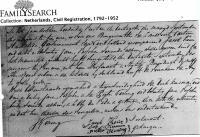
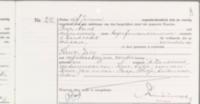
- She was born on August 21, 1886 in Zandvoort, Noord-Holland, Nederland.
- She died on April 13, 1970 in Haarlem, Noord-Holland, Nederland, she was 83 years old.
- A child of Jan Keur and Sijtje Keur
- This information was last updated on February 25, 2009.
Household of Antje Keur
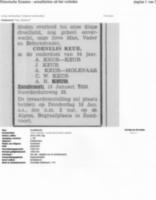
She is married to Cornelis Keur.
They got married on January 13, 1910 at Zandvoort, Noord-Holland, Nederland, she was 23 years old.
Child(ren):
- Maarten Keur 1911-1937
- Cornelis Willem Keur 1918-
- The couple has common ancestors.
Timeline Antje Keur
This functionality is only available in Javascript supporting browsers.
Click on the names for more info.
Symbols used:  grandparents
 parents
 brothers/sisters
 children
grandparents
parents
brothers/sisters
children
Relationship Antje Keur
- Antje Keur is the 6th great granddaughter of Cornelis Floren:
The data shown has no sources.
Historical events
Birthday August 21, 1886
- The temperature on August 21, 1886 was about 24.7 °C. The air pressure was 4 kgf/m2 and came mainly from the east-northeast. The airpressure was 76 cm mercury. The atmospheric humidity was 51%. Source: KNMI
- Koning Willem III (Huis van Oranje-Nassau) was from 1849 till 1890 sovereign of the Netherlands (also known as Koninkrijk der Nederlanden)
- In The Netherlands , there was from April 23, 1884 to April 21, 1888 the cabinet Heemskerk, with Mr. J. Heemskerk Azn. (conservatief) as prime minister.
- In the year 1886: Source: Wikipedia
- The Netherlands had about 4.5 million citizens.
- January 29 » Karl Benz patents the first successful gasoline-driven automobile.
- February 23 » Charles Martin Hall produced the first samples of aluminium from the electrolysis of aluminium oxide, after several years of intensive work. He was assisted in this project by his older sister, Julia Brainerd Hall.
- March 1 » The Anglo-Chinese School, Singapore is founded by Bishop William Oldham.
- March 29 » John Pemberton brews the first batch of Coca-Cola in a backyard in Atlanta.
- September 4 » American Indian Wars: After almost 30 years of fighting, Apache leader Geronimo, with his remaining warriors, surrenders to General Nelson Miles in Arizona.
- October 28 » President Cleveland dedicates the Statue of Liberty.
Day of marriage January 13, 1910
- The temperature on January 13, 1910 was between -1.1 °C and 6.1 °C and averaged 1.8 °C. There was 0.6 mm of rain. There was 3.2 hours of sunshine (39%). The average windspeed was 3 Bft (moderate breeze) and was prevailing from the west. Source: KNMI
- Koningin Wilhelmina (Huis van Oranje-Nassau) was from 1890 till 1948 sovereign of the Netherlands (also known as Koninkrijk der Nederlanden)
- In The Netherlands , there was from February 12, 1908 to August 29, 1913 the cabinet Heemskerk, with Mr. Th. Heemskerk (AR) as prime minister.
- In the year 1910: Source: Wikipedia
- The Netherlands had about 5.9 million citizens.
- March 1 » The deadliest avalanche in United States history buries a Great Northern Railway train in northeastern King County, Washington, killing 96 people.
- April 28 » Frenchman Louis Paulhan wins the 1910 London to Manchester air race, the first long-distance aeroplane race in England.
- May 11 » An act of the U.S. Congress establishes Glacier National Park in Montana.
- September 26 » Indian journalist Swadeshabhimani Ramakrishna Pillai is arrested after publishing criticism of the government of Travancore and is exiled.
- October 20 » The hull of the RMSOlympic, sister-ship to the ill-fated RMS Titanic, is launched from the Harland and Wolff shipyard in Belfast.
- November 14 » Aviator Eugene Burton Ely performs the first takeoff from a ship in Hampton Roads, Virginia, taking off from a makeshift deck on the USS Birmingham in a Curtiss pusher.
Day of death April 13, 1970
- The temperature on April 13, 1970 was between 3.1 °C and 11.5 °C and averaged 6.8 °C. There was 3.4 mm of rain during 3.3 hours. There was 4.5 hours of sunshine (33%). The partly clouded was. The average windspeed was 2 Bft (weak wind) and was prevailing from the west. Source: KNMI
- Koningin Juliana (Huis van Oranje-Nassau) was from September 4, 1948 till April 30, 1980 sovereign of the Netherlands (also known as Koninkrijk der Nederlanden)
- In The Netherlands , there was from April 5, 1967 to Tuesday, July 6, 1971 the cabinet De Jong, with P.J.S. de Jong (KVP) as prime minister.
- In the year 1970: Source: Wikipedia
- The Netherlands had about 13.0 million citizens.
- April 13 » An oxygen tank aboard the Apollo 13 Service Module explodes, putting the crew in great danger and causing major damage to the Apollo command and service module (codenamed "Odyssey") while en route to the Moon.
- May 14 » Andreas Baader is freed from custody by Ulrike Meinhof, Gudrun Ensslin and others, a pivotal moment in the formation of the Red Army Faction.
- May 15 » President Richard Nixon appoints Anna Mae Hays and Elizabeth P. Hoisington the first female United States Army generals.
- September 7 » Fighting begins between Arab guerrillas and government forces in Jordan.
- September 8 » Trans International Airlines Flight 863 crashes during takeoff from John F. Kennedy International Airport in New York City, killing all 11 aboard.
- November 13 » Bhola cyclone: A 150-mph tropical cyclone hits the densely populated Ganges Delta region of East Pakistan (now Bangladesh), killing an estimated 500,000 people in one night.
Same birth/death day
- 1884 » Chandler Egan, American golfer and architect († 1936)
- 1885 » Édouard Fabre, Canadian runner († 1939)
- 1886 » Ruth Manning-Sanders, Welsh-English author and poet († 1988)
- 1887 » James Paul Moody, English sailor († 1912)
- 1891 » Emiliano Mercado del Toro, Puerto Rican-American soldier († 2007)
- 1892 » Charles Vanel, French actor and director († 1989)
- 1966 » Abdul Salam Arif, Iraqi colonel and politician, 2nd President of Iraq (b. 1921)
- 1966 » Carlo Carrà, Italian painter (b. 1881)
- 1967 » Nicole Berger, French actress (b. 1934)
- 1969 » Alfred Karindi, Estonian pianist and composer (b. 1901)
- 1971 » Juhan Smuul, Estonian author, poet, and screenwriter (b. 1921)
- 1971 » Michel Brière, Canadian ice hockey player (b. 1949)
About the surname Keur
- View the information that Genealogie Online has about the surname Keur.
- Check the information Open Archives has about Keur.
- Check the Wie (onder)zoekt wie? register to see who is (re)searching Keur.
The Family tree Keur publication was prepared by D. van der Werff-van der Mije.
When copying data from this family tree, please include a reference to the origin:
D. van der Werff-van der Mije, "Family tree Keur", database, Genealogy Online (https://www.genealogieonline.nl/parenteel-keur/I461.php : accessed February 19, 2026), "Antje Keur (1886-1970)".
D. van der Werff-van der Mije, "Family tree Keur", database, Genealogy Online (https://www.genealogieonline.nl/parenteel-keur/I461.php : accessed February 19, 2026), "Antje Keur (1886-1970)".