Descendants Hemerik-Broekhuizen-Huner-Koper-Barink » Pieter HEMERIK (1923-1995)
Personal data Pieter HEMERIK
- He was born on July 6, 1923 in Leiden.
- He died on March 11, 1995 in Leiden, he was 71 years old.
- A child of Pieter HEMERIK and Alida de Meij
- This information was last updated on March 10, 2008.
Household of Pieter HEMERIK
He is married to Helena Maria Klinkenberg.
They got married on November 21, 1945 at Leiden, he was 22 years old.
Child(ren):
- (Not public)
- (Not public)
Timeline Pieter HEMERIK
This functionality is only available in Javascript supporting browsers.
Click on the names for more info.
Symbols used:  grandparents
 parents
 brothers/sisters
 children
grandparents
parents
brothers/sisters
children
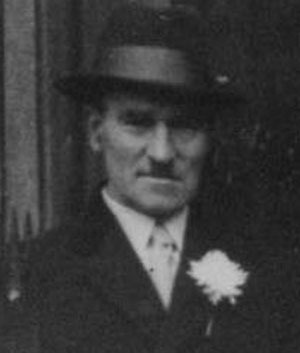
Image(s) Pieter HEMERIK

Ancestors (and descendant) of Pieter HEMERIK
Pieter HEMERIK | |||||||||||||||||||||||||||||||||||||
1945 | |||||||||||||||||||||||||||||||||||||
Helena Maria Klinkenberg | |||||||||||||||||||||||||||||||||||||
Relationship Pieter HEMERIK
- Pieter HEMERIK is the 10th great grandson of ? HEMERICK:
- Pieter HEMERIK is the 9th great grandson of Robert de Haan:
- Pieter HEMERIK is the 6th great grandson of Joannes Schreuder:
- Pieter HEMERIK is the 7th great grandson of Bastiaan Alderse:
- Pieter HEMERIK is the 8th great grandson of Bertholomi le Clercq:
- Pieter HEMERIK is the 7th great grandson of Wardenelis Chaerls Turnhout:
- Pieter HEMERIK is the 7th great grandson of Jan Randa:
- Pieter HEMERIK is the 8th great grandson of Floris Dirksz Waasdorp:
- Pieter HEMERIK is the 10th great grandson of NN Serese:
- Pieter HEMERIK is the 7th great grandson of Jasper Arisz Rosenburg:
- Pieter HEMERIK is the 6th great grandson of Michiel van Arkel:
- Pieter HEMERIK is the 11th great grandson of Xxx Lightvoet:
- Pieter HEMERIK is the 6th great grandson of Jan Janszn Stavleu:
The data shown has no sources.
Historical events
Birthday July 6, 1923
- The temperature on July 6, 1923 was between 14.0 °C and 29.6 °C and averaged 22.5 °C. There was 13.0 hours of sunshine (78%). The average windspeed was 2 Bft (weak wind) and was prevailing from the south east. Source: KNMI
- Koningin Wilhelmina (Huis van Oranje-Nassau) was from 1890 till 1948 sovereign of the Netherlands (also known as Koninkrijk der Nederlanden)
- In The Netherlands , there was from September 19, 1922 to August 4, 1925 the cabinet Ruys de Beerenbrouck II, with Jonkheer mr. Ch.J.M. Ruys de Beerenbrouck (RKSP) as prime minister.
- In the year 1923: Source: Wikipedia
- The Netherlands had about 7.1 million citizens.
- January 9 » Juan de la Cierva makes the first autogyro flight.
- January 9 » Lithuanian residents of the Memel Territory rebel against the League of Nations' decision to leave the area as a mandated region under French control.
- January 11 » Occupation of the Ruhr: Troops from France and Belgium occupy the Ruhr area to force Germany to make its World War I reparation payments.
- April 18 » Yankee Stadium: "The House that Ruth Built" opens.
- August 23 » Captain Lowell Smith and Lieutenant John P. Richter performed the first mid-air refueling on De Havilland DH-4B, setting an endurance flight record of 37 hours.
- October 13 » Ankara becomes the capital of Turkey.
Day of marriage November 21, 1945
- The temperature on November 21, 1945 was between 1.3 °C and 5.0 °C and averaged 3.7 °C. There was 0.8 mm of rain during 2.9 hours. The average windspeed was 2 Bft (weak wind) and was prevailing from the east. Source: KNMI
- Koningin Wilhelmina (Huis van Oranje-Nassau) was from 1890 till 1948 sovereign of the Netherlands (also known as Koninkrijk der Nederlanden)
- In The Netherlands , there was from July 27, 1941 to February 23, 1945 the cabinet Gerbrandy II, with Prof. dr. P.S. Gerbrandy (ARP) as prime minister.
- In The Netherlands , there was from February 23, 1945 to June 24, 1945 the cabinet Gerbrandy III, with Prof. dr. P.S. Gerbrandy (ARP) as prime minister.
- From June 24, 1945 till July 3, 1946 the Netherlands had a cabinet Schermerhorn - Drees with the prime ministers Prof. ir. W. Schermerhorn (VDB) and W. Drees (PvdA).
- In the year 1945: Source: Wikipedia
- The Netherlands had about 9.2 million citizens.
- February 4 » World War II: The Yalta Conference between the "Big Three" (Churchill, Roosevelt, and Stalin) opens at the Livadia Palace in the Crimea.
- February 19 » World War II: Battle of Iwo Jima: About 30,000 United States Marines land on the island of Iwo Jima.
- April 11 » World War II: American forces liberate the Buchenwald concentration camp.
- April 16 » The United States Army liberates Nazi Sonderlager (high security) prisoner-of-war camp Oflag IV-C (better known as Colditz).
- May 11 » World War II: Off the coast of Okinawa, the aircraft carrier USSBunker Hill is hit by two kamikazes.
- August 30 » The Allied Control Council, governing Germany after World War II, comes into being.
Day of death March 11, 1995
- The temperature on March 11, 1995 was between 3.8 °C and 13.4 °C and averaged 8.1 °C. There was 10.1 hours of sunshine (88%). The partly clouded was. The average windspeed was 3 Bft (moderate breeze) and was prevailing from the south east. Source: KNMI
- Koningin Beatrix (Huis van Oranje-Nassau) was from April 30, 1980 till April 30, 2013 sovereign of the Netherlands (also known as Koninkrijk der Nederlanden)
- In The Netherlands , there was from Monday, August 22, 1994 to Monday, August 3, 1998 the cabinet a href="https://nl.wikipedia.org/wiki/Kabinet-Kok_I" class="extern">Kok I, with W. Kok (PvdA) as prime minister.
- In the year 1995: Source: Wikipedia
- The Netherlands had about 15.4 million citizens.
- January 1 » The Draupner wave in the North Sea in Norway is detected, confirming the existence of freak waves.
- September 19 » The Washington Post and The New York Times publish the Unabomber's manifesto.
- November 12 » Erdut Agreement regarding the peaceful resolution to the Croatian War of Independence was reached.
- November 30 » U.S. President Bill Clinton visits Northern Ireland and speaks in favour of the "Northern Ireland peace process" to a huge rally at Belfast City Hall; he calls terrorists "yesterday's men".
- December 10 » The Israeli army withdraws from Nablus pursuant to the terms of Oslo Accord.
- December 20 » American Airlines Flight 965, a Boeing 757, crashes into a mountain 50km north of Cali, Colombia killing 159.
About the surname HEMERIK
- View the information that Genealogie Online has about the surname HEMERIK.
- Check the information Open Archives has about HEMERIK.
- Check the Wie (onder)zoekt wie? register to see who is (re)searching HEMERIK.
The Descendants Hemerik-Broekhuizen-Huner-Koper-Barink publication was prepared by R.A.Hemerik.
When copying data from this family tree, please include a reference to the origin:
R.A.Hemerik, "Descendants Hemerik-Broekhuizen-Huner-Koper-Barink", database, Genealogy Online (https://www.genealogieonline.nl/parenteel-hemerik/I34747.php : accessed March 9, 2026), "Pieter HEMERIK (1923-1995)".
R.A.Hemerik, "Descendants Hemerik-Broekhuizen-Huner-Koper-Barink", database, Genealogy Online (https://www.genealogieonline.nl/parenteel-hemerik/I34747.php : accessed March 9, 2026), "Pieter HEMERIK (1923-1995)".