Family tree Bol » Antonius van der Werff (1915-1945)
Personal data Antonius van der Werff
- He was born on May 27, 1915 in Velsen, Noord-Holland, Nederland.
- He died on April 23, 1945 in Cham Duitsland, Bavaria, Duitsland, he was 29 years old.
- This information was last updated on October 31, 2017.
Household of Antonius van der Werff
He is married to Anna Bol.
They got married on January 29, 1942 at Velsen, Noord-Holland, Nederland, he was 26 years old.
Child(ren):
- (Not public)
- (Not public)
Notes about Antonius van der Werff
Hij werd tijdens de 2e wereldoorlog in Velsen gearresteerd en naar Kamp Amerfoort gebracht. Dit gebeurde t
Second World War victim
- He appears on documents at Arolsen Archives
- He is listed on the website Oorlogsbronnen
- He appears in the missing lists in the Dutch Government Gazette (via Delpher)
Image(s) Antonius van der Werff


Ancestors (and descendant) of Antonius van der Werff
Antonius van der Werff 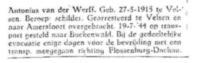 | |||||||||||||||||||||||||||||||||||
1942 | |||||||||||||||||||||||||||||||||||
Anna Bol 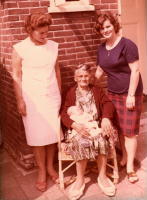 | |||||||||||||||||||||||||||||||||||
The data shown has no sources.
Historical events
Birthday May 27, 1915
- The temperature on May 27, 1915 was between 8.9 °C and 15.4 °C and averaged 12.0 °C. There was 8.9 hours of sunshine (55%). The average windspeed was 4 Bft (moderate breeze) and was prevailing from the north-northeast. Source: KNMI
- Koningin Wilhelmina (Huis van Oranje-Nassau) was from 1890 till 1948 sovereign of the Netherlands (also known as Koninkrijk der Nederlanden)
- In The Netherlands , there was from August 29, 1913 to September 9, 1918 the cabinet Cort van der Linden, with Mr. P.W.A. Cort van der Linden (liberaal) as prime minister.
- In the year 1915: Source: Wikipedia
- The Netherlands had about 6.3 million citizens.
- May 1 » The RMSLusitania departs from New York City on her 202nd, and final, crossing of the North Atlantic. Six days later, the ship is torpedoed off the coast of Ireland with the loss of 1,198 lives.
- May 23 » World War I: Italy joins the Allies, fulfilling its part of the Treaty of London.
- July 16 » Henry James becomes a British citizen to highlight his commitment to Britain during the first World War.
- July 25 » RFC Captain Lanoe Hawker becomes the first British pursuit aviator to earn the Victoria Cross.
- September 25 » World War I: The Second Battle of Champagne begins.
- October 13 » First World War: The Battle of the Hohenzollern Redoubt marks the end of the Battle of Loos.
Day of marriage January 29, 1942
- The temperature on January 29, 1942 was between -3.8 °C and 2.2 °C and averaged -0.3 °C. There was 3.2 mm of rain during 1.5 hours. There was 1.2 hours of sunshine (13%). The average windspeed was 3 Bft (moderate breeze) and was prevailing from the northwest. Source: KNMI
- Koningin Wilhelmina (Huis van Oranje-Nassau) was from 1890 till 1948 sovereign of the Netherlands (also known as Koninkrijk der Nederlanden)
- In The Netherlands , there was from July 27, 1941 to February 23, 1945 the cabinet Gerbrandy II, with Prof. dr. P.S. Gerbrandy (ARP) as prime minister.
- In the year 1942: Source: Wikipedia
- The Netherlands had about 9.0 million citizens.
- January 11 » World War II: Japanese forces capture Kuala Lumpur, the capital of the Federated Malay States.
- July 27 » World War II: Allied forces successfully halt the final Axis advance into Egypt.
- July 28 » World War II: Soviet leader Joseph Stalin issues Order No. 227. In response to alarming German advances, all those who retreat or otherwise leave their positions without orders to do so are to be tried in a military court, with punishment ranging from duty in a shtrafbat battalion, imprisonment in a Gulag, or execution.
- August 7 » World War II: The Battle of Guadalcanal begins as the United States Marines initiate the first American offensive of the war with landings on Guadalcanal and Tulagi in the Solomon Islands.
- August 19 » World War II: Operation Jubilee: The 2nd Canadian Infantry Division leads an amphibious assault by allied forces on Dieppe, France and fails, many Canadians are killed or captured. The operation was intended to develop and try new amphibious landing tactics for the coming full invasion in Normandy.
- September 26 » Holocaust: Senior SS official August Frank issues a memorandum detailing how Jews should be "evacuated".
Day of death April 23, 1945
- The temperature on April 23, 1945 was between 4.3 °C and 12.1 °C and averaged 7.5 °C. Source: KNMI
- Koningin Wilhelmina (Huis van Oranje-Nassau) was from 1890 till 1948 sovereign of the Netherlands (also known as Koninkrijk der Nederlanden)
- In The Netherlands , there was from July 27, 1941 to February 23, 1945 the cabinet Gerbrandy II, with Prof. dr. P.S. Gerbrandy (ARP) as prime minister.
- In The Netherlands , there was from February 23, 1945 to June 24, 1945 the cabinet Gerbrandy III, with Prof. dr. P.S. Gerbrandy (ARP) as prime minister.
- From June 24, 1945 till July 3, 1946 the Netherlands had a cabinet Schermerhorn - Drees with the prime ministers Prof. ir. W. Schermerhorn (VDB) and W. Drees (PvdA).
- In the year 1945: Source: Wikipedia
- The Netherlands had about 9.2 million citizens.
- April 13 » World War II: German troops kill more than 1,000 political and military prisoners in Gardelegen, Germany.
- April 16 » More than 7,000 die when the German refugee ship Goya is sunk by a Soviet submarine.
- May 8 » Hundreds of Algerian civilians are killed by French Army soldiers in the Sétif massacre.
- May 15 » World War II: The Battle of Poljana, the final skirmish in Europe is fought near Prevalje, Slovenia.
- June 26 » The United Nations Charter is signed by 50 Allied nations in San Francisco, California.
- October 15 » The former premier of Vichy France, Pierre Laval, is executed for treason.
Same birth/death day
- 1912 » John Cheever, American novelist and short story writer († 1982)
- 1912 » Sam Snead, American golfer and sportscaster († 2002)
- 1912 » Terry Moore, American baseball player, coach, and manager († 1995)
- 1915 » Ester Soré, Chilean singer-songwriter († 1996)
- 1915 » Herman Wouk, American novelist († 2019)
- 1917 » Harry Webster, English engineer († 2007)
- 1936 » Teresa de la Parra, French-Venezuelan author (b. 1889)
- 1951 » Charles G. Dawes, American banker and politician, 30th Vice President of the United States, Nobel Peace Prize laureate (b. 1865)
- 1951 » Jules Berry, French actor and director (b. 1883)
- 1959 » Bak Jungyang, Korean politician
- 1965 » George Adamski, Polish-American ufologist and author (b. 1891)
- 1966 » George Ohsawa, Japanese founder of the Macrobiotic diet (b. 1893)
About the surname Van der Werff
- View the information that Genealogie Online has about the surname Van der Werff.
- Check the information Open Archives has about Van der Werff.
- Check the Wie (onder)zoekt wie? register to see who is (re)searching Van der Werff.
The Family tree Bol publication was prepared by D. v.d. Werff v.d. Mije.
When copying data from this family tree, please include a reference to the origin:
D. v.d. Werff v.d. Mije, "Family tree Bol", database, Genealogy Online (https://www.genealogieonline.nl/parenteel-bol/I2.php : accessed January 11, 2026), "Antonius van der Werff (1915-1945)".
D. v.d. Werff v.d. Mije, "Family tree Bol", database, Genealogy Online (https://www.genealogieonline.nl/parenteel-bol/I2.php : accessed January 11, 2026), "Antonius van der Werff (1915-1945)".