About the day » Saturday August 19, 1939Calender converter
August 20, 1939 
 August 18, 1939
Born on Saturday August 19, 1939
- Antoinette Leopoldine SOBRY, Vilvoorde, Vlaams-Brabant, België († 1994)
- Luchiena Reinds († 1996)
- DINA AARTJE MOSTERD, APELDOORN († 2010)
- Joe Louis Brown, Berkeley, South Carolina, Verenigde Staten († 2004)
- Jan Toutenhoofd, Musselkanaal (Onstwedde) († 2018)
- Ada Hol, Buurmalsen (West Betuwe) (GL) († 2016)
- John Jacob Volz, Huntingburg, Dubois, Indiana, Verenigde Staten († 2001)
- Lies Aarts, Asten-Heusden,, Noord-Brabant, Nederland († 2016)
- Joannes Arnoldus Marie (Nolly) Schroeder, Koningsbosch, Netherlands († 1940)
- Guy Georget RENARD, Somain,59490,Nord,Hauts-de-France,FRANCE († 2019)
Died on Saturday August 19, 1939
- Clara Susanna Louise Arnoldine van Son (73), Assen
- Carel ridder van Rappard (64), Bückeburg,,Lower Saxony,Germany
- Antonius Gerardus Seesink (82), Delft
- Baukje (Bertha) Bantstra (69), Pipestone County, Minnesota, Verenigde Staten
- Albertina van Maaren (32), Deventer
- Allegonda VERVLOED Mdr (66)
- Antonius Gerardus Seesink (82), DELFT, Zuid-Holland, Nederland
- Adriana van Bork (79), Rotterdam, Zuid-Holland, Nederland
- Abram van Antwerpen (76), Sommelsdijk
- Abraham van Antwerpen (76), sommelsdijk (goeree overflakkee)
Source: Delpher (KB | national library) Newspapers from August 19, 1939 at Delpher
- Het nieuws van den dag voor Nederlandsch-Indië
- Het nieuws van den dag voor Nederlandsch-Indië
- Amigoe di Curacao : weekblad voor de Curacaosche eilanden
- Nieuwsblad van het Noorden
- Algemeen Handelsblad
- Algemeen Handelsblad
- Nieuwe Tilburgsche Courant
- Het Vaderland : staat- en letterkundig nieuwsblad
- Het Vaderland : staat- en letterkundig nieuwsblad
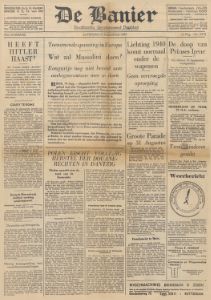
- De banier : staatkundig gereformeerd dagblad
Born on August 19
- 1936 » Richard McBrien, American priest, theologian, and academic († 2015)
- 1937 » Richard Ingrams, English journalist, founded The Oldie
- 1937 » William Motzing, American composer and conductor († 2014)
- 1938 » Diana Muldaur, American actress
- 1938 » Nelly Vuksic, Argentine conductor and musician
- 1939 » Ginger Baker, English drummer and songwriter († 2019)
- 1940 » Jill St. John, American model and actress
- 1940 » Johnny Nash, American singer-songwriter
- 1940 » Roger Cook, English songwriter, singer, and producer
- 1941 » Mihalis Papagiannakis, Greek educator and politician († 2009)
Died on August 19
- 1923 » Vilfredo Pareto, Italian sociologist and economist (b. 1845)
- 1928 » Stephanos Skouloudis, Greek banker and diplomat, 97th Prime Minister of Greece (b. 1838)
- 1929 » Sergei Diaghilev, Russian critic and producer, founded Ballets Russes (b. 1872)
- 1932 » Louis Anquetin, French painter (b. 1861)
- 1936 » Federico García Lorca, Spanish poet, playwright, and director (b. 1898)
- 1942 » Harald Kaarmann, Estonian footballer (b. 1901)
- 1945 » Tomás Burgos, Chilean philanthropist (b. 1875)
- 1950 » Giovanni Giorgi, Italian physicist and engineer (b. 1871)
- 1954 » Alcide De Gasperi, Italian journalist and politician, 30th Prime Minister of Italy (b. 1881)
- 1957 » David Bomberg, English soldier and painter (b. 1890)
Names that were popular for boys in 1939
- Johannes
- Jan
- Cornelis
- Maria
- Hendrik
- Willem
- Petrus
- Gerardus
- Adrianus
- Antonius
- Wilhelmus
- Jacobus
- Pieter
- Gerrit
- Franciscus
- Jacob
Names that were popular for girls in 1939
- Maria
- Johanna
- Cornelia
- Elisabeth
- Anna
- Wilhelmina
- Catharina
- Adriana
- Petronella
- Hendrika
- Jacoba
- Geertruida
- Margaretha
- Helena
- Marie
- Antonia
Source: Wikipedia Historical events 1939
- Koningin Wilhelmina (Huis van Oranje-Nassau) was from 1890 till 1948 sovereign of the Netherlands (also known as Koninkrijk der Nederlanden)
- In The Netherlands , there was from June 24, 1937 to July 25, 1939 the cabinet Colijn IV, with Dr. H. Colijn (ARP) as prime minister.
- In The Netherlands , there was from July 25, 1939 to August 10, 1939 the cabinet Colijn V, with Dr. H. Colijn (ARP) as prime minister.
- In The Netherlands , there was from August 10, 1939 to September 3, 1940 the cabinet De Geer II, with Jonkheer mr. D.J. de Geer (CHU) as prime minister.
- The Netherlands had about 8.7 million citizens.
- April 18 » Robert Menzies, who became Australia's longest-serving prime minister, is elected as leader of the United Australia Party after the death of Prime Minister Joseph Lyons.
- August 2 » Albert Einstein and Leo Szilard write a letter to Franklin D. Roosevelt, urging him to begin the Manhattan Project to develop a nuclear weapon.
- September 14 » World War II: The Estonian military boards the Polish submarine ORPOrzeł in Tallinn, sparking a diplomatic incident that the Soviet Union will later use to justify the annexation of Estonia.
- October 6 » World War II: The Battle of Kock is the final combat of the September Campaign in Poland.
- November 26 » Shelling of Mainila: The Soviet Army orchestrates an incident which is used to justify the start of the Winter War with Finland four days later.
- December 15 » Gone with the Wind (highest inflation adjusted grossing film) receives its premiere at Loew's Grand Theatre in Atlanta, Georgia, United States.
The weather on Saturday August 19, 1939
The temperature on August 19, 1939 was between 13.9 °C and 27.1 °C and averaged 20.7 °C. There was 12.8 hours of sunshine (88%). The average windspeed was 3 Bft (moderate breeze) and was prevailing from the east-northeast.
Source: KNMI
Source: KNMI