Bevolkingsreconstructie Wesuwe » Johann Bernard - Jo Heller (1938-1999)
Personal data Johann Bernard - Jo Heller
- He was born on September 14, 1938 in Barger-Compascuum, Gemeente Emmen, Drenthe, Nederland.Source 1
- Resident: Barger-Compascuum | Nieuw-Schoonebeek.
- He died on January 23, 1999, he was 60 years old.Source 2
- He is buried on January 29, 1999 in Nieuw-Schoonebeek, Emmen, Drenthe, Nederland.Source 3
- A child of Johan Herman Heller and Maria Margaretha Nieters
- This information was last updated on February 11, 2023.
Household of Johann Bernard - Jo Heller
Timeline Johann Bernard - Jo Heller
This functionality is only available in Javascript supporting browsers.
Click on the names for more info.
Symbols used:  grandparents
 parents
 brothers/sisters
 children
grandparents
parents
brothers/sisters
children
Ancestors (and descendant) of Johann Bernard - Jo Heller
Johann Bernard - Jo Heller | ||||||||||||||||||
Sources

bidprentje- bidprentje
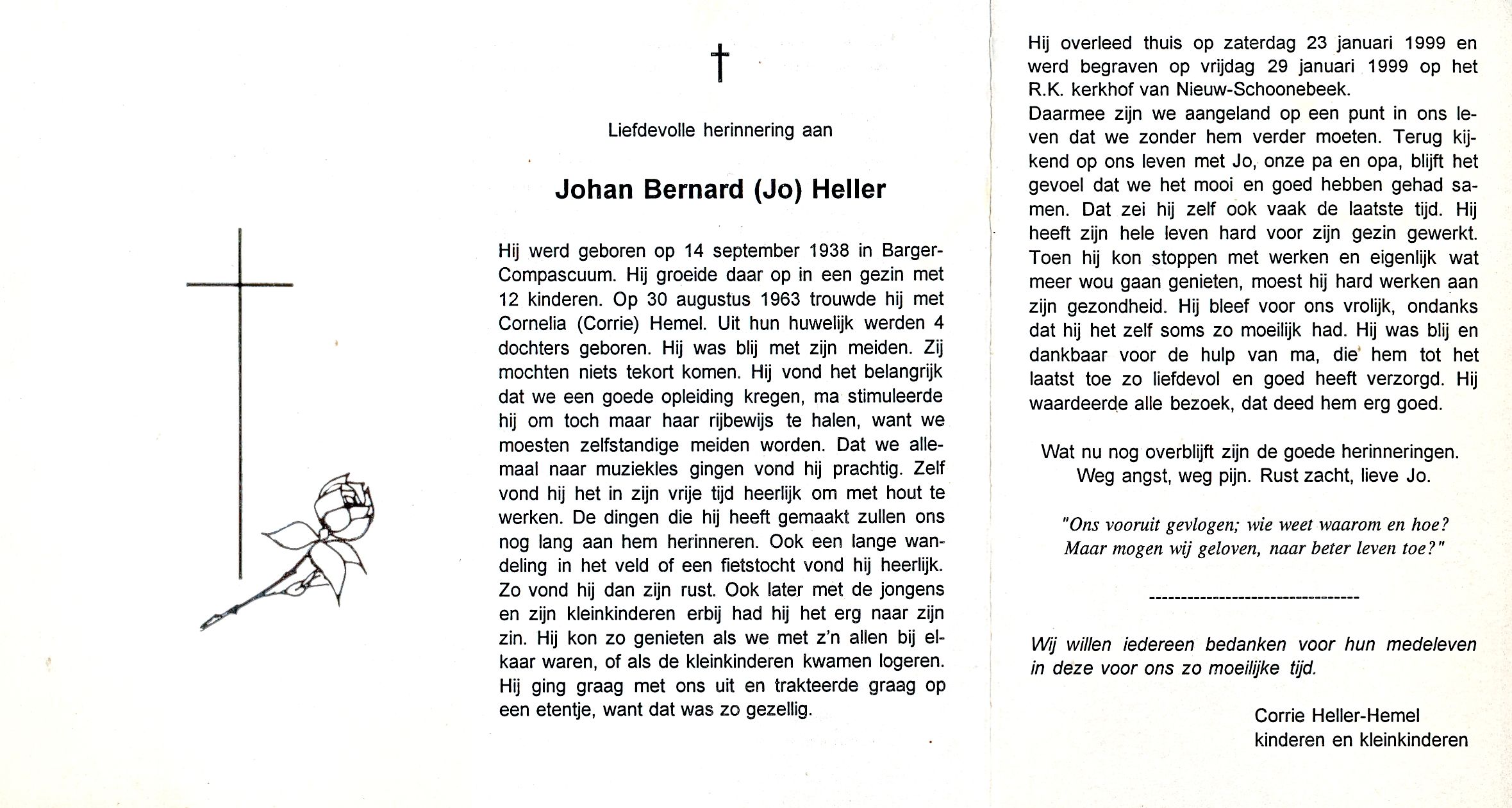 Johan Bernard (Jo) Heller bidprentje
Matches in other publications
This person also appears in the publication: View all
- Bevolkingsreconstructie Barger-Compascuum + Gezin + Rechtstreekse Voorouders + Nakomelingen
- Bevolkingsreconstructie Rütenbrock + Rechtstreekse Voorouders + Nakomelingen
- Het verborgen verleden van Pauline Berens aka Genealogienetwerk zus Greetje Berens aka EemslandBoekweitBoerenImmigratie aka The Dutch Connection
Historical events
Birthday September 14, 1938
- The temperature on September 14, 1938 was between 10.3 °C and 19.0 °C and averaged 15.2 °C. There was 9.5 mm of rain during 7.6 hours. There was 1.1 hours of sunshine (9%). The average windspeed was 3 Bft (moderate breeze) and was prevailing from the west. Source: KNMI
- Koningin Wilhelmina (Huis van Oranje-Nassau) was from 1890 till 1948 sovereign of the Netherlands (also known as Koninkrijk der Nederlanden)
- In The Netherlands , there was from June 24, 1937 to July 25, 1939 the cabinet Colijn IV, with Dr. H. Colijn (ARP) as prime minister.
- In the year 1938: Source: Wikipedia
- The Netherlands had about 8.6 million citizens.
- February 11 » BBC Television produces the world's first ever science fiction television programme, an adaptation of a section of the Karel Čapek play R.U.R., that coined the term "robot".
- April 10 » The 1938 German parliamentary election and referendum seeks approval for a single list of Nazi candidates and the recent annexation of Austria.
- May 26 » In the United States, the House Un-American Activities Committee begins its first session.
- July 31 » Archaeologists discover engraved gold and silver plates from King Darius the Great in Persepolis.
- September 12 » Adolf Hitler demands autonomy and self-determination for the Germans of the Sudetenland region of Czechoslovakia.
- September 30 » Britain, France, Germany and Italy sign the Munich Agreement, whereby Germany annexes the Sudetenland region of Czechoslovakia.
Day of death January 23, 1999
- The temperature on January 23, 1999 was between -2.9 °C and 6.1 °C and averaged 3.7 °C. There was -0.1 mm of rain. The heavily clouded was. The average windspeed was 2 Bft (weak wind) and was prevailing from the south. Source: KNMI
- Koningin Beatrix (Huis van Oranje-Nassau) was from April 30, 1980 till April 30, 2013 sovereign of the Netherlands (also known as Koninkrijk der Nederlanden)
- In The Netherlands , there was from Monday, August 3, 1998 to Monday, July 22, 2002 the cabinet Kok II, with W. Kok (PvdA) as prime minister.
- In the year 1999: Source: Wikipedia
- The Netherlands had about 15.8 million citizens.
- February 4 » Unarmed West African immigrant Amadou Diallo is shot 41 times by four plainclothes New York City police officers on an unrelated stake-out, inflaming race relations in the city.
- March 24 » A lorry carrying margarine and flour catches fire inside the Mont Blanc Tunnel. The resulting inferno kills 38 people.
- March 29 » A magnitude 6.8 earthquake in India strikes the Chamoli district in Uttar Pradesh, killing 103.
- April 14 » NATO mistakenly bombs a convoy of ethnic Albanian refugees. Yugoslav officials say 75 people were killed.
- October 26 » Britain's House of Lords votes to end the right of hereditary peers to vote in Britain's upper chamber of Parliament.
- October 29 » A large cyclone devastates Odisha, India.
Day of burial January 29, 1999
- The temperature on January 29, 1999 was between -5.5 °C and 1.6 °C and averaged -0.6 °C. There was 4.4 hours of sunshine (49%). The partly clouded was. The average windspeed was 2 Bft (weak wind) and was prevailing from the north-northeast. Source: KNMI
- Koningin Beatrix (Huis van Oranje-Nassau) was from April 30, 1980 till April 30, 2013 sovereign of the Netherlands (also known as Koninkrijk der Nederlanden)
- In The Netherlands , there was from Monday, August 3, 1998 to Monday, July 22, 2002 the cabinet Kok II, with W. Kok (PvdA) as prime minister.
- In the year 1999: Source: Wikipedia
- The Netherlands had about 15.8 million citizens.
- January 21 » War on Drugs: In one of the largest drug busts in American history, the United States Coast Guard intercepts a ship with over 4,300 kilograms (9,500lb) of cocaine on board.
- February 11 » Pluto crosses Neptune's orbit, ending a nearly 20-year period when it was closer to the Sun than the gas giant; Pluto is not expected to interact with Neptune's orbit again until 2231.
- March 12 » Former Warsaw Pact members the Czech Republic, Hungary and Poland join NATO.
- April 14 » A severe hailstorm strikes Sydney, Australia causing A$2.3billion in insured damages, the most costly natural disaster in Australian history.
- May 7 » Kosovo War: Three Chinese citizens are killed and 20 wounded when a NATO aircraft apparently inadvertently bombs the Chinese embassy in Belgrade, Serbia.
- November 11 » The House of Lords Act is given Royal Assent, restricting membership of the British House of Lords by virtue of a hereditary peerage.
Same birth/death day
- 1936 » Harry Danielsen, Norwegian educator and politician († 2011)
- 1936 » Terence Donovan, English photographer and director († 1996)
- 1937 » Renzo Piano, Italian architect and engineer, designed The Shard and The New York Times Building
- 1938 » Franco Califano, Libya-born Italian singer-songwriter († 2013)
- 1938 » Nicol Williamson, Scottish actor († 2011)
- 1939 » DeWitt Weaver, American golfer
- 1999 » Jay Pritzker, American businessman, co-founded the Hyatt Corporation (b. 1922)
- 1999 » Joe D'Amato, Italian director and cinematographer (b. 1936)
- 2002 » Paul Aars, American race car driver (b. 1934)
- 2002 » Pierre Bourdieu, French sociologist, anthropologist, and philosopher (b. 1930)
- 2002 » Robert Nozick, American philosopher, author, and academic (b. 1938)
- 2003 » Nell Carter, American actress and singer (b. 1948)
About the surname Heller
- View the information that Genealogie Online has about the surname Heller.
- Check the information Open Archives has about Heller.
- Check the Wie (onder)zoekt wie? register to see who is (re)searching Heller.
The Bevolkingsreconstructie Wesuwe publication was prepared by Pauline Berens Wesuwe.
When copying data from this family tree, please include a reference to the origin:
Pauline Berens Wesuwe, "Bevolkingsreconstructie Wesuwe", database, Genealogy Online (https://www.genealogieonline.nl/ofb-wesuwe/I57560.php : accessed January 29, 2026), "Johann Bernard - Jo Heller (1938-1999)".
Pauline Berens Wesuwe, "Bevolkingsreconstructie Wesuwe", database, Genealogy Online (https://www.genealogieonline.nl/ofb-wesuwe/I57560.php : accessed January 29, 2026), "Johann Bernard - Jo Heller (1938-1999)".