Local Heritage Book Barger-Compascuum » Jan Tabak (1886-1978)
Personal data Jan Tabak
- He was born on October 24, 1886 in Bovensmilde, Midden-Drenthe, Drenthe, Nederland.Source 1
- Profession: arbeider, veenarbeider.
- Resident: Fehndorf, Duitsland | 23-11-1915 Barger-Compascuum, Nederland | Barger-Oosterveld | 04-1928 Emmen.
- He died on June 8, 1978, he was 91 years old.Source 2
- He is buried in Klazienaveen, Gemeente Emmen, Drenthe, Nederland.Source 3
- A child of Hendrik Tabak and Trientje van der Werff
- This information was last updated on December 10, 2023.
Household of Jan Tabak
He is married to Maria Catharina - Maria Katharina Holle.
They got married on July 27, 1912 at Wesuwe, Haren (Ems), Landkreis Emsland, Lower Saxony, Germany, he was 25 years old.Source 4
Child(ren):
- Treintje Tabak 1913-
- Margaretha Tabak 1915-
- Henderika Tabak 1917-2004
- Geziena Tabak 1919-1922
- Antonetta Tabak 1921-
- Geziena Tabak 1922-
- Lena Tabak 1924-1986
- Margaretha Tabak 1927-2020
- Jan Tabak 1930-1987
- Jacob Tabak 1934-2005
Timeline Jan Tabak
This functionality is only available in Javascript supporting browsers.
Click on the names for more info.
Symbols used:  grandparents
 parents
 brothers/sisters
 children
grandparents
parents
brothers/sisters
children
Ancestors (and descendant) of Jan Tabak
Jan Tabak | |||||||||||||||||||||||||||||||||||||||||||||||||||||||||||||||||||||||||
1912 | |||||||||||||||||||||||||||||||||||||||||||||||||||||||||||||||||||||||||
Sources



https://www.wiewaswie.nl/nl/detail/14627107- https://www.online-begraafplaatsen.nl/graf/727148/1100733/Jan-Tabak-1886-1978
- https://www.online-begraafplaatsen.nl/graf/727148/1100733/Jan-Tabak-1886-1978
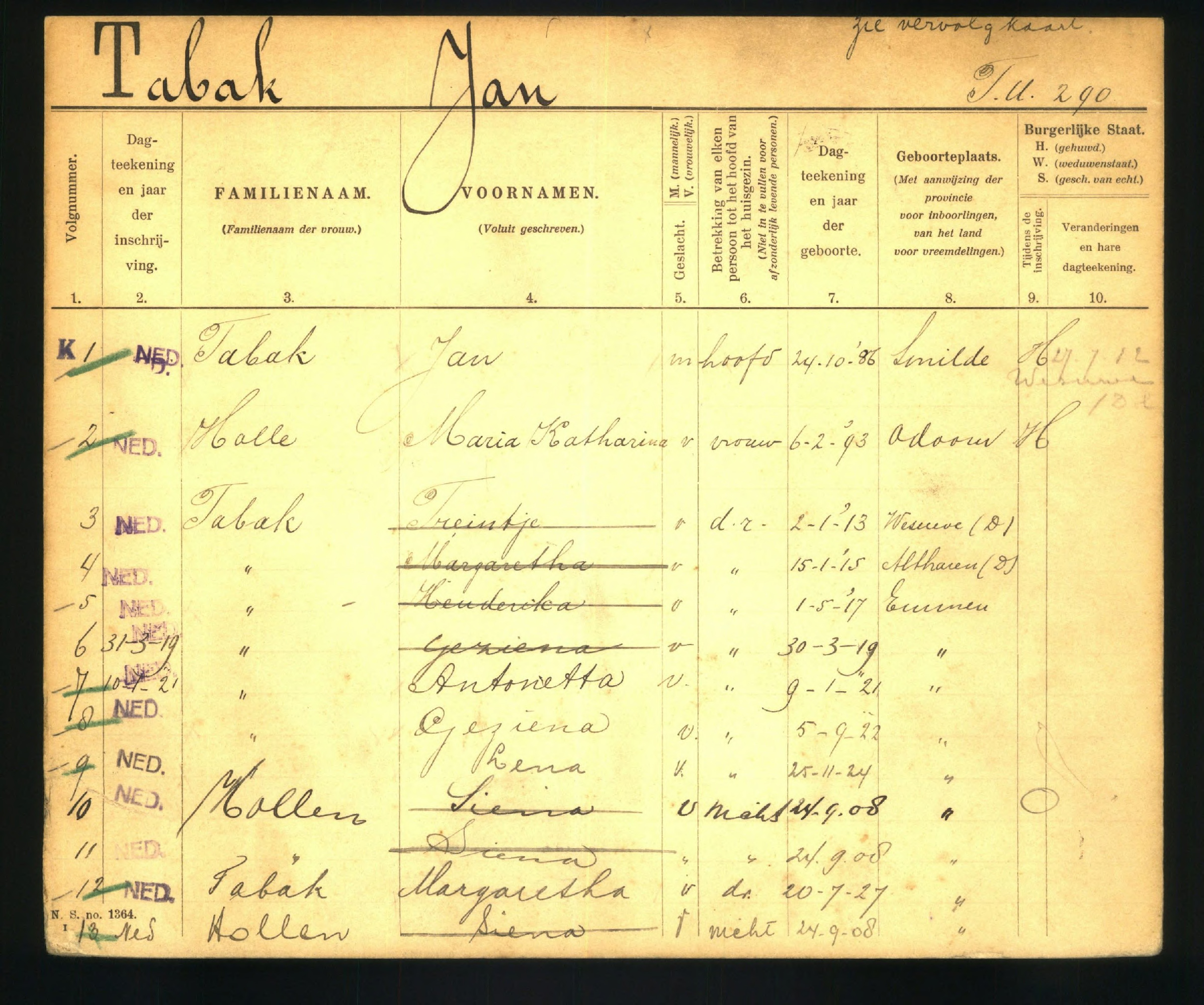 gezinskaart Tabak-Holle 16911 p16911 1918-1936
https://www.drentsarchief.nl/onderzoeken/genealogie/bladeren-door-bronnen/registers/
Matches in other publications
This person also appears in the publication: View all
Historical events
Birthday October 24, 1886
- The temperature on October 24, 1886 was about 10.4 °C. The air pressure was 31 kgf/m2 and came mainly from the east. The airpressure was 77 cm mercury. The atmospheric humidity was 70%. Source: KNMI
- Koning Willem III (Huis van Oranje-Nassau) was from 1849 till 1890 sovereign of the Netherlands (also known as Koninkrijk der Nederlanden)
- In The Netherlands , there was from April 23, 1884 to April 21, 1888 the cabinet Heemskerk, with Mr. J. Heemskerk Azn. (conservatief) as prime minister.
- In the year 1886: Source: Wikipedia
- The Netherlands had about 4.5 million citizens.
- April 8 » William Ewart Gladstone introduces the first Irish Home Rule Bill into the British House of Commons.
- June 26 » Henri Moissan isolated elemental Fluorine for the first time.
- July 3 » Karl Benz officially unveils the Benz Patent-Motorwagen, the first purpose-built automobile.
- July 3 » The New-York Tribune becomes the first newspaper to use a linotype machine, eliminating typesetting by hand.
- August 31 » The 7.0 Mw Charleston earthquake affects southeastern South Carolina with a maximum Mercalli intensity of X (Extreme). Sixty people killed with damage estimated at $5–6 million.
- September 4 » American Indian Wars: After almost 30 years of fighting, Apache leader Geronimo, with his remaining warriors, surrenders to General Nelson Miles in Arizona.
Day of marriage July 27, 1912
- The temperature on July 27, 1912 was between 14.2 °C and 23.6 °C and averaged 19.0 °C. There was 5.0 hours of sunshine (32%). The average windspeed was 3 Bft (moderate breeze) and was prevailing from the east-southeast. Source: KNMI
- Koningin Wilhelmina (Huis van Oranje-Nassau) was from 1890 till 1948 sovereign of the Netherlands (also known as Koninkrijk der Nederlanden)
- In The Netherlands , there was from February 12, 1908 to August 29, 1913 the cabinet Heemskerk, with Mr. Th. Heemskerk (AR) as prime minister.
- In the year 1912: Source: Wikipedia
- The Netherlands had about 6.0 million citizens.
- March 6 » Italo-Turkish War: Italian forces become the first to use airships in war, as two dirigibles drop bombs on Turkish troops encamped at Janzur, from an altitude of 6,000 feet.
- September 28 » Corporal Frank S. Scott of the United States Army becomes the first enlisted man to die in an airplane crash.
- October 7 » The Helsinki Stock Exchange sees its first transaction.
- October 24 » First Balkan War: The Battle of Kumanovo concludes with the Serbian victory against the Ottoman Empire.
- November 7 » The Deutsche Opernhaus (now Deutsche Oper Berlin) opens in the Berlin neighborhood of Charlottenburg, with a production of Beethoven's Fidelio.
- November 27 » Spain declares a protectorate over the north shore of Morocco.
Day of death June 8, 1978
- The temperature on June 8, 1978 was between 12.2 °C and 19.0 °C and averaged 15.0 °C. There was 4.6 mm of rain during 3.3 hours. There was 9.8 hours of sunshine (59%). The partly or heavily clouded was. The average windspeed was 3 Bft (moderate breeze) and was prevailing from the west. Source: KNMI
- Koningin Juliana (Huis van Oranje-Nassau) was from September 4, 1948 till April 30, 1980 sovereign of the Netherlands (also known as Koninkrijk der Nederlanden)
- In The Netherlands , there was from Monday, December 19, 1977 to Friday, September 11, 1981 the cabinet Van Agt I, with Mr. A.A.M. van Agt (CDA/KVP) as prime minister.
- In the year 1978: Source: Wikipedia
- The Netherlands had about 13.9 million citizens.
- January 24 » Soviet satellite Kosmos 954, with a nuclear reactor on board, burns up in Earth's atmosphere, scattering radioactive debris over Canada's Northwest Territories. Only 1% is recovered.
- February 17 » The Troubles: The Provisional IRA detonates an incendiary bomb at the La Mon restaurant, near Belfast, killing 12 and seriously injuring 30 others, all Protestants.
- June 28 » The United States Supreme Court, in Regents of the University of California v. Bakke bars quota systems in college admissions.
- July 1 » The Northern Territory in Australia is granted self-government.
- August 17 » Double Eagle II becomes first balloon to cross the Atlantic Ocean when it lands in Miserey, France near Paris, 137 hours after leaving Presque Isle, Maine.
- August 19 » In Iran, Cinema Rex fire caused more than 400 deaths.
Same birth/death day
- 1882 » Sybil Thorndike, English actress († 1976)
- 1884 » Emil Fjellström, Swedish actor († 1944)
- 1885 » Alice Perry, Irish engineer and poet († 1969)
- 1887 » Octave Lapize, French cyclist and pilot († 1917)
- 1887 » Victoria Eugenie of Battenberg († 1969)
- 1891 » Rafael Trujillo, Dominican soldier and politician, 36th President of the Dominican Republic († 1961)
- 1969 » Arunachalam Mahadeva, Sri Lankan politician and diplomat (b. 1885)
- 1970 » Abraham Maslow, American psychologist and academic (b. 1908)
- 1971 » J.I. Rodale, American author and playwright (b. 1898)
- 1976 » Thorleif Schjelderup-Ebbe, Norwegian zoologist and psychologist (b. 1894)
- 1982 » Satchel Paige, American baseball player and coach (b. 1906)
- 1984 » Gordon Jacob, English composer and academic (b. 1895)
About the surname Tabak
- View the information that Genealogie Online has about the surname Tabak.
- Check the information Open Archives has about Tabak.
- Check the Wie (onder)zoekt wie? register to see who is (re)searching Tabak.
The Local Heritage Book Barger-Compascuum publication was prepared by Pauline Berens BC.
When copying data from this family tree, please include a reference to the origin:
Pauline Berens BC, "Local Heritage Book Barger-Compascuum", database, Genealogy Online (https://www.genealogieonline.nl/ofb-barger-compascuum/I75043.php : accessed February 16, 2026), "Jan Tabak (1886-1978)".
Pauline Berens BC, "Local Heritage Book Barger-Compascuum", database, Genealogy Online (https://www.genealogieonline.nl/ofb-barger-compascuum/I75043.php : accessed February 16, 2026), "Jan Tabak (1886-1978)".