Local Heritage Book Barger-Compascuum » Trientien Bergsma (1904-1934)
Personal data Trientien Bergsma
- She was born on April 21, 1904 in Erica, Gemeente Emmen, Drenthe, Nederland.Source 1
- Profession: arbeidster.
- Resident: Lonneker | 29-02-1908 Emmererfscheidenveen | Barger-Compascuum.
- She died on May 2, 1934 in Barger-Compascuum, Gemeente Emmen, Drenthe, Nederland, she was 30 years old.Source 2
- A child of Hindrik Bergsma and Trientien Pol
- This information was last updated on October 10, 2024.
Household of Trientien Bergsma
She is married to Jan Prins.
They got married on May 16, 1925 at Emmen, Gemeente Emmen, Drenthe, Nederland, she was 21 years old.Source 3
Child(ren):
- Jan Prins 1926-2002
- Hendrik Prins 1927-1994
- Betje Prins 1928-2016
- Katrinus Prins 1929-2006
- Margje Prins 1933-1983
Timeline Trientien Bergsma
This functionality is only available in Javascript supporting browsers.
Click on the names for more info.
Symbols used:  grandparents
 parents
 brothers/sisters
 children
grandparents
parents
brothers/sisters
children
Ancestors (and descendant) of Trientien Bergsma
Trientien Bergsma | ||||||||||||||||||||||||||||||||||||||
1925 | ||||||||||||||||||||||||||||||||||||||
Jan Prins | ||||||||||||||||||||||||||||||||||||||
Sources

https://www.drentsarchief.nl/onderzoeken/genealogie/bladeren-door-bronnen/registers/ gezinskaart 1918-193621 in 1925
- https://www.wiewaswie.nl/nl/detail/14957878
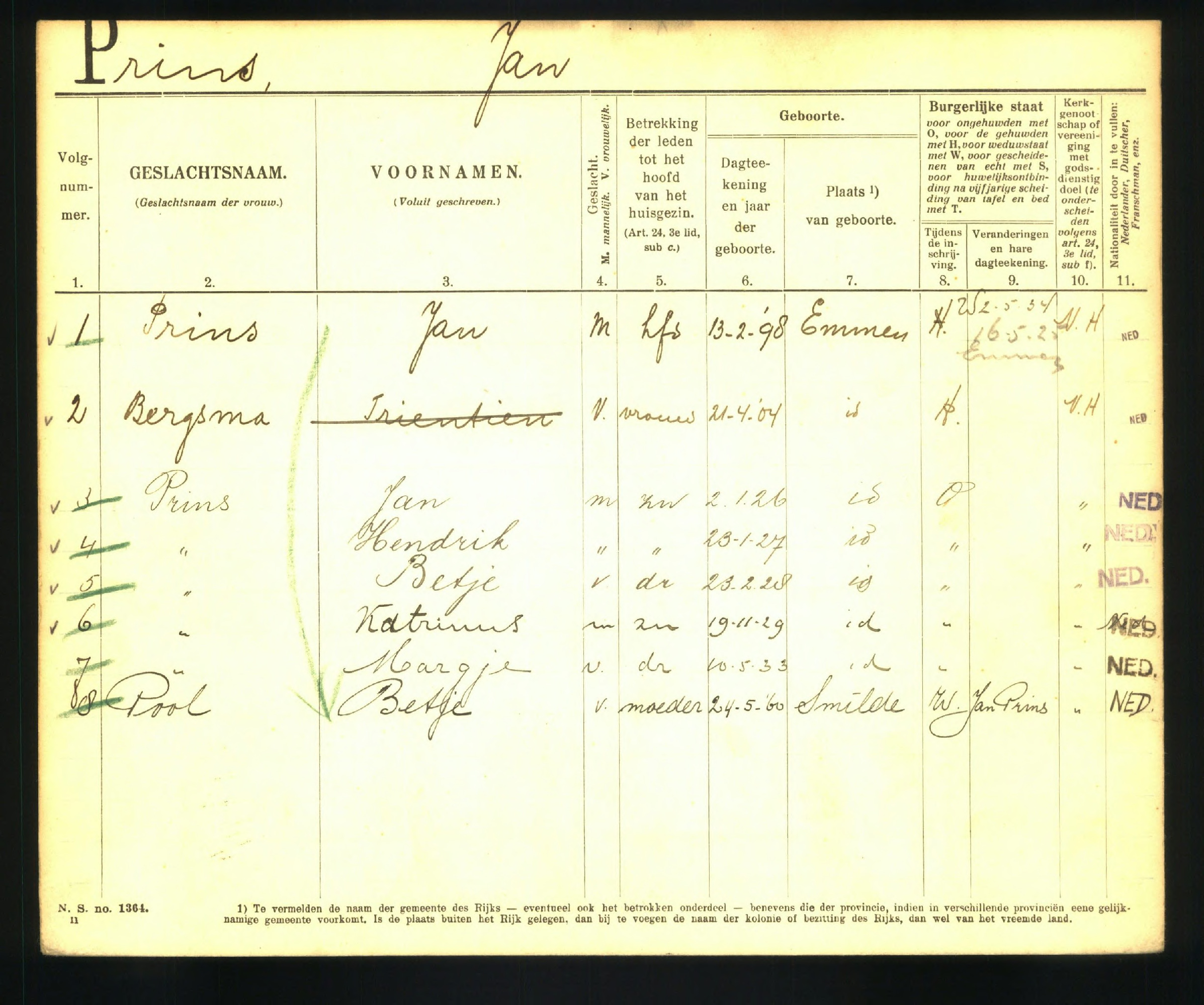 gezinskaart Prins-Bergsma 13901 p13901 1918-1936
https://www.drentsarchief.nl/onderzoeken/genealogie/bladeren-door-bronnen/registers/ https://www.wiewaswie.nl/nl/detail/14710593
Matches in other publications
This person also appears in the publication: View all
Historical events
Birthday April 21, 1904
- The temperature on April 21, 1904 was between 6.0 °C and 16.9 °C and averaged 11.8 °C. There was 7.2 hours of sunshine (51%). The average windspeed was 4 Bft (moderate breeze) and was prevailing from the north-northeast. Source: KNMI
- Koningin Wilhelmina (Huis van Oranje-Nassau) was from 1890 till 1948 sovereign of the Netherlands (also known as Koninkrijk der Nederlanden)
- In The Netherlands , there was from August 1, 1901 to August 16, 1905 the cabinet Kuijper, with Dr. A. Kuijper (AR) as prime minister.
- In the year 1904: Source: Wikipedia
- The Netherlands had about 5.4 million citizens.
- January 23 » Ålesund Fire: the Norwegian coastal town Ålesund is devastated by fire, leaving 10,000 people homeless and one person dead. Kaiser Wilhelm II funds the rebuilding of the town in Jugendstil style.
- February 8 » Aceh War: Dutch Colonial Army's Marechaussee regiment led by General G.C.E. van Daalen launch military campaign to capture Gayo Highland, Alas Highland, and Batak Highland in Dutch East Indies' Northern Sumatra region, which ends with genocide to Acehnese and Bataks people.
- April 8 » Longacre Square in Midtown Manhattan is renamed Times Square after The New York Times.
- May 10 » The Horch & Cir. Motorwagenwerke AG is founded. It would eventually become the Audi company.
- June 16 » Eugen Schauman assassinates Nikolay Bobrikov, Governor-General of Finland.
- June 16 » Irish author James Joyce begins a relationship with Nora Barnacle and subsequently uses the date to set the actions for his novel Ulysses; this date is now traditionally called "Bloomsday".
Day of marriage May 16, 1925
- The temperature on May 16, 1925 was between 12.6 °C and 27.2 °C and averaged 20.2 °C. There was 12.3 hours of sunshine (78%). The average windspeed was 3 Bft (moderate breeze) and was prevailing from the south east. Source: KNMI
- Koningin Wilhelmina (Huis van Oranje-Nassau) was from 1890 till 1948 sovereign of the Netherlands (also known as Koninkrijk der Nederlanden)
- In The Netherlands , there was from September 19, 1922 to August 4, 1925 the cabinet Ruys de Beerenbrouck II, with Jonkheer mr. Ch.J.M. Ruys de Beerenbrouck (RKSP) as prime minister.
- In The Netherlands , there was from August 4, 1925 to March 8, 1926 the cabinet Colijn I, with Dr. H. Colijn (ARP) as prime minister.
- In the year 1925: Source: Wikipedia
- The Netherlands had about 7.3 million citizens.
- January 3 » Benito Mussolini announces he is taking dictatorial powers over Italy.
- February 21 » The New Yorker publishes its first issue.
- March 18 » The Tri-State Tornado hits the Midwestern states of Missouri, Illinois, and Indiana, killing 695 people.
- April 4 » The Schutzstaffel (SS) is founded under Adolf Hitler's Nazi party in Germany.
- July 21 » Malcolm Campbell becomes the first man to exceed 150mph (241km/h) on land. At Pendine Sands in Wales, he drives Sunbeam 350HP built by Sunbeam at a two-way average speed of 150.33mph (242km/h).
- December 11 » Roman Catholic papal encyclical Quas primas introduces the Feast of Christ the King.
Day of death May 2, 1934
- The temperature on May 2, 1934 was between 9.7 °C and 17.4 °C and averaged 13.0 °C. There was 3.8 mm of rain during 1.8 hours. There was 2.2 hours of sunshine (15%). The average windspeed was 3 Bft (moderate breeze) and was prevailing from the west-southwest. Source: KNMI
- Koningin Wilhelmina (Huis van Oranje-Nassau) was from 1890 till 1948 sovereign of the Netherlands (also known as Koninkrijk der Nederlanden)
- In The Netherlands , there was from May 26, 1933 to July 31, 1935 the cabinet Colijn II, with Dr. H. Colijn (ARP) as prime minister.
- In the year 1934: Source: Wikipedia
- The Netherlands had about 8.3 million citizens.
- January 15 » The 8.0 Mw Nepal–Bihar earthquake strikes Nepal and Bihar with a maximum Mercalli intensity of XI (Extreme), killing an estimated 6,000–10,700 people.
- March 26 » The United Kingdom driving test is introduced.
- June 30 » The Night of the Long Knives, Adolf Hitler's violent purge of his political rivals in Germany, takes place.
- July 2 » The Night of the Long Knives ends with the death of Ernst Röhm.
- November 11 » The Shrine of Remembrance in Melbourne, Australia is opened.
- December 5 » Abyssinia Crisis: Italian troops attack Wal Wal in Abyssinia, taking four days to capture the city.
Same birth/death day
- 1898 » Maurice Wilson, English soldier, pilot, and mountaineer († 1934)
- 1899 » Randall Thompson, American composer and academic († 1984)
- 1903 » Luis Saslavsky, Argentinian director, producer, and screenwriter († 1995)
- 1904 » Jean Hélion, French painter († 1987)
- 1904 » Odilo Globocnik, Italian-Austrian SS officer († 1945)
- 1905 » Pat Brown, American lawyer and politician, 32nd Governor of California († 1996)
- 1925 » Antun Branko Šimić, Croatian and Bosnian-Herzegovinian poet (b. 1898)
- 1925 » Johann Palisa, Austrian astronomer (b. 1848)
- 1927 » Ernest Starling, English physiologist and academic (b. 1866)
- 1929 » Charalambos Tseroulis, Greek general and politician, Greek Minister for Military Affairs (b. 1879)
- 1941 » Penelope Delta, Greek author (b. 1874)
- 1945 » Martin Bormann, German politician (b. 1900)
About the surname Bergsma
- View the information that Genealogie Online has about the surname Bergsma.
- Check the information Open Archives has about Bergsma.
- Check the Wie (onder)zoekt wie? register to see who is (re)searching Bergsma.
The Local Heritage Book Barger-Compascuum publication was prepared by Pauline Berens BC.
When copying data from this family tree, please include a reference to the origin:
Pauline Berens BC, "Local Heritage Book Barger-Compascuum", database, Genealogy Online (https://www.genealogieonline.nl/ofb-barger-compascuum/I72614.php : accessed February 7, 2026), "Trientien Bergsma (1904-1934)".
Pauline Berens BC, "Local Heritage Book Barger-Compascuum", database, Genealogy Online (https://www.genealogieonline.nl/ofb-barger-compascuum/I72614.php : accessed February 7, 2026), "Trientien Bergsma (1904-1934)".