Local Heritage Book Barger-Compascuum » Eva van Komen (1871-1949)
Personal data Eva van Komen
- Also known as Komen.
- She was born on August 9, 1871 in Zevenhuizen, Westerkwartier, Groningen, Nederland.Source 1
- Profession: arbeidster.
- Resident: gemeente Veendam | 18-05-1909 Emmer-Compascuum | Emmer-Erfscheidenveen | Zwartemeer.
- She died on March 1, 1949 in Emmen, Drenthe, Nederland, she was 77 years old.Source 2
- She is buried in Emmer-Compascuum, Gemeente Emmen, Drenthe, Nederland.Source 3
- A child of Pouwel - Pauwel van Komen and Bonje Seip
- This information was last updated on October 19, 2023.
Household of Eva van Komen
She is married to Jelis Lamain.
They got married on January 2, 1892 at Veendam, Gemeente Veendam, Groningen, Nederland, she was 20 years old.Source 4
Child(ren):
- Bonnegina Lamain 1894-1959
- Pauwel - Pouwel Lamain 1897-1946
- Hilje Lamain 1900-1991
- Willem Lamain 1902-1991
- Trijntje Lamain 1903-1995
- Jantje Lamain 1905-1970
- Hendrik Lamain 1908-
- Roelfke Lamain 1911-1912
- Roelfke Lamain 1913-1914
- Eva Lamain 1915-1999
Timeline Eva van Komen
This functionality is only available in Javascript supporting browsers.
Click on the names for more info.
Symbols used:  grandparents
 parents
 brothers/sisters
 children
grandparents
parents
brothers/sisters
children
Ancestors (and descendant) of Eva van Komen
Eva van Komen | |||||||||||||||||||||||||||||||||||||||||||||||||||||||||||||||||||||||||||
1892 | |||||||||||||||||||||||||||||||||||||||||||||||||||||||||||||||||||||||||||
Jelis Lamain | |||||||||||||||||||||||||||||||||||||||||||||||||||||||||||||||||||||||||||
Sources
- https://www.drentsarchief.nl/onderzoeken/genealogie/bladeren-door-bronnen/registers/ gezinskaart 1918-1936
https://www.wiewaswie.nl/nl/detail/6488952
https://www.wiewaswie.nl/nl/detail/1890879720 in 1892
- https://www.wiewaswie.nl/nl/detail/14992809
- https://graftombe.nl/names/info/614913/komen_van
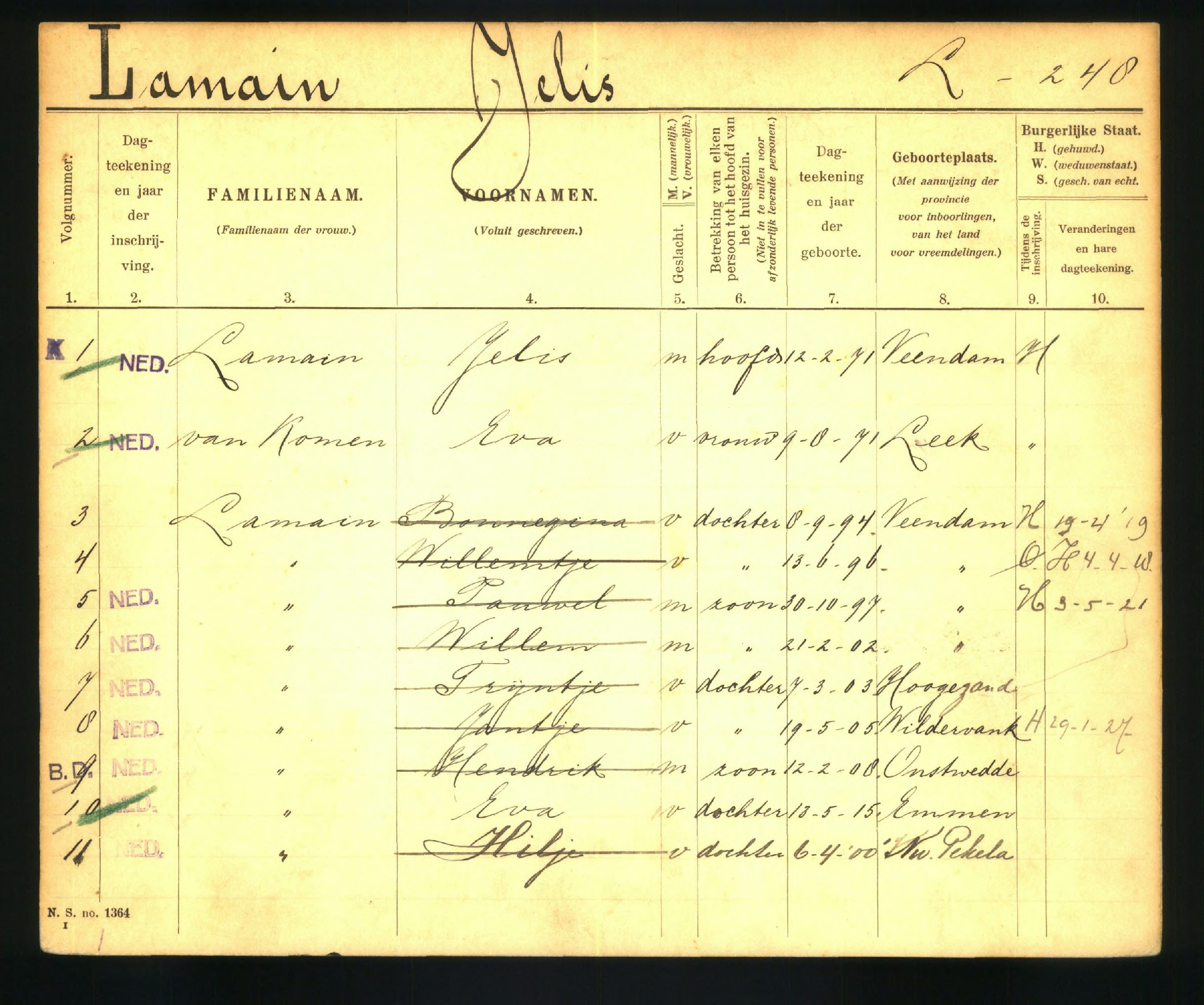 gezinskaart Jelis Lamain - Eva van Komen 10265 10265 1918-1936
https://www.drentsarchief.nl/onderzoeken/genealogie/bladeren-door-bronnen/registers/ https://www.wiewaswie.nl/nl/detail/6488952
Matches in other publications
This person also appears in the publication: View all
Historical events
Birthday August 9, 1871
- The temperature on August 9, 1871 was about 18.4 °C. The atmospheric humidity was 84%. Source: KNMI
- Koning Willem III (Huis van Oranje-Nassau) was from 1849 till 1890 sovereign of the Netherlands (also known as Koninkrijk der Nederlanden)
- From June 4, 1868 till January 4, 1871 the Netherlands had a cabinet Van Bosse - Fock with the prime ministers Mr. P.P. van Bosse (liberaal) and Mr. C. Fock (liberaal).
- In The Netherlands , there was from January 4, 1871 to July 6, 1872 the cabinet Thorbecke III, with Mr. J.R. Thorbecke (liberaal) as prime minister.
- In the year 1871: Source: Wikipedia
- The Netherlands had about 4.0 million citizens.
- January 18 » Wilhelm I of Germany is proclaimed Kaiser Wilhelm in the Hall of Mirrors of the Palace of Versailles (France) towards the end of the Franco-Prussian War. Wilhelm already had the title of German Emperor since the constitution of 1 January 1871, but he had hesitated to accept the title.
- March 26 » The elections of Commune council of the Paris Commune are held.
- May 28 » The Paris Commune falls after two months.
- June 10 » Sinmiyangyo: Captain McLane Tilton leads 109 US Marines in a naval attack on Han River forts on Kanghwa Island, Korea.
- June 16 » The Universities Tests Act 1871 allows students to enter the universities of Oxford, Cambridge and Durham without religious tests (except for those intending to study theology).
- December 24 » The opera Aida premieres in Cairo, Egypt.
Day of marriage January 2, 1892
- The temperature on January 2, 1892 was about 2.1 °C. There was 0.3 mm of rain. The airpressure was 76 cm mercury. The atmospheric humidity was 93%. Source: KNMI
- Koningin Wilhelmina (Huis van Oranje-Nassau) was from 1890 till 1948 sovereign of the Netherlands (also known as Koninkrijk der Nederlanden)
- Regentes Emma (Huis van Oranje-Nassau) was from 1890 till 1898 sovereign of the Netherlands (also known as Koninkrijk der Nederlanden)
- In The Netherlands , there was from August 21, 1891 to May 9, 1894 the cabinet Van Tienhoven, with Mr. G. van Tienhoven (unie-liberaal) as prime minister.
- In the year 1892: Source: Wikipedia
- The Netherlands had about 5.1 million citizens.
- April 15 » The General Electric Company is formed.
- June 30 » The Homestead Strike begins near Pittsburgh, Pennsylvania.
- July 26 » Dadabhai Naoroji is elected as the first Indian Member of Parliament in Britain.
- August 4 » The father and stepmother of Lizzie Borden are found murdered in their Fall River, Massachusetts home. She was tried and acquitted for the crimes a year later.
- November 8 » The New Orleans general strike begins, uniting black and white American trade unionists in a successful four-day general strike action for the first time.
- December 9 » English football club Newcastle United is founded.
Day of death March 1, 1949
- The temperature on March 1, 1949 was between 0.1 °C and 7.1 °C and averaged 4.0 °C. There was 5.7 mm of rain during 2.9 hours. There was 5.6 hours of sunshine (52%). The average windspeed was 7 Bft (strong wind) and was prevailing from the northwest. Source: KNMI
- Koningin Juliana (Huis van Oranje-Nassau) was from September 4, 1948 till April 30, 1980 sovereign of the Netherlands (also known as Koninkrijk der Nederlanden)
- From August 7, 1948 till March 15, 1951 the Netherlands had a cabinet Drees - Van Schaik with the prime ministers Dr. W. Drees (PvdA) and Mr. J.R.H. van Schaik (KVP).
- In the year 1949: Source: Wikipedia
- The Netherlands had about 9.9 million citizens.
- January 25 » The first Emmy Awards are presented; the venue is the Hollywood Athletic Club.
- February 15 » Gerald Lankester Harding and Roland de Vaux begin excavations at Cave 1 of the Qumran Caves, where they will eventually discover the first seven Dead Sea Scrolls.
- April 1 » Chinese Civil War: The Chinese Communist Party holds unsuccessful peace talks with the Nationalist Party in Beijing, after three years of fighting.
- April 5 » A fire in a hospital in Effingham, Illinois, kills 77 people and leads to nationwide fire code improvements in the United States.
- August 10 » An amendment to the National Security Act of 1947 enhances the authority of the United States Secretary of Defense over the Army, Navy and Air Force, and replaces the National Military Establishment with the Department of Defense.
- August 22 » The Queen Charlotte earthquake is Canada's strongest since the 1700 Cascadia earthquake.
Same birth/death day
- 1867 » Evelina Haverfield, Scottish nurse and activist († 1920)
- 1872 » Archduke Joseph August of Austria († 1962)
- 1874 » Reynaldo Hahn, Venezuelan composer and conductor († 1947)
- 1875 » Albert Ketèlbey, English pianist, composer, and conductor († 1959)
- 1878 » Eileen Gray, Irish architect and furniture designer († 1976)
- 1879 » John Willcock, Australian politician, 15th Premier of Western Australia, († 1956)
- 1936 » Mikhail Kuzmin, Russian author and poet (b. 1871)
- 1938 » Gabriele D'Annunzio, Italian journalist and politician (b. 1863)
- 1940 » Anton Hansen Tammsaare, Estonian author (b. 1878)
- 1942 » George S. Rentz, American commander (b. 1882)
- 1943 » Alexandre Yersin, Swiss-French physician and bacteriologist (b. 1863)
- 1952 » Mariano Azuela, Mexican physician and author (b. 1873)
About the surname Van Komen
- View the information that Genealogie Online has about the surname Van Komen.
- Check the information Open Archives has about Van Komen.
- Check the Wie (onder)zoekt wie? register to see who is (re)searching Van Komen.
The Local Heritage Book Barger-Compascuum publication was prepared by Pauline Berens BC.
When copying data from this family tree, please include a reference to the origin:
Pauline Berens BC, "Local Heritage Book Barger-Compascuum", database, Genealogy Online (https://www.genealogieonline.nl/ofb-barger-compascuum/I68607.php : accessed March 12, 2026), "Eva van Komen (1871-1949)".
Pauline Berens BC, "Local Heritage Book Barger-Compascuum", database, Genealogy Online (https://www.genealogieonline.nl/ofb-barger-compascuum/I68607.php : accessed March 12, 2026), "Eva van Komen (1871-1949)".