Local Heritage Book Barger-Compascuum » Teunis de Jonge (1884-1944)
Personal data Teunis de Jonge
- He was born on November 23, 1884 in Borger-Odoorn, Drenthe, Nederland.Source 1
- Profession: arbeider, veenarbeider, vervener.
- Resident: gemeente Odoorn | 18-01-1927 Barger-Compascuum | 05-1929 aan boord |06-1933 Emmer-Erfscheidenveen.
- He died on April 15, 1944 in Emmen, Drenthe, Nederland, he was 59 years old.Source 2
- He is buried in Emmer-Compascuum, Gemeente Emmen, Drenthe, Nederland.Source 3
- A child of Jan de Jonge and Teuntje Smit
- This information was last updated on August 2, 2023.
Household of Teunis de Jonge
He is married to Jacoba Reintsema.
They got married on February 19, 1909 at Odoorn, Borger-Odoorn, Drenthe, Nederland, he was 24 years old.Source 4
Timeline Teunis de Jonge
This functionality is only available in Javascript supporting browsers.
Click on the names for more info.
Symbols used:  grandparents
 parents
 brothers/sisters
 children
grandparents
parents
brothers/sisters
children
Ancestors (and descendant) of Teunis de Jonge
Teunis de Jonge | ||||||||||||||||||
1909 | ||||||||||||||||||
Jacoba Reintsema | ||||||||||||||||||
Sources

https://www.drentsarchief.nl/onderzoeken/genealogie/bladeren-door-bronnen/registers/ gezinskaart 1918-1936
https://www.wiewaswie.nl/nl/detail/14696925
https://www.wiewaswie.nl/nl/detail/1452310024 in 1909, gemeente Odoorn
- https://www.wiewaswie.nl/nl/detail/14979402
- https://graftombe.nl/names/info/615317/jonge_de
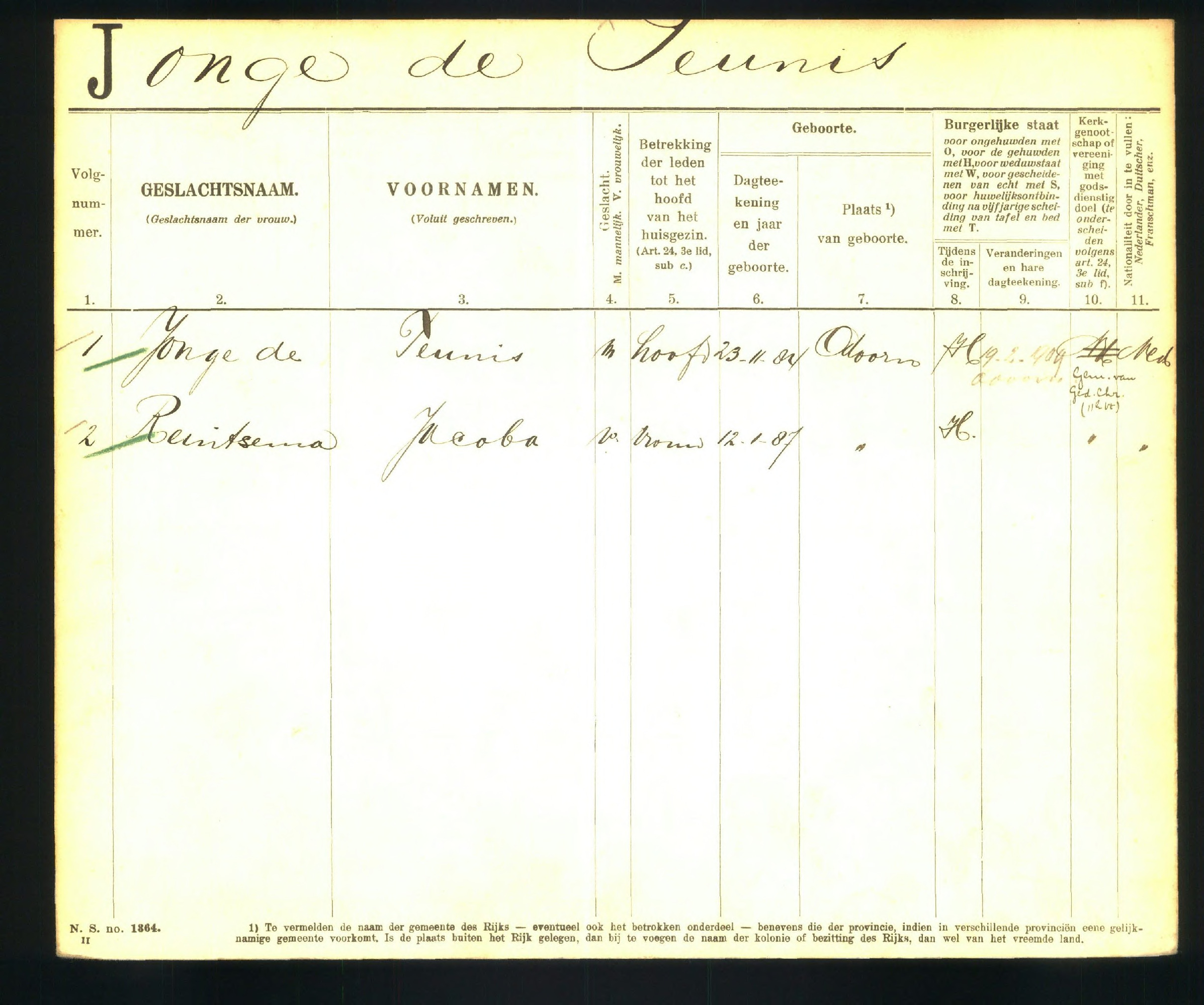 gezinskaart de Jonge-Reintsema 08233 p8233 1918-1936
https://www.drentsarchief.nl/onderzoeken/genealogie/bladeren-door-bronnen/registers/ https://www.wiewaswie.nl/nl/detail/14696925
Matches in other publications
This person also appears in the publication: View all
Historical events
Birthday November 23, 1884
- The temperature on November 23, 1884 was about 4.0 °C. The air pressure was 1 kgf/m2 and came mainly from the west-northwest. The airpressure was 76 cm mercury. The atmospheric humidity was 81%. Source: KNMI
- Koning Willem III (Huis van Oranje-Nassau) was from 1849 till 1890 sovereign of the Netherlands (also known as Koninkrijk der Nederlanden)
- In The Netherlands , there was from April 23, 1884 to April 21, 1888 the cabinet Heemskerk, with Mr. J. Heemskerk Azn. (conservatief) as prime minister.
- In the year 1884: Source: Wikipedia
- The Netherlands had about 4.5 million citizens.
- February 19 » More than sixty tornadoes strike the Southern United States, one of the largest tornado outbreaks in U.S. history.
- May 1 » The Federation of Organized Trades and Labor Unions demands the eight-hour work day in the United States.
- October 6 » The Naval War College of the United States is founded in Rhode Island.
- October 13 » The International Meridian Conference establishes the meridian of the Greenwich Observatory as the prime meridian.
- October 22 » The International Meridian Conference designates the Royal Observatory, Greenwich as the world's prime meridian.
- November 1 » The Gaelic Athletic Association is set up in Hayes's Hotel in Thurles, County Tipperary.
Day of marriage February 19, 1909
- The temperature on February 19, 1909 was between -2.9 °C and 6.4 °C and averaged 1.1 °C. There was 8.9 hours of sunshine (87%). The average windspeed was 3 Bft (moderate breeze) and was prevailing from the south east. Source: KNMI
- Koningin Wilhelmina (Huis van Oranje-Nassau) was from 1890 till 1948 sovereign of the Netherlands (also known as Koninkrijk der Nederlanden)
- In The Netherlands , there was from February 12, 1908 to August 29, 1913 the cabinet Heemskerk, with Mr. Th. Heemskerk (AR) as prime minister.
- In the year 1909: Source: Wikipedia
- The Netherlands had about 5.8 million citizens.
- February 26 » Kinemacolor, the first successful color motion picture process, is first shown to the general public at the Palace Theatre in London.
- April 11 » The city of Tel Aviv is founded.
- April 13 » The military of the Ottoman Empire reverses the Ottoman countercoup of 1909 to force the overthrow of Sultan Abdul Hamid II.
- May 13 » The first Giro d'Italia starts from Milan. Italian cyclist Luigi Ganna will be the winner.
- July 16 » Persian Constitutional Revolution: Mohammad Ali Shah Qajar is forced out as Shah of Persia and is replaced by his son Ahmad Shah Qajar.
- October 26 » An Jung-geun assassinates Japan's Resident-General of Korea.
Day of death April 15, 1944
- The temperature on April 15, 1944 was between 10.1 °C and 17.6 °C and averaged 13.5 °C. There was 0.2 mm of rain during 0.2 hours. There was 4.2 hours of sunshine (30%). The average windspeed was 3 Bft (moderate breeze) and was prevailing from the south-southeast. Source: KNMI
- Koningin Wilhelmina (Huis van Oranje-Nassau) was from 1890 till 1948 sovereign of the Netherlands (also known as Koninkrijk der Nederlanden)
- In The Netherlands , there was from July 27, 1941 to February 23, 1945 the cabinet Gerbrandy II, with Prof. dr. P.S. Gerbrandy (ARP) as prime minister.
- In the year 1944: Source: Wikipedia
- The Netherlands had about 9.1 million citizens.
- March 30 » World War II: Allied bombers conduct their most severe bombing run on Sofia, Bulgaria.
- June 4 » World War II: The United States Fifth Army captures Rome, although much of the German Fourteenth Army is able to withdraw to the north.
- September 3 » Holocaust: Diarist Anne Frank and her family are placed on the last transport train from the Westerbork transit camp to the Auschwitz concentration camp, arriving three days later.
- September 6 » World War II: The city of Ypres, Belgium is liberated by Allied forces.
- October 21 » World War II: The first kamikaze attack damages HMASAustralia as the Battle of Leyte Gulf begins.
- December 3 » Greek Civil War: Fighting breaks out in Athens between the ELAS and government forces supported by the British Army.
Same birth/death day
- 1883 » José Clemente Orozco, Mexican painter († 1949)
- 1886 » Eduards Smiļģis, Latvian actor and director († 1966)
- 1887 » Boris Karloff, English actor († 1969)
- 1887 » Henry Moseley, English physicist and chemist († 1915)
- 1888 » Harpo Marx, American comedian and musician († 1964)
- 1889 » Harry Sunderland, Australian-English journalist and businessman († 1964)
- 1942 » Robert Musil, Austrian-Swiss author and playwright (b. 1880)
- 1943 » Aristarkh Lentulov, Russian painter and set designer (b. 1882)
- 1944 » Nikolai Fyodorovich Vatutin, Russian general (b. 1901)
- 1945 » Hermann Florstedt, German SS officer (b. 1895)
- 1948 » Radola Gajda, Montenegrin-Czech general and politician (b. 1892)
- 1949 » Wallace Beery, American actor, director, and screenwriter (b. 1885)
About the surname De Jonge
- View the information that Genealogie Online has about the surname De Jonge.
- Check the information Open Archives has about De Jonge.
- Check the Wie (onder)zoekt wie? register to see who is (re)searching De Jonge.
The Local Heritage Book Barger-Compascuum publication was prepared by Pauline Berens BC.
When copying data from this family tree, please include a reference to the origin:
Pauline Berens BC, "Local Heritage Book Barger-Compascuum", database, Genealogy Online (https://www.genealogieonline.nl/ofb-barger-compascuum/I67693.php : accessed March 1, 2026), "Teunis de Jonge (1884-1944)".
Pauline Berens BC, "Local Heritage Book Barger-Compascuum", database, Genealogy Online (https://www.genealogieonline.nl/ofb-barger-compascuum/I67693.php : accessed March 1, 2026), "Teunis de Jonge (1884-1944)".