Local Heritage Book Barger-Compascuum » Karst Veeninga (1889-1973)
Personal data Karst Veeninga
- Also known as Veninga.
- He was born on November 14, 1889 in Emmen, Drenthe, Nederland.Source 1
- Profession: arbeider, veenarbeider.
- Resident: 1916 Zwartemeer | Klazienaveen | 01-1928 Barger-Compascuum.
- He died on February 15, 1973, he was 83 years old.Source 2
- He is buried in Klazienaveen, Gemeente Emmen, Drenthe, Nederland.Source 3
- A child of Willem Veeninga and Jantje Donker
- This information was last updated on January 16, 2025.
Household of Karst Veeninga
He is married to Anna Hof.
They got married on September 3, 1914 at Emmen, Gemeente Emmen, Drenthe, Nederland, he was 24 years old.Source 4
Child(ren):
- Wilhelm - Willem Veninga 1914-
- Aaltje Veeninga 1916-2003
- Dirk Veeninga 1922-1945
- Jantje Veeninga 1929-2016
Timeline Karst Veeninga
This functionality is only available in Javascript supporting browsers.
Click on the names for more info.
Symbols used:  grandparents
 parents
 brothers/sisters
 children
grandparents
parents
brothers/sisters
children
Ancestors (and descendant) of Karst Veeninga
Karst Veeninga | |||||||||||||||||||||||||||||||||||||
1914 | |||||||||||||||||||||||||||||||||||||
Anna Hof | |||||||||||||||||||||||||||||||||||||
Sources

https://www.wiewaswie.nl/nl/detail/111533120- https://www.online-begraafplaatsen.nl/graf/1444114/2259918/Karst-Veeninga-1889-1973
- https://www.online-begraafplaatsen.nl/graf/1444114/2259918/Karst-Veeninga-1889-1973
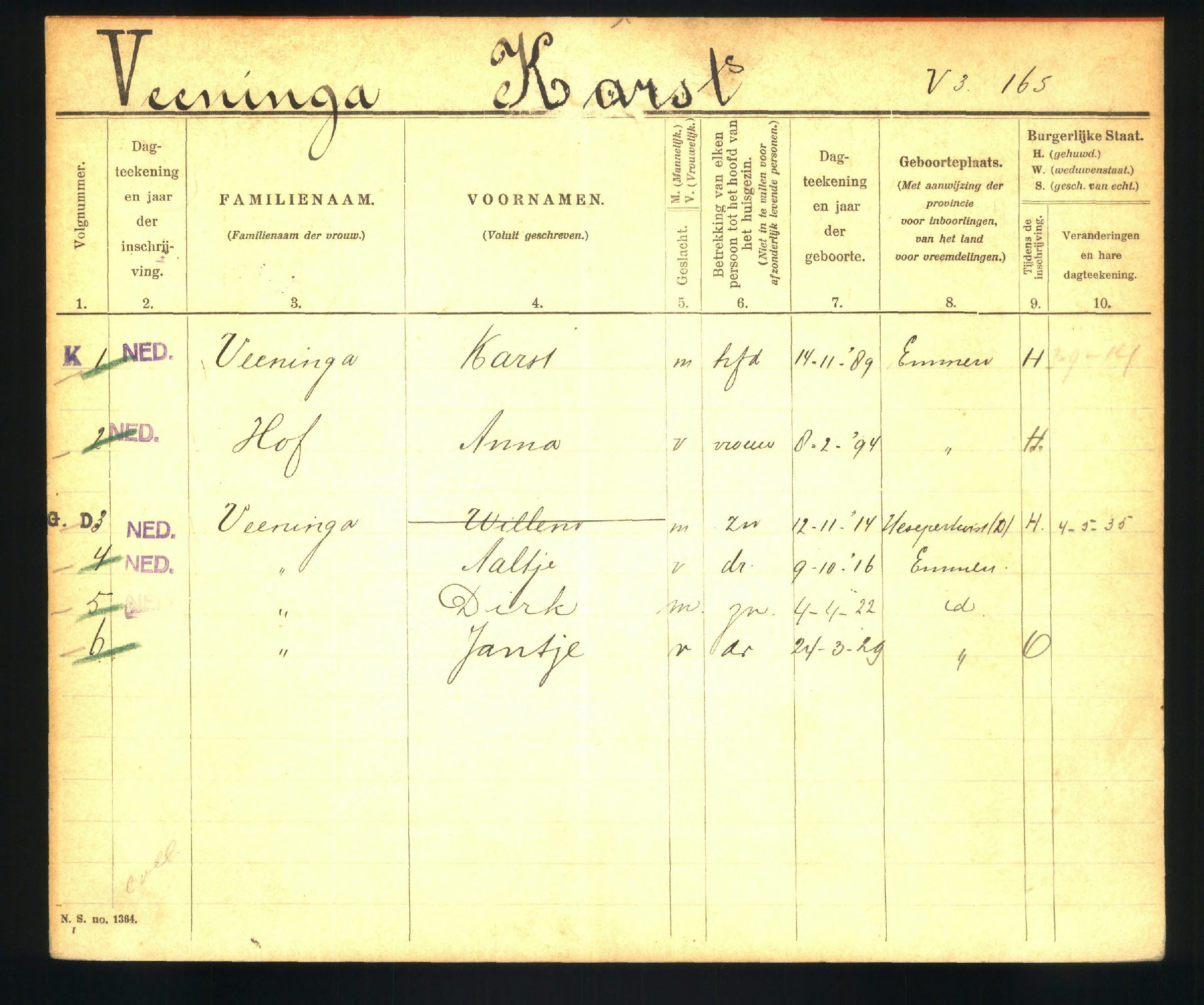 gezinskaart Veeninga-Hof 17821 p17821 1918-1936
https://www.drentsarchief.nl/onderzoeken/genealogie/bladeren-door-bronnen/registers/ https://www.wiewaswie.nl/nl/detail/14690980
Matches in other publications
This person also appears in the publication: View all
Historical events
Birthday November 14, 1889
- The temperature on November 14, 1889 was about 7.8 °C. The air pressure was 4 kgf/m2 and came mainly from the south-southeast. The airpressure was 77 cm mercury. The atmospheric humidity was 86%. Source: KNMI
- Koning Willem III (Huis van Oranje-Nassau) was from 1849 till 1890 sovereign of the Netherlands (also known as Koninkrijk der Nederlanden)
- In The Netherlands , there was from April 21, 1888 to August 21, 1891 the cabinet Mackay, with Mr. A. baron Mackay (AR) as prime minister.
- In the year 1889: Source: Wikipedia
- The Netherlands had about 4.5 million citizens.
- February 9 » US president Grover Cleveland signs a bill elevating the United States Department of Agriculture to a Cabinet-level agency.
- February 22 » President Grover Cleveland signs a bill admitting North Dakota, South Dakota, Montana and Washington as U.S. states.
- March 31 » The Eiffel Tower is officially opened.
- June 26 » Bangui is founded by Albert Dolisie and Alfred Uzac in what was then the upper reaches of the French Congo.
- September 23 » Nintendo Koppai (Later Nintendo Company, Limited) is founded by Fusajiro Yamauchi to produce and market the playing card game Hanafuda.
- November 11 » The State of Washington is admitted as the 42nd state of the United States.
Day of marriage September 3, 1914
- The temperature on September 3, 1914 was between 7.8 °C and 24.8 °C and averaged 16.2 °C. There was 11.3 hours of sunshine (84%). The average windspeed was 2 Bft (weak wind) and was prevailing from the northeast. Source: KNMI
- Koningin Wilhelmina (Huis van Oranje-Nassau) was from 1890 till 1948 sovereign of the Netherlands (also known as Koninkrijk der Nederlanden)
- In The Netherlands , there was from August 29, 1913 to September 9, 1918 the cabinet Cort van der Linden, with Mr. P.W.A. Cort van der Linden (liberaal) as prime minister.
- In the year 1914: Source: Wikipedia
- The Netherlands had about 6.2 million citizens.
- May 17 » The Protocol of Corfu is signed, recognising full autonomy to Northern Epirus under nominal Albanian sovereignty.
- August 12 » World War I: The Battle of Halen a.k.a. Battle of the Silver Helmets a clash between large Belgian and German cavalry formations at Halen, Belgium.
- August 27 » World War I: Battle of Étreux: A British rearguard action by the Royal Munster Fusiliers during the Great Retreat.
- August 28 » World War I: The Royal Navy defeats the German fleet in the Battle of Heligoland Bight.
- August 29 » World War I: Start of the Battle of St. Quentin in which the French Fifth Army counter-attacked the invading Germans at Saint-Quentin, Aisne.
- October 29 » Ottoman entry into World War I.
Day of death February 15, 1973
- The temperature on February 15, 1973 was between 0.4 °C and 5.4 °C and averaged 2.5 °C. There was -0.1 mm of rain. There was 0.2 hours of sunshine (2%). The partly or heavily clouded was. The average windspeed was 3 Bft (moderate breeze) and was prevailing from the east-southeast. Source: KNMI
- Koningin Juliana (Huis van Oranje-Nassau) was from September 4, 1948 till April 30, 1980 sovereign of the Netherlands (also known as Koninkrijk der Nederlanden)
- In The Netherlands , there was from Thursday, July 20, 1972 to Friday, May 11, 1973 the cabinet Biesheuvel II, with Mr. B.W. Biesheuvel (ARP) as prime minister.
- In The Netherlands , there was from Friday, May 11, 1973 to Monday, December 19, 1977 the cabinet Den Uyl, with Drs. J.M. den Uyl (PvdA) as prime minister.
- In the year 1973: Source: Wikipedia
- The Netherlands had about 13.4 million citizens.
- March 1 » Black September storms the Saudi embassy in Khartoum, Sudan, resulting in the assassination of three Western hostages.
- April 10 » Invicta International Airlines Flight 435 crashes in a snowstorm on approach to Basel, Switzerland, killing 108 people.
- July 25 » Soviet Mars 5 space probe is launched.
- October 25 » Egypt and Israel accept United Nations Security Council Resolution 339.
- October 31 » Mountjoy Prison helicopter escape. Three Provisional Irish Republican Army members escape from Mountjoy Prison, Dublin aboard a hijacked helicopter that landed in the exercise yard.
- November 3 » Mariner program: NASA launches the Mariner 10 toward Mercury. On March 29, 1974, it becomes the first space probe to reach that planet.
Same birth/death day
- 1883 » Ado Birk, Estonian lawyer and politician, 3rd Prime Minister of Estonia († 1942)
- 1889 » Jawaharlal Nehru, Indian lawyer and politician, 1st Prime Minister of India († 1964)
- 1891 » Frederick Banting, Canadian physician and academic, Nobel Prize laureate († 1941)
- 1895 » Walter Jackson Freeman II, American physician and psychiatrist († 1972)
- 1897 » John Steuart Curry, American painter and academic († 1946)
- 1898 » Benjamin Fondane, Romanian-French philosopher, poet, and critic († 1944)
- 1966 » Gerard Antoni Ciołek, Polish architect and historian (b. 1909)
- 1967 » Antonio Moreno, Spanish-American actor and director (b. 1887)
- 1970 » Hugh Dowding, 1st Baron Dowding, Scottish air marshal (b. 1882)
- 1973 » Tim Holt, American actor (b. 1919)
- 1973 » Wally Cox, American actor (b. 1924)
- 1974 » Kurt Atterberg, Swedish composer and engineer (b. 1887)
About the surname Veeninga
- View the information that Genealogie Online has about the surname Veeninga.
- Check the information Open Archives has about Veeninga.
- Check the Wie (onder)zoekt wie? register to see who is (re)searching Veeninga.
The Local Heritage Book Barger-Compascuum publication was prepared by Pauline Berens BC.
When copying data from this family tree, please include a reference to the origin:
Pauline Berens BC, "Local Heritage Book Barger-Compascuum", database, Genealogy Online (https://www.genealogieonline.nl/ofb-barger-compascuum/I67095.php : accessed January 22, 2026), "Karst Veeninga (1889-1973)".
Pauline Berens BC, "Local Heritage Book Barger-Compascuum", database, Genealogy Online (https://www.genealogieonline.nl/ofb-barger-compascuum/I67095.php : accessed January 22, 2026), "Karst Veeninga (1889-1973)".