Local Heritage Book Barger-Compascuum » Luttina Kok (1886-1957)
Personal data Luttina Kok
- She was born on December 18, 1886 in Tweede Exloërmond, Valthermond, Borger-Odoorn, Drenthe, Nederland.Source 1
- Profession: arbeider, arbeidster.
- Resident: gemeente Odoorn | 12-03-1901 Emmer-Compascuum | 1928 Barger-Compascuum | Klazienaveen | Emmer-Erfscheidenveen.
- She died on August 19, 1957, she was 70 years old.Source 2
- She is buried in Emmer-Compascuum, Gemeente Emmen, Drenthe, Nederland.Source 3
- A child of Paulus Kok and Geeske - Geesje Bosma
- This information was last updated on August 26, 2023.
Household of Luttina Kok
She is married to Albert Huizinga.
They got married on October 24, 1907 at Emmen, Gemeente Emmen, Drenthe, Nederland, she was 20 years old.Source 4
Child(ren):
- Klaassien Huizinga 1907-2003
- Pauwel Huizinga 1909-1909
- Geesje Huizinga 1914-
- Jan Huizinga 1916-1917
- Jantina Huizinga 1918-
- Paulina Huizinga 1920-2012
- Jan Huizinga 1922-
- Pauwel - Paul Huizinga 1923-2009
- Leentje Huizinga 1925-2005
- Gesinus Huizinga 1926-1993
- Grietus Huizinga 1927-1928
- Albert Huizinga 1929-1950
Timeline Luttina Kok
This functionality is only available in Javascript supporting browsers.
Click on the names for more info.
Symbols used:  grandparents
 parents
 brothers/sisters
 children
grandparents
parents
brothers/sisters
children
Ancestors (and descendant) of Luttina Kok
Luttina Kok | |||||||||||||||||||||||||||||||||||||||||||||||||||||||||||||||||||||||||||
1907 | |||||||||||||||||||||||||||||||||||||||||||||||||||||||||||||||||||||||||||
Albert Huizinga | |||||||||||||||||||||||||||||||||||||||||||||||||||||||||||||||||||||||||||
Sources

https://www.drentsarchief.nl/onderzoeken/genealogie/bladeren-door-bronnen/registers/ gezinskaart 1918-1936gemeente Odoorn
- https://www.wiewaswie.nl/nl/detail/32493053 https://www.online-begraafplaatsen.nl/graf/1641314/2617810/Luttina-Kok-1886-1957
- https://www.online-begraafplaatsen.nl/graf/1641314/2617810/Luttina-Kok-1886-1957
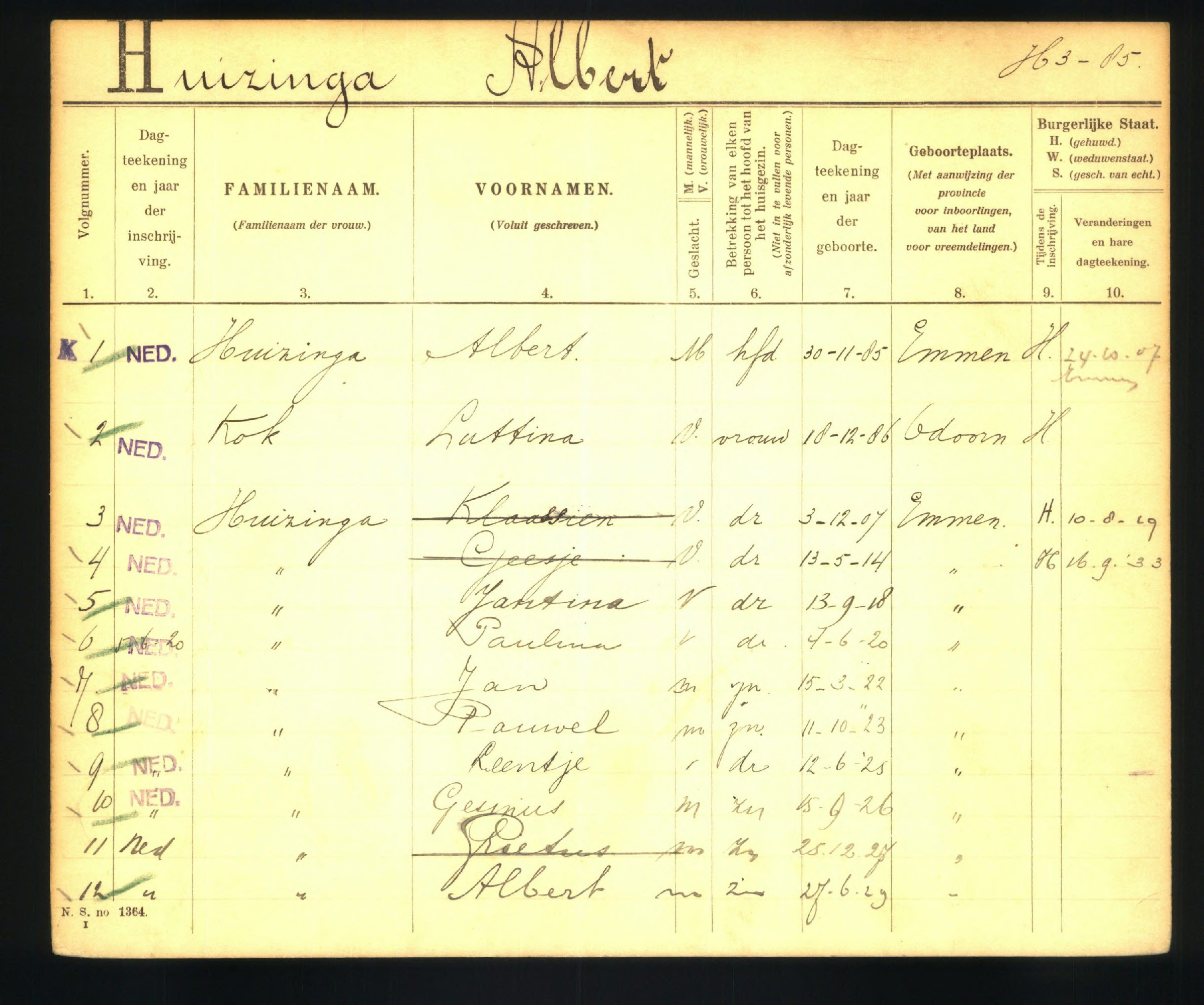 gezinskaart Huizinga-Kok 07355 p7355 1918-1936
https://www.drentsarchief.nl/onderzoeken/genealogie/bladeren-door-bronnen/registers/ https://www.wiewaswie.nl/nl/detail/14682715
Matches in other publications
This person also appears in the publication: View all
- Stamboom Mink
- Stamboom Klavers
- Het geslacht Jacob Hindriks Bosma, one author has confirmed this is the same person
Historical events
Birthday December 18, 1886
- The temperature on December 18, 1886 was about 1.0 °C. There was 6 mm of rain. The air pressure was 4 kgf/m2 and came mainly from the north. The airpressure was 75 cm mercury. The atmospheric humidity was 98%. Source: KNMI
- Koning Willem III (Huis van Oranje-Nassau) was from 1849 till 1890 sovereign of the Netherlands (also known as Koninkrijk der Nederlanden)
- In The Netherlands , there was from April 23, 1884 to April 21, 1888 the cabinet Heemskerk, with Mr. J. Heemskerk Azn. (conservatief) as prime minister.
- In the year 1886: Source: Wikipedia
- The Netherlands had about 4.5 million citizens.
- January 18 » Modern field hockey is born with the formation of The Hockey Association in England.
- January 29 » Karl Benz patents the first successful gasoline-driven automobile.
- March 29 » John Pemberton brews the first batch of Coca-Cola in a backyard in Atlanta.
- May 29 » The pharmacist John Pemberton places his first advertisement for Coca-Cola, which appeared in The Atlanta Journal.
- July 4 » The Canadian Pacific Railway's first scheduled train from Montreal arrives in Port Moody on the Pacific coast, after six days of travel.
- November 27 » German judge Emil Hartwich sustains fatal injuries in a duel, which would become the background for Theodor Fontane's Effi Briest.
Day of marriage October 24, 1907
- The temperature on October 24, 1907 was between 8.6 °C and 11.4 °C and averaged 10.0 °C. There was 5.4 mm of rain. The average windspeed was 2 Bft (weak wind) and was prevailing from the southwest. Source: KNMI
- Koningin Wilhelmina (Huis van Oranje-Nassau) was from 1890 till 1948 sovereign of the Netherlands (also known as Koninkrijk der Nederlanden)
- In The Netherlands , there was from August 17, 1905 to February 11, 1908 the cabinet De Meester, with Mr. Th. de Meester (unie-liberaal) as prime minister.
- In the year 1907: Source: Wikipedia
- The Netherlands had about 5.6 million citizens.
- January 14 » An earthquake in Kingston, Jamaica kills more than 1,000 people.
- April 15 » Triangle Fraternity is founded at the University of Illinois at Urbana–Champaign.
- August 29 » The Quebec Bridge collapses during construction, killing 75 workers.
- September 30 » The McKinley National Memorial, the final resting place of assassinated U.S. President William McKinley and his family, is dedicated in Canton, Ohio.
- December 16 » The American Great White Fleet begins its circumnavigation of the world.
- December 21 » The Chilean Army commits a massacre of at least 2,000 striking saltpeter miners in Iquique, Chile.
Day of death August 19, 1957
- The temperature on August 19, 1957 was between 11.8 °C and 20.0 °C and averaged 16.0 °C. There was 0.1 mm of rain during 0.3 hours. There was 7.6 hours of sunshine (52%). The partly or heavily clouded was. The average windspeed was 3 Bft (moderate breeze) and was prevailing from the west. Source: KNMI
- Koningin Juliana (Huis van Oranje-Nassau) was from September 4, 1948 till April 30, 1980 sovereign of the Netherlands (also known as Koninkrijk der Nederlanden)
- In The Netherlands , there was from October 13, 1956 to December 22, 1957 the cabinet Drees III, with Dr. W. Drees (PvdA) as prime minister.
- In the year 1957: Source: Wikipedia
- The Netherlands had about 11.0 million citizens.
- March 8 » The 1957 Georgia Memorial to Congress, which petitions the U.S. Congress to declare the ratification of the 14th and 15th Amendments to the U.S. Constitution null and void, is adopted by the U.S. state of Georgia.
- May 22 » South Africa's government approves of racial separation in universities.
- June 24 » In Roth v. United States, the U.S. Supreme Court rules that obscenity is not protected by the First Amendment.
- August 1 » The United States and Canada form the North American Aerospace Defense Command (NORAD).
- September 22 » In Haiti, François Duvalier is elected president.
- October 29 » Israel's prime minister David Ben-Gurion and five of his ministers are injured when Moshe Dwek throws a grenade into Israel's Knesset.
Same birth/death day
- 1882 » Richard Maury, American-Argentinian engineer, designed the Salta–Antofagasta railway († 1950)
- 1884 » Emil Starkenstein, Czech pharmacologist, co-founded clinical pharmacology († 1942)
- 1886 » Ty Cobb, American baseball player and manager († 1961)
- 1887 » Bhikhari Thakur, Indian actor, singer, and playwright († 1971)
- 1888 » Gladys Cooper, English actress and singer († 1971)
- 1888 » Robert Moses, American urban planner († 1981)
- 1950 » Giovanni Giorgi, Italian physicist and engineer (b. 1871)
- 1954 » Alcide De Gasperi, Italian journalist and politician, 30th Prime Minister of Italy (b. 1881)
- 1957 » David Bomberg, English soldier and painter (b. 1890)
- 1967 » Hugo Gernsback, Luxembourg-born American author and publisher (b. 1884)
- 1967 » Isaac Deutscher, Polish-English journalist and historian (b. 1907)
- 1968 » George Gamow, Ukrainian-American physicist and cosmologist (b. 1904)
About the surname Kok
- View the information that Genealogie Online has about the surname Kok.
- Check the information Open Archives has about Kok.
- Check the Wie (onder)zoekt wie? register to see who is (re)searching Kok.
The Local Heritage Book Barger-Compascuum publication was prepared by Pauline Berens BC.
When copying data from this family tree, please include a reference to the origin:
Pauline Berens BC, "Local Heritage Book Barger-Compascuum", database, Genealogy Online (https://www.genealogieonline.nl/ofb-barger-compascuum/I66813.php : accessed March 15, 2026), "Luttina Kok (1886-1957)".
Pauline Berens BC, "Local Heritage Book Barger-Compascuum", database, Genealogy Online (https://www.genealogieonline.nl/ofb-barger-compascuum/I66813.php : accessed March 15, 2026), "Luttina Kok (1886-1957)".