Local Heritage Book Barger-Compascuum » Hasiena Aaltina de Jonge (1897-1994)
Personal data Hasiena Aaltina de Jonge
- Also known as van Beilen.
- She was born on January 9, 1897 in Barger-Oosterveen, Gemeente Emmen, Drenthe, Nederland.Source 1
- Resident: Zwartemeer | Barger-Compascuum | Nieuw-Weerdinge | Klazienaveen.
- She died on September 22, 1994, she was 97 years old.Source 2
- She is buried in Emmen, Gemeente Emmen, Drenthe, Nederland.Source 3
- A child of Albert de Jonge and Hielkje van der Meer
- This information was last updated on April 15, 2023.
Household of Hasiena Aaltina de Jonge
She is married to Harm van Beilen.
They got married on April 16, 1921 at Emmen, Gemeente Emmen, Drenthe, Nederland, she was 24 years old.Source 4
Child(ren):
- Antje van Beilen 1922-2005
- Hielkje van Beilen 1927-2013
Timeline Hasiena Aaltina de Jonge
This functionality is only available in Javascript supporting browsers.
Click on the names for more info.
Symbols used:  grandparents
 parents
 brothers/sisters
 children
grandparents
parents
brothers/sisters
children
Ancestors (and descendant) of Hasiena Aaltina de Jonge
Hasiena Aaltina de Jonge | |||||||||||||||||||||||||||||||||||
1921 | |||||||||||||||||||||||||||||||||||
Harm van Beilen | |||||||||||||||||||||||||||||||||||
Sources

https://www.drentsarchief.nl/onderzoeken/genealogie/bladeren-door-bronnen/registers/ gezinskaart 1918-1936
https://www.wiewaswie.nl/nl/detail/14524661- https://www.online-begraafplaatsen.nl/graf/1117385/1683683/Hasiena-Aaltina-de-Jonge-1897-1994
- https://www.online-begraafplaatsen.nl/graf/1117385/1683683/Hasiena-Aaltina-de-Jonge-1897-1994
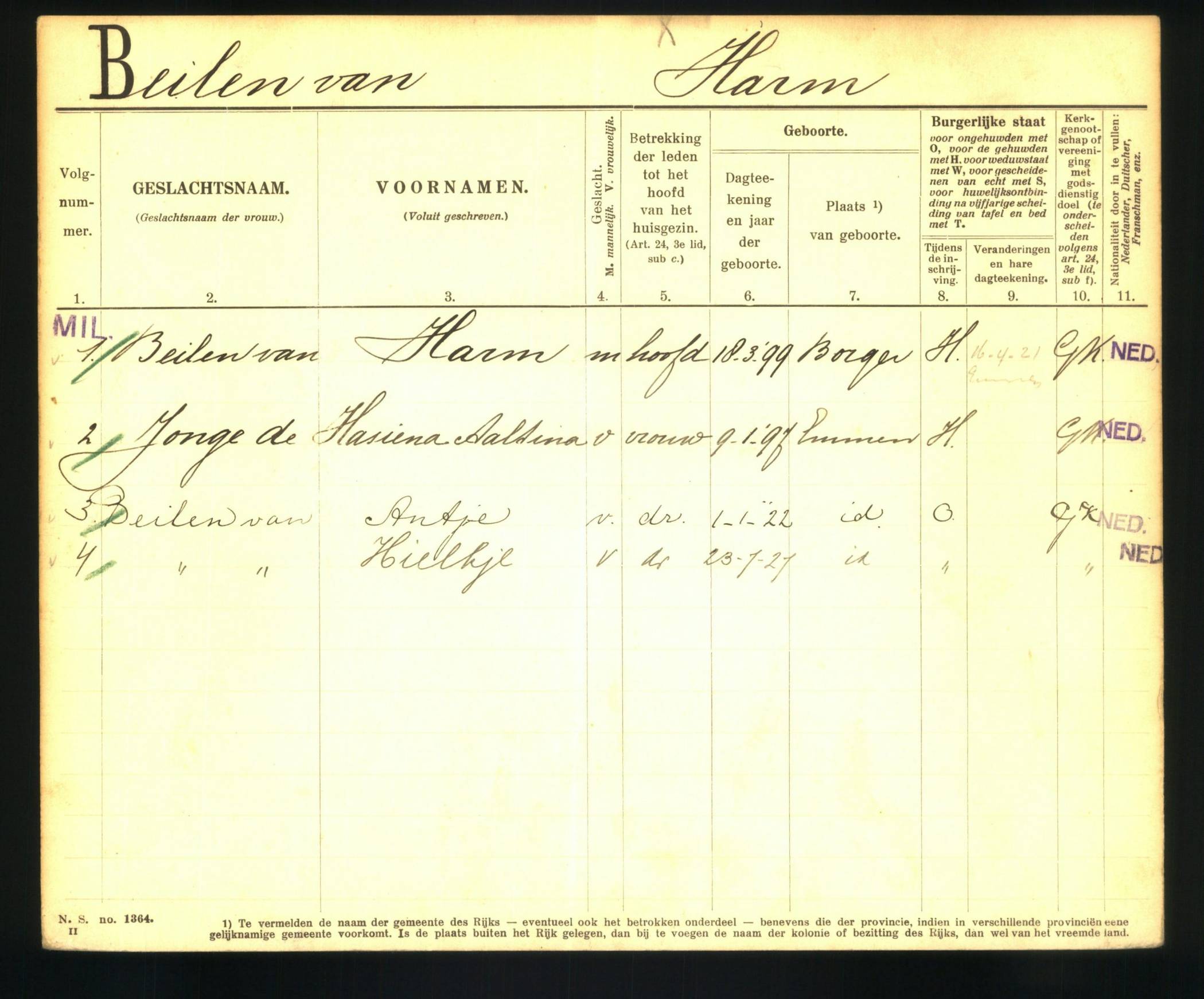 gezinskaart van Beilen-de Jonge scan 680612 #691 1918-1936
https://www.drentsarchief.nl/onderzoeken/genealogie/bladeren-door-bronnen/registers/
Matches in other publications
This person also appears in the publication: View all
Historical events
Birthday January 9, 1897
- The temperature on January 9, 1897 was about -0.8 °C. The airpressure was 75 cm mercury. The atmospheric humidity was 100%. Source: KNMI
- Koningin Wilhelmina (Huis van Oranje-Nassau) was from 1890 till 1948 sovereign of the Netherlands (also known as Koninkrijk der Nederlanden)
- Regentes Emma (Huis van Oranje-Nassau) was from 1890 till 1898 sovereign of the Netherlands (also known as Koninkrijk der Nederlanden)
- In The Netherlands , there was from May 9, 1894 to July 27, 1897 the cabinet Roëll, with Jonkheer mr. J. Roëll (oud-liberaal) as prime minister.
- In The Netherlands , there was from July 27, 1897 to August 1, 1901 the cabinet Pierson, with Mr. N.G. Pierson (unie-liberaal) as prime minister.
- In the year 1897: Source: Wikipedia
- The Netherlands had about 5.1 million citizens.
- July 2 » British-Italian engineer Guglielmo Marconi obtains a patent for radio in London.
- July 11 » Salomon August Andrée leaves Spitsbergen to attempt to reach the North Pole by balloon. He later crashes and dies.
- September 10 » Lattimer massacre: A sheriff's posse kills 19 unarmed striking immigrant miners in Lattimer, Pennsylvania, United States.
- November 1 » The first Library of Congress building opens its doors to the public; the library had previously been housed in the Congressional Reading Room in the U.S. Capitol.
- December 6 » London becomes the world's first city to host licensed taxicabs.
- December 30 » The British Colony of Natal annexes Zululand.
Day of marriage April 16, 1921
- The temperature on April 16, 1921 was between -4.1 °C and 6.6 °C and averaged 1.1 °C. There was 2.5 mm of rain. There was 2.2 hours of sunshine (16%). The average windspeed was 2 Bft (weak wind) and was prevailing from the southwest. Source: KNMI
- Koningin Wilhelmina (Huis van Oranje-Nassau) was from 1890 till 1948 sovereign of the Netherlands (also known as Koninkrijk der Nederlanden)
- In The Netherlands , there was from September 9, 1918 to September 18, 1922 the cabinet Ruys de Beerenbrouck I, with Jonkheer mr. Ch.J.M. Ruys de Beerenbrouck (RKSP) as prime minister.
- In the year 1921: Source: Wikipedia
- The Netherlands had about 6.9 million citizens.
- January 20 » The British K-class submarine HMS K5 sinks in the English Channel; all 56 on board die.
- February 21 » Rezā Shāh takes control of Tehran during a successful coup.
- March 17 » The Second Polish Republic adopts the March Constitution.
- June 30 » U.S. President Warren G. Harding appoints former President William Howard Taft as Chief Justice of the United States.
- July 23 » The Communist Party of China (CPC) is established at the founding National Congress.
- September 11 » Nahalal, the first moshav in Palestine, is settled as part of a Zionist plan of creating a Jewish state, later to be Israel.
Day of death September 22, 1994
- The temperature on September 22, 1994 was between 8.5 °C and 18.1 °C and averaged 12.5 °C. There was 8.0 hours of sunshine (65%). The partly clouded was. The average windspeed was 2 Bft (weak wind) and was prevailing from the east-northeast. Source: KNMI
- Koningin Beatrix (Huis van Oranje-Nassau) was from April 30, 1980 till April 30, 2013 sovereign of the Netherlands (also known as Koninkrijk der Nederlanden)
- In The Netherlands , there was from Tuesday, November 7, 1989 to Monday, August 22, 1994 the cabinet Lubbers III, with Drs. R.F.M. Lubbers (CDA) as prime minister.
- In The Netherlands , there was from Monday, August 22, 1994 to Monday, August 3, 1998 the cabinet a href="https://nl.wikipedia.org/wiki/Kabinet-Kok_I" class="extern">Kok I, with W. Kok (PvdA) as prime minister.
- In the year 1994: Source: Wikipedia
- The Netherlands had about 15.3 million citizens.
- February 5 » Markale massacres, more than 60 people are killed and some 200 wounded as a mortar shell explodes in a downtown marketplace in Sarajevo.
- July 4 » Rwandan genocide: Kigali, the Rwandan capital, is captured by the Rwandan Patriotic Front, ending the genocide in the city.
- September 16 » The British government lifts the broadcasting ban imposed against members of Sinn Féin and Irish paramilitary groups in 1988.
- September 30 » Ongar railway station, the furthest London Underground from central London, closes.
- November 19 » In the United Kingdom, the first National Lottery draw is held. A £1 ticket gave a one-in-14-million chance of correctly guessing the winning six out of 49 numbers.
- December 10 » Rwandan genocide: Maurice Baril, military advisor to the U.N. Secretary-General and head of the Military Division of the Department of Peacekeeping Operations, recommends that UNAMIR stand down.
Same birth/death day
- 1893 » Edwin Baker, Canadian soldier and educator, co-founded the Canadian National Institute for the Blind († 1968)
- 1896 » Warwick Braithwaite, New Zealand-English conductor and director († 1971)
- 1897 » Karl Löwith, German philosopher, author, and academic († 1973)
- 1898 » Gracie Fields, English actress and singer († 1979)
- 1899 » Harald Tammer, Estonian journalist and weightlifter († 1942)
- 1900 » Richard Halliburton, American journalist and author († 1939)
- 1989 » Ambrose Folorunsho Alli, Nigerian academic and politician (b. 1929)
- 1992 » Aurelio López, Mexican baseball player (b. 1948)
- 1993 » Maurice Abravanel, Greek-American pianist and conductor (b. 1903)
- 1994 » Leonard Feather, English-American pianist, composer, producer, and journalist (b. 1914)
- 1996 » Dorothy Lamour, American actress and singer (b. 1914)
- 1996 » Ludmilla Chiriaeff, Latvian-Canadian ballerina, choreographer, and director (b. 1924)
About the surname De Jonge
- View the information that Genealogie Online has about the surname De Jonge.
- Check the information Open Archives has about De Jonge.
- Check the Wie (onder)zoekt wie? register to see who is (re)searching De Jonge.
The Local Heritage Book Barger-Compascuum publication was prepared by Pauline Berens BC.
When copying data from this family tree, please include a reference to the origin:
Pauline Berens BC, "Local Heritage Book Barger-Compascuum", database, Genealogy Online (https://www.genealogieonline.nl/ofb-barger-compascuum/I62222.php : accessed March 16, 2026), "Hasiena Aaltina de Jonge (1897-1994)".
Pauline Berens BC, "Local Heritage Book Barger-Compascuum", database, Genealogy Online (https://www.genealogieonline.nl/ofb-barger-compascuum/I62222.php : accessed March 16, 2026), "Hasiena Aaltina de Jonge (1897-1994)".