Local Heritage Book Barger-Compascuum » Hermann Wilken (1906-1944)
Personal data Hermann Wilken
- He was born in the year 1906 in Wesuwe, Haren (Ems), Landkreis Emsland, Lower Saxony, Germany.Source 1
- He was christened in Wesuwe, Haren (Ems), Landkreis Emsland, Lower Saxony, Germany.
- He died on July 22, 1944, he was 38 years old.Source 2
- A child of Johann Gerhard Wilken and Maria Margaretha Krüssel
- This information was last updated on May 6, 2021.
Household of Hermann Wilken
Timeline Hermann Wilken
This functionality is only available in Javascript supporting browsers.
Click on the names for more info.
Symbols used:  grandparents
 parents
 brothers/sisters
 children
grandparents
parents
brothers/sisters
children
Ancestors (and descendant) of Hermann Wilken
Hermann Wilken | ||||||||||||||||||
Sources

Johan Bernard (Broer) Berens: burgerlijke stand en/of kerkboeken DTB https://fjmblom.home.xs4all.nl/Pauline Berens: Genealogienetwerk zus Greetje Berens voorheen EemslandBoekweitBoerenImmigratie
https://www.genealogieonline.nl/the-dutch-connection/I5960.php- Johan Bernard (Broer) Berens: burgerlijke stand en/of kerkboeken DTB https://fjmblom.home.xs4all.nl/dutchconnection/hebelermeer-kriegerdenkmal.jpg https://nl.wikipedia.org/wiki/Slachtoffers_in_de_Tweede_Wereldoorlog https://fjmblom.home.xs4all.nl/
vermist in WOII
Matches in other publications
This person also appears in the publication: View all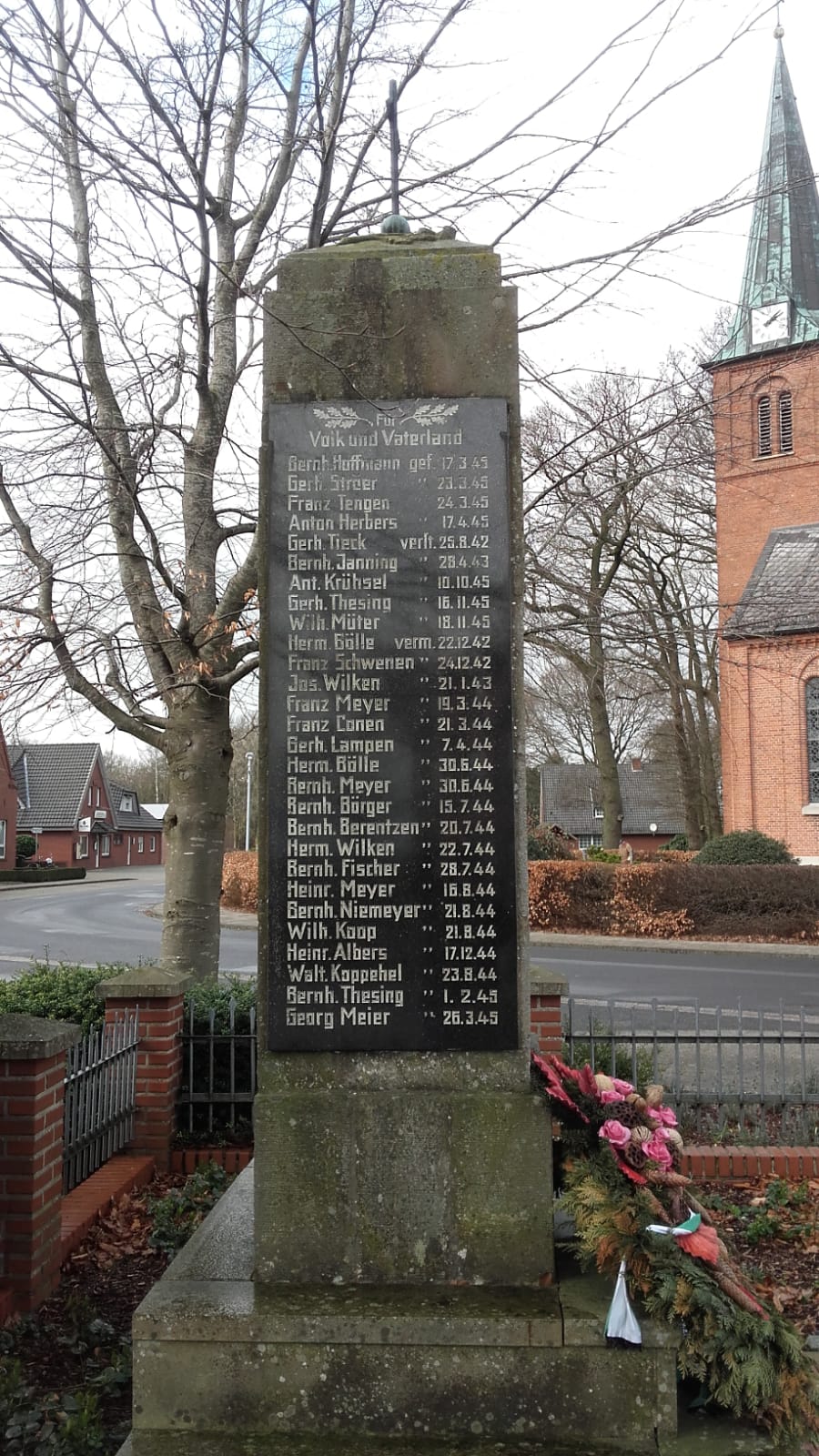
Historical events
Day of death July 22, 1944
- The temperature on July 22, 1944 was between 12.7 °C and 18.4 °C and averaged 15.4 °C. There was 1.0 mm of rain during 0.8 hours. There was 0.9 hours of sunshine (6%). The average windspeed was 3 Bft (moderate breeze) and was prevailing from the north. Source: KNMI
- Koningin Wilhelmina (Huis van Oranje-Nassau) was from 1890 till 1948 sovereign of the Netherlands (also known as Koninkrijk der Nederlanden)
- In The Netherlands , there was from July 27, 1941 to February 23, 1945 the cabinet Gerbrandy II, with Prof. dr. P.S. Gerbrandy (ARP) as prime minister.
- In the year 1944: Source: Wikipedia
- The Netherlands had about 9.1 million citizens.
- June 9 » World War II: The Soviet Union invades East Karelia and the previously Finnish part of Karelia, occupied by Finland since 1941.
- June 22 » U.S. President Franklin D. Roosevelt signs into law the Servicemen's Readjustment Act of 1944, commonly known as the G.I. Bill.
- July 9 » World War II: Continuation War: Finland wins the Battle of Tali-Ihantala, the largest battle ever fought in northern Europe. The Red Army withdraws its troops from Ihantala and digs into a defensive position, thus ending the Vyborg–Petrozavodsk Offensive.
- August 26 » World War II: Charles de Gaulle enters Paris.
- September 25 » World War II: Surviving elements of the British 1st Airborne Division withdraw from Arnhem via Oosterbeek.
- December 28 » Maurice Richard becomes the first player to score eight points in one game of NHL ice hockey.
Same birth/death day
- 1934 » John Dillinger, American gangster (b. 1903)
- 1937 » Ted McDonald, Australian cricketer and footballer (b. 1891)
- 1940 » Albert Young, American boxer and promoter (b. 1877)
- 1940 » George Fuller, Australian politician, 22nd Premier of New South Wales (b. 1861)
- 1948 » Rūdolfs Jurciņš, Latvian basketball player (b. 1909)
- 1950 » William Lyon Mackenzie King, Canadian economist and politician, 10th Prime Minister of Canada (b. 1874)
About the surname Wilken
- View the information that Genealogie Online has about the surname Wilken.
- Check the information Open Archives has about Wilken.
- Check the Wie (onder)zoekt wie? register to see who is (re)searching Wilken.
The Local Heritage Book Barger-Compascuum publication was prepared by Pauline Berens BC.
When copying data from this family tree, please include a reference to the origin:
Pauline Berens BC, "Local Heritage Book Barger-Compascuum", database, Genealogy Online (https://www.genealogieonline.nl/ofb-barger-compascuum/I5960.php : accessed February 23, 2026), "Hermann Wilken (1906-1944)".
Pauline Berens BC, "Local Heritage Book Barger-Compascuum", database, Genealogy Online (https://www.genealogieonline.nl/ofb-barger-compascuum/I5960.php : accessed February 23, 2026), "Hermann Wilken (1906-1944)".