Local Heritage Book Barger-Compascuum » Anna Maria Wehkamp (1923-1944)
Personal data Anna Maria Wehkamp
- She was born on September 16, 1923 in Barger-Compascuum, Gemeente Emmen, Drenthe, Nederland.Source 1
- Resident: Barger-Compascuum.
- She died on July 27, 1944 in Hoogeveen, Gemeente Hoogeveen, Drenthe, Nederland, she was 20 years old.Source 2
- She is buried on July 31, 1944 in Barger-Compascuum, Gemeente Emmen, Drenthe, Nederland.Source 3
- A child of Jan Hendrik Wehkamp and Maria Helena Suelmann
- This information was last updated on December 17, 2023.
Household of Anna Maria Wehkamp
Timeline Anna Maria Wehkamp
This functionality is only available in Javascript supporting browsers.
Click on the names for more info.
Symbols used:  grandparents
 parents
 brothers/sisters
 children
grandparents
parents
brothers/sisters
children
Ancestors (and descendant) of Anna Maria Wehkamp
Anna Maria Wehkamp | ||||||||||||||||||
Sources

https://www.drentsarchief.nl/onderzoeken/genealogie/bladeren-door-bronnen/registers/ gezinskaart 1918-1936- https://www.ngv-afdelingen.nl/dre/bidprentjes/
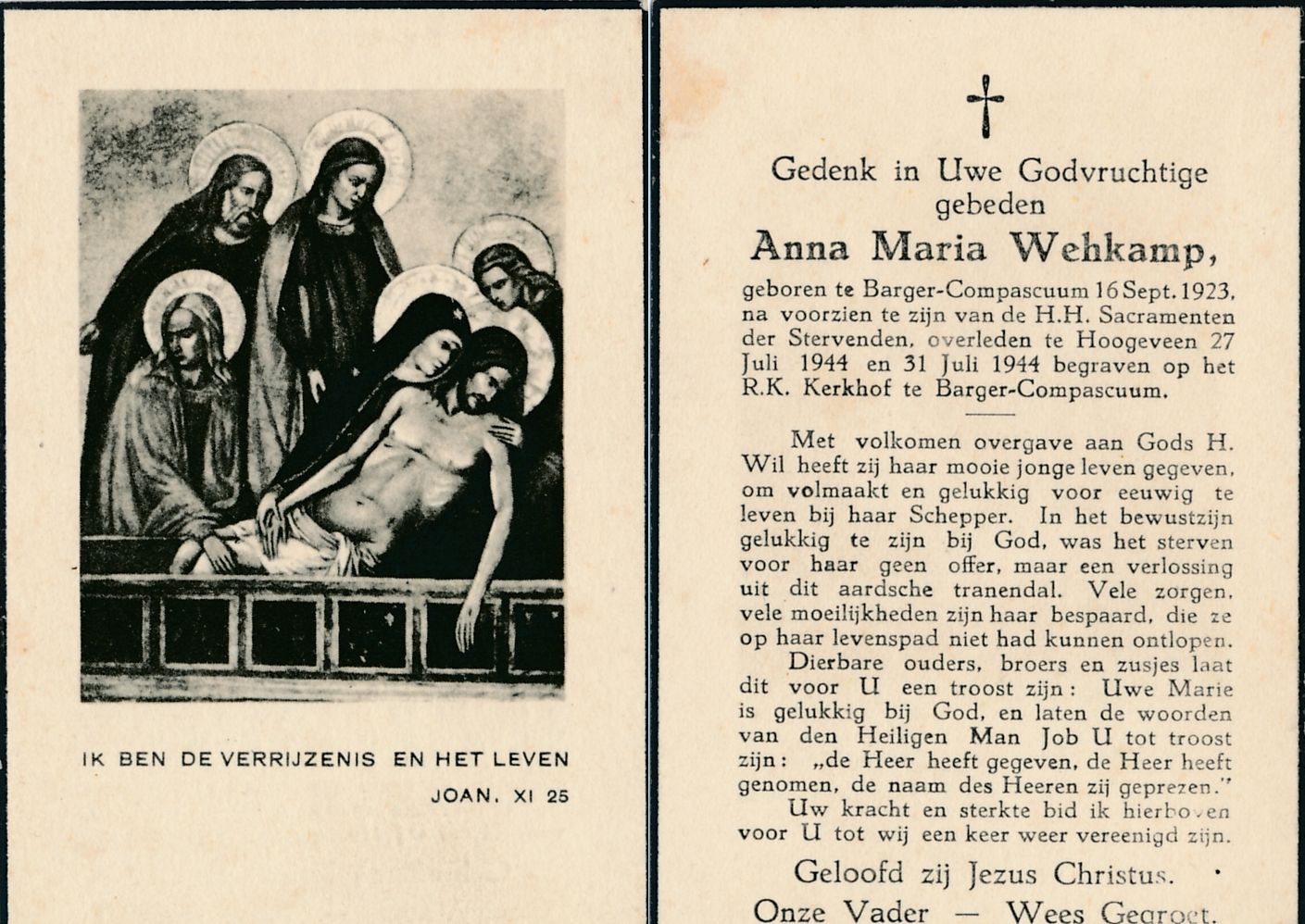 Anna Maria Wehkamp bidprentje
https://www.online-begraafplaatsen.nl/graf/1392388/2167445/Anna-Maria-Wehkamp-1923-1944
Matches in other publications
This person also appears in the publication: View all
Historical events
Birthday September 16, 1923
- The temperature on September 16, 1923 was between 7.7 °C and 17.3 °C and averaged 12.1 °C. There was 10.9 hours of sunshine (86%). The average windspeed was 3 Bft (moderate breeze) and was prevailing from the southwest. Source: KNMI
- Koningin Wilhelmina (Huis van Oranje-Nassau) was from 1890 till 1948 sovereign of the Netherlands (also known as Koninkrijk der Nederlanden)
- In The Netherlands , there was from September 19, 1922 to August 4, 1925 the cabinet Ruys de Beerenbrouck II, with Jonkheer mr. Ch.J.M. Ruys de Beerenbrouck (RKSP) as prime minister.
- In the year 1923: Source: Wikipedia
- The Netherlands had about 7.1 million citizens.
- February 10 » Texas Tech University is founded as Texas Technological College in Lubbock, Texas
- April 15 » Insulin becomes generally available for use by people with diabetes.
- June 18 » Checker Taxi puts its first taxi on the streets.
- August 2 » Vice President Calvin Coolidge becomes U.S. President upon the death of President Warren G. Harding.
- October 6 » The Turkish National Movement enters Constantinople.
- October 31 » The first of 160 consecutive days of 100° Fahrenheit at Marble Bar, Western Australia.
Day of death July 27, 1944
- The temperature on July 27, 1944 was between 14.8 °C and 21.5 °C and averaged 17.6 °C. There was 4.5 mm of rain during 0.8 hours. There was 4.7 hours of sunshine (30%). The average windspeed was 3 Bft (moderate breeze) and was prevailing from the southwest. Source: KNMI
- Koningin Wilhelmina (Huis van Oranje-Nassau) was from 1890 till 1948 sovereign of the Netherlands (also known as Koninkrijk der Nederlanden)
- In The Netherlands , there was from July 27, 1941 to February 23, 1945 the cabinet Gerbrandy II, with Prof. dr. P.S. Gerbrandy (ARP) as prime minister.
- In the year 1944: Source: Wikipedia
- The Netherlands had about 9.1 million citizens.
- June 14 » World War II: After several failed attempts, the British Army abandons Operation Perch, its plan to capture the German-occupied town of Caen.
- August 4 » The Holocaust: A tip from a Dutch informer leads the Gestapo to a sealed-off area in an Amsterdam warehouse, where they find and arrest Jewish diarist Anne Frank, her family, and four others.
- September 9 » World War II: The Fatherland Front takes power in Bulgaria through a military coup in the capital and armed rebellion in the country. A new pro-Soviet government is established.
- October 15 » World War II: Germany replaces the Hungarian government after it announces an armistice with the Soviet Union.
- October 21 » World War II: The first kamikaze attack damages HMASAustralia as the Battle of Leyte Gulf begins.
- November 26 » World War II: Germany begins V-1 and V-2 attacks on Antwerp, Belgium.
Day of burial July 31, 1944
- The temperature on July 31, 1944 was between 14.4 °C and 22.0 °C and averaged 17.6 °C. There was 1.7 mm of rain during 0.8 hours. There was 7.3 hours of sunshine (47%). The average windspeed was 3 Bft (moderate breeze) and was prevailing from the north-northwest. Source: KNMI
- Koningin Wilhelmina (Huis van Oranje-Nassau) was from 1890 till 1948 sovereign of the Netherlands (also known as Koninkrijk der Nederlanden)
- In The Netherlands , there was from July 27, 1941 to February 23, 1945 the cabinet Gerbrandy II, with Prof. dr. P.S. Gerbrandy (ARP) as prime minister.
- In the year 1944: Source: Wikipedia
- The Netherlands had about 9.1 million citizens.
- March 3 » The Order of Nakhimov and Order of Ushakov are instituted in USSR as the highest naval awards.
- August 15 » World War II: Operation Dragoon: Allied forces land in southern France.
- September 9 » World War II: The Fatherland Front takes power in Bulgaria through a military coup in the capital and armed rebellion in the country. A new pro-Soviet government is established.
- October 26 » World War II: The Battle of Leyte Gulf ends with an overwhelming American victory.
- November 18 » The Popular Socialist Youth is founded in Cuba.
- December 30 » King George II of Greece declares a regency, leaving the throne vacant.
Same birth/death day
- 1921 » Jon Hendricks, American singer-songwriter († 2017)
- 1921 » Ursula Franklin, German-Canadian metallurgist († 2016)
- 1922 » Guy Hamilton, French-English director and screenwriter († 2016)
- 1922 » Janis Paige, American actress and singer
- 1923 » Lee Kuan Yew, Singaporean lawyer and politician, 1st Prime Minister of Singapore († 2015)
- 1924 » Lauren Bacall, American actress († 2014)
- 1941 » Alfred Henry O'Keeffe, New Zealand painter and educator (b. 1858)
- 1942 » Karl Pärsimägi, Estonian painter (b. 1902)
- 1946 » Gertrude Stein, American novelist, poet, and playwright (b. 1874)
- 1948 » Dorothea Bleek, South African anthropologist and philologist (b. 1873)
- 1948 » Joe Tinker, American baseball player and manager (b. 1880)
- 1948 » Woolf Barnato, English race car driver and businessman (b. 1898)
About the surname Wehkamp
- View the information that Genealogie Online has about the surname Wehkamp.
- Check the information Open Archives has about Wehkamp.
- Check the Wie (onder)zoekt wie? register to see who is (re)searching Wehkamp.
The Local Heritage Book Barger-Compascuum publication was prepared by Pauline Berens BC.
When copying data from this family tree, please include a reference to the origin:
Pauline Berens BC, "Local Heritage Book Barger-Compascuum", database, Genealogy Online (https://www.genealogieonline.nl/ofb-barger-compascuum/I58717.php : accessed March 14, 2026), "Anna Maria Wehkamp (1923-1944)".
Pauline Berens BC, "Local Heritage Book Barger-Compascuum", database, Genealogy Online (https://www.genealogieonline.nl/ofb-barger-compascuum/I58717.php : accessed March 14, 2026), "Anna Maria Wehkamp (1923-1944)".