Local Heritage Book Barger-Compascuum » Lute de Vries (1870-1950)
Personal data Lute de Vries
- He was born on January 1, 1870 in Borger-Odoorn, Drenthe, Nederland.Source 1
- Profession: arbeider, veenarbeider.
- Resident: gemeente Odoorn | 24-12-1888 Barger-Compascuum | 1894 Nieuw-Dordrecht | Oranjedorp | 1927 Barger-Compascuum.
- He died on January 22, 1950 in Emmen, Drenthe, Nederland, he was 80 years old.Source 2
- A child of Sietze - Sijtze de Vries and Femke Kuiper
- This information was last updated on January 9, 2024.
Household of Lute de Vries
He is married to Jennechien Kotterink.
They got married on September 14, 1894 at Emmen, Gemeente Emmen, Drenthe, Nederland, he was 24 years old.Source 3
Child(ren):
- Femke de Vries 1894-1974
- Sijtze de Vries 1904-1978
Timeline Lute de Vries
This functionality is only available in Javascript supporting browsers.
Click on the names for more info.
Symbols used:  grandparents
 parents
 brothers/sisters
 children
grandparents
parents
brothers/sisters
children
Ancestors (and descendant) of Lute de Vries
Lute de Vries | |||||||||||||||||||||||||||||||||||||||||||||||||||||||||||||||||||||||
1894 | |||||||||||||||||||||||||||||||||||||||||||||||||||||||||||||||||||||||
Jennechien Kotterink | |||||||||||||||||||||||||||||||||||||||||||||||||||||||||||||||||||||||
Sources

https://www.wiewaswie.nl/nl/detail/1452259726 in 1896
- https://www.wiewaswie.nl/nl/detail/14995050
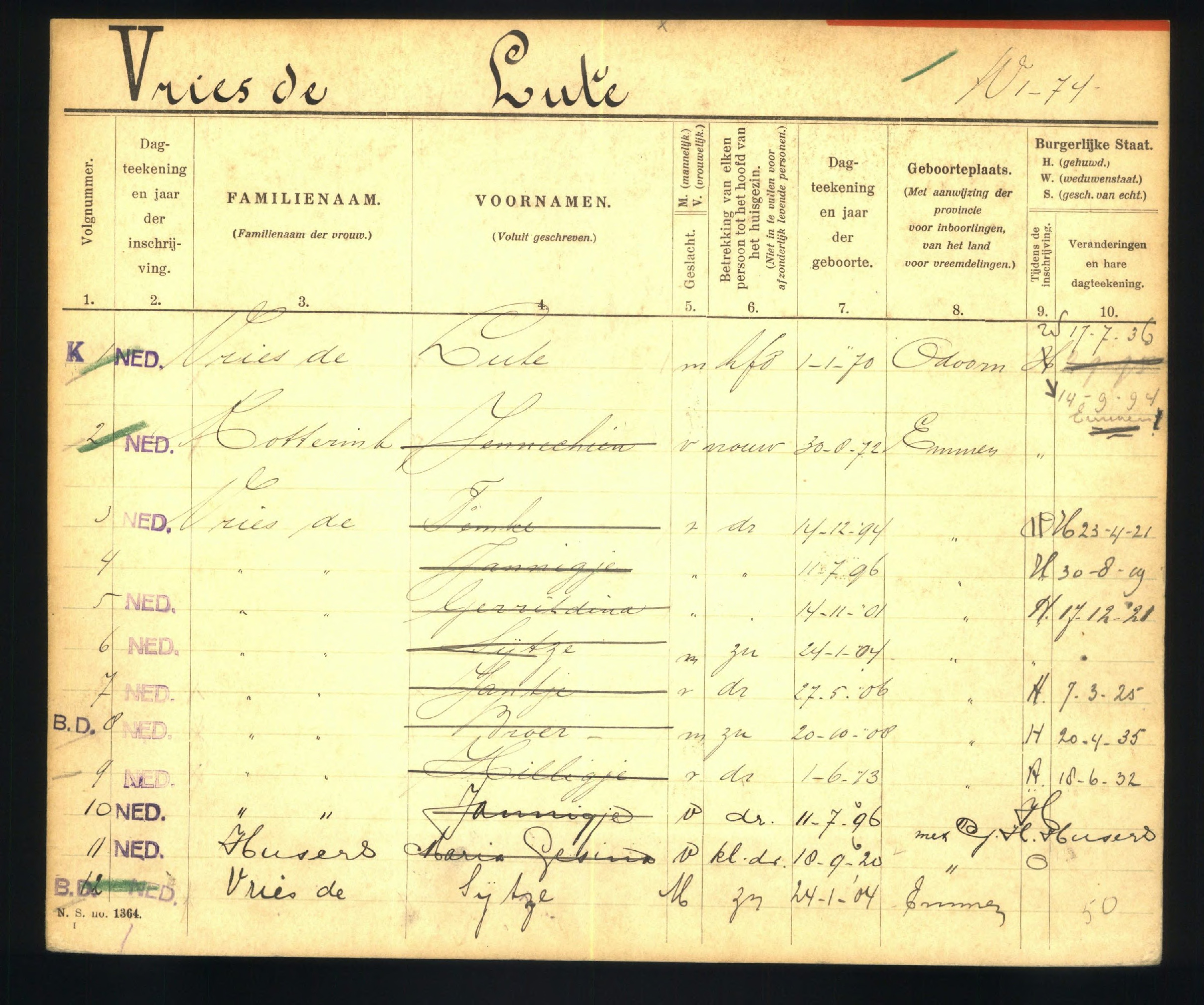 gezinskaart de Vries-Kotterink 18633 p18633 1918-1936
https://www.drentsarchief.nl/onderzoeken/genealogie/bladeren-door-bronnen/registers/ https://www.wiewaswie.nl/nl/detail/14671940
Matches in other publications
This person also appears in the publication: View all
Historical events
Birthday January 1, 1870
- The temperature on January 1, 1870 was about 5.0 °C. There was 2 mm of rain. The air pressure was 4 kgf/m2 and came mainly from the south-southwest. The airpressure was 75 cm mercury. The atmospheric humidity was 100%. Source: KNMI
- Koning Willem III (Huis van Oranje-Nassau) was from 1849 till 1890 sovereign of the Netherlands (also known as Koninkrijk der Nederlanden)
- From June 4, 1868 till January 4, 1871 the Netherlands had a cabinet Van Bosse - Fock with the prime ministers Mr. P.P. van Bosse (liberaal) and Mr. C. Fock (liberaal).
- In the year 1870: Source: Wikipedia
- The Netherlands had about 3.6 million citizens.
- February 15 » Stevens Institute of Technology is founded in New Jersey, USA and offers the first Bachelor of Engineering degree in Mechanical Engineering.
- February 28 » The Bulgarian Exarchate is established by decree of Sultan Abdülaziz of the Ottoman Empire.
- August 18 » Franco-Prussian War: Battle of Gravelotte is fought.
- August 24 » The Wolseley expedition reaches Manitoba to end the Red River Rebellion.
- September 19 » Franco-Prussian War: The siege of Paris begins. The city will hold out for over four months before surrendering.
- December 12 » Joseph H. Rainey of South Carolina becomes the second black U.S. congressman.
Day of marriage September 14, 1894
- The temperature on September 14, 1894 was about 12.5 °C. There was 0.3 mm of rain. The airpressure was 77 cm mercury. The atmospheric humidity was 80%. Source: KNMI
- Koningin Wilhelmina (Huis van Oranje-Nassau) was from 1890 till 1948 sovereign of the Netherlands (also known as Koninkrijk der Nederlanden)
- Regentes Emma (Huis van Oranje-Nassau) was from 1890 till 1898 sovereign of the Netherlands (also known as Koninkrijk der Nederlanden)
- In The Netherlands , there was from August 21, 1891 to May 9, 1894 the cabinet Van Tienhoven, with Mr. G. van Tienhoven (unie-liberaal) as prime minister.
- In The Netherlands , there was from May 9, 1894 to July 27, 1897 the cabinet Roëll, with Jonkheer mr. J. Roëll (oud-liberaal) as prime minister.
- In the year 1894: Source: Wikipedia
- The Netherlands had about 5.1 million citizens.
- June 23 » The International Olympic Committee is founded at the Sorbonne in Paris, at the initiative of Baron Pierre de Coubertin.
- June 28 » Labor Day becomes an official US holiday.
- July 4 » The short-lived Republic of Hawaii is proclaimed by Sanford B. Dole.
- August 25 » Kitasato Shibasaburō discovers the infectious agent of the bubonic plague and publishes his findings in The Lancet.
- September 17 » Battle of the Yalu River, the largest naval engagement of the First Sino-Japanese War.
- November 1 » Buffalo Bill, 15 of his Indians, and Annie Oakley were filmed by Thomas Edison in his Black Maria Studio in West Orange, New Jersey.
Day of death January 22, 1950
- The temperature on January 22, 1950 was between -0.5 °C and 1.7 °C and averaged 0.5 °C. There was 0.3 mm of rain. The average windspeed was 2 Bft (weak wind) and was prevailing from the east-northeast. Source: KNMI
- Koningin Juliana (Huis van Oranje-Nassau) was from September 4, 1948 till April 30, 1980 sovereign of the Netherlands (also known as Koninkrijk der Nederlanden)
- From August 7, 1948 till March 15, 1951 the Netherlands had a cabinet Drees - Van Schaik with the prime ministers Dr. W. Drees (PvdA) and Mr. J.R.H. van Schaik (KVP).
- In the year 1950: Source: Wikipedia
- The Netherlands had about 10.0 million citizens.
- January 13 » British submarine HMSTruculent collides with an oil tanker in the Thames Estuary, killing 64 men.
- July 16 » Chaplain–Medic massacre: American POWs are massacred by North Korean Army.
- August 18 » Julien Lahaut, the chairman of the Communist Party of Belgium is assassinated by far-right elements.
- October 19 » China defeats the Tibetan Army at Chambo.
- November 5 » Korean War: British and Australian forces from the 27th British Commonwealth Brigade successfully halted the advancing Chinese 117th Division during the Battle of Pakchon.
- November 19 » US General Dwight D. Eisenhower becomes Supreme Commander of NATO-Europe.
Same birth/death day
- 1863 » Pierre de Coubertin, French historian and educator, founded the International Olympic Committee († 1937)
- 1864 » Alfred Stieglitz, American photographer and curator († 1946)
- 1864 » Qi Baishi, Chinese painter († 1957)
- 1867 » Mary Ackworth Evershed, English astronomer and scholar († 1949)
- 1874 » Frank Knox, American publisher and politician, 46th United States Secretary of the Navy († 1944)
- 1874 » Gustave Whitehead, German-American pilot and engineer († 1927)
- 1945 » Else Lasker-Schüler, German poet and playwright (b. 1869)
- 1949 » William Thomas Walsh, American author, poet, and playwright (b. 1891)
- 1950 » Alan Hale, Sr., American actor and director (b. 1892)
- 1951 » Lawson Robertson, Scottish-American sprinter and high jumper (b. 1883)
- 1955 » Jonni Myyrä, Finnish-American athlete (b. 1892)
- 1957 » Ralph Barton Perry, American philosopher and academic (b. 1876)
About the surname De Vries
- View the information that Genealogie Online has about the surname De Vries.
- Check the information Open Archives has about De Vries.
- Check the Wie (onder)zoekt wie? register to see who is (re)searching De Vries.
The Local Heritage Book Barger-Compascuum publication was prepared by Pauline Berens BC.
When copying data from this family tree, please include a reference to the origin:
Pauline Berens BC, "Local Heritage Book Barger-Compascuum", database, Genealogy Online (https://www.genealogieonline.nl/ofb-barger-compascuum/I57964.php : accessed March 16, 2026), "Lute de Vries (1870-1950)".
Pauline Berens BC, "Local Heritage Book Barger-Compascuum", database, Genealogy Online (https://www.genealogieonline.nl/ofb-barger-compascuum/I57964.php : accessed March 16, 2026), "Lute de Vries (1870-1950)".