Local Heritage Book Barger-Compascuum » Henricus van den Berg (1908-1975)
Personal data Henricus van den Berg
- He was born on February 14, 1908 in IJsselmuiden, Kampen, Overijssel, Nederland.Source 1
- Profession: oppperwachtmeesterrayoncommandant bij de Rijkspolitie.
- Resident: Deurningen.
- He died on June 13, 1975 in Hengelo, Gemeente Hengelo, Overijssel, Nederland, he was 67 years old.Source 2
- A child of Johannes van den Berg and Antonia Hendrika Meuleman
- This information was last updated on October 6, 2022.
Household of Henricus van den Berg
He is married to Johanna Maria - An - Anneke Hermelink.
They got married on June 7, 1938 at Weerselo, Gemeente Dinkelland, Overijssel, Nederland, he was 30 years old.Source 3
Timeline Henricus van den Berg
This functionality is only available in Javascript supporting browsers.
Click on the names for more info.
Symbols used:  grandparents
 parents
 brothers/sisters
 children
grandparents
parents
brothers/sisters
children
Ancestors (and descendant) of Henricus van den Berg
Henricus van den Berg | ||||||||||
1938 | ||||||||||
Sources
- https://www.wiewaswie.nl/nl/detail/97129546
- Jan Gortemaker
- Fons van den Berg https://fjmblom.home.xs4all.nl/dutchconnection/van-den-berg-hermelink.jpg
Matches in other publications
This person also appears in the publication: View all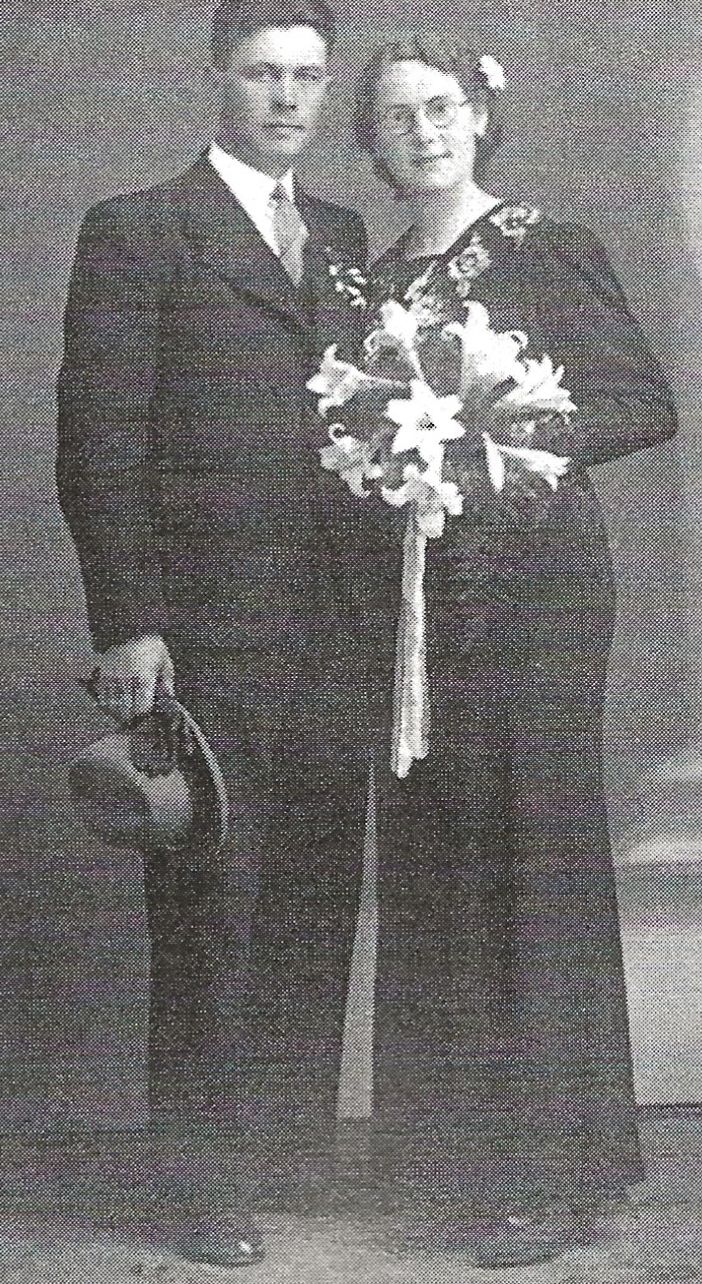
Historical events
Birthday February 14, 1908
- The temperature on February 14, 1908 was between -1.2 °C and 6.5 °C and averaged 3.3 °C. The average windspeed was 3 Bft (moderate breeze) and was prevailing from the southwest. Source: KNMI
- Koningin Wilhelmina (Huis van Oranje-Nassau) was from 1890 till 1948 sovereign of the Netherlands (also known as Koninkrijk der Nederlanden)
- In The Netherlands , there was from August 17, 1905 to February 11, 1908 the cabinet De Meester, with Mr. Th. de Meester (unie-liberaal) as prime minister.
- In The Netherlands , there was from February 12, 1908 to August 29, 1913 the cabinet Heemskerk, with Mr. Th. Heemskerk (AR) as prime minister.
- In the year 1908: Source: Wikipedia
- The Netherlands had about 5.7 million citizens.
- January 13 » The Rhoads Opera House fire in Boyertown, Pennsylvania kills 171 people.
- January 24 » The first Boy Scout troop is organized in England by Robert Baden-Powell.
- March 4 » The Collinwood school fire, Collinwood near Cleveland, Ohio, kills 174 people.
- April 14 » Hauser Dam, a steel dam on the Missouri River in Montana, U.S., fails, sending a surge of water 25 to 30 feet (7.6 to 9.1m) high downstream.
- July 26 » United States Attorney General Charles Joseph Bonaparte issues an order to immediately staff the Office of the Chief Examiner (later renamed the Federal Bureau of Investigation).
- December 2 » Puyi becomes Emperor of China at the age of two.
Day of marriage June 7, 1938
- The temperature on June 7, 1938 was between 11.4 °C and 26.6 °C and averaged 19.3 °C. There was 13.7 hours of sunshine (83%). The average windspeed was 3 Bft (moderate breeze) and was prevailing from the south. Source: KNMI
- Koningin Wilhelmina (Huis van Oranje-Nassau) was from 1890 till 1948 sovereign of the Netherlands (also known as Koninkrijk der Nederlanden)
- In The Netherlands , there was from June 24, 1937 to July 25, 1939 the cabinet Colijn IV, with Dr. H. Colijn (ARP) as prime minister.
- In the year 1938: Source: Wikipedia
- The Netherlands had about 8.6 million citizens.
- January 28 » The World Land Speed Record on a public road is broken by Rudolf Caracciola in the Mercedes-Benz W195 at a speed of 432.7 kilometres per hour (268.9mph).
- June 7 » Second Sino-Japanese War: The Chinese Nationalist government creates the 1938 Yellow River flood to halt Japanese forces. Five hundred to nine hundred thousand civilians are killed.
- June 11 » Second Sino-Japanese War: The Battle of Wuhan starts.
- June 23 » The Civil Aeronautics Act is signed into law, forming the Civil Aeronautics Authority in the United States.
- July 10 » Howard Hughes begins a 91-hour airplane flight around the world that will set a new record.
- November 1 » Seabiscuit defeats War Admiral in an upset victory during a match race deemed "the match of the century" in horse racing.
Day of death June 13, 1975
- The temperature on June 13, 1975 was between 9.3 °C and 25.8 °C and averaged 17.5 °C. There was 9.0 hours of sunshine (54%). The partly clouded was. The average windspeed was 2 Bft (weak wind) and was prevailing from the northwest. Source: KNMI
- Koningin Juliana (Huis van Oranje-Nassau) was from September 4, 1948 till April 30, 1980 sovereign of the Netherlands (also known as Koninkrijk der Nederlanden)
- In The Netherlands , there was from Friday, May 11, 1973 to Monday, December 19, 1977 the cabinet Den Uyl, with Drs. J.M. den Uyl (PvdA) as prime minister.
- In the year 1975: Source: Wikipedia
- The Netherlands had about 13.6 million citizens.
- February 4 » Haicheng earthquake (magnitude 7.3 on the Richter scale) occurs in Haicheng, Liaoning, China.
- September 4 » The Sinai Interim Agreement relating to the Arab–Israeli conflict is signed.
- September 16 » The first prototype of the Mikoyan MiG-31 interceptor makes its maiden flight.
- October 16 » Three-year-old Rahima Banu, from Bangladesh, is the last known case of naturally occurring smallpox.
- November 11 » Australian constitutional crisis of 1975: Australian Governor-General Sir John Kerr dismisses the government of Gough Whitlam, appoints Malcolm Fraser as caretaker Prime Minister and announces a general election to be held in early December.
- November 11 » Independence of Angola.
Same birth/death day
- 1903 » Stuart Erwin, American actor († 1967)
- 1905 » Thelma Ritter, American actress and singer († 1969)
- 1907 » Johnny Longden, English-American jockey and trainer († 2003)
- 1911 » Willem Johan Kolff, Dutch physician and inventor († 2009)
- 1912 » Tibor Sekelj, Hungarian lawyer, explorer, and author († 1988)
- 1913 » Mel Allen, American sportscaster († 1996)
- 1969 » Pralhad Keshav Atre, Indian journalist, director, and producer (b. 1898)
- 1972 » Georg von Békésy, Hungarian biophysicist and academic, Nobel Prize laureate (b. 1899)
- 1972 » Stephanie von Hohenlohe, Austrian-German spy (b. 1891)
- 1979 » Demetrio Stratos, Egyptian-Italian singer-songwriter and pianist (b. 1945)
- 1980 » Walter Rodney, Guyanese historian and activist (b. 1942)
- 1981 » Olivério Pinto, Brazilian zoologist and physician (b. 1896)
About the surname Van den Berg
- View the information that Genealogie Online has about the surname Van den Berg.
- Check the information Open Archives has about Van den Berg.
- Check the Wie (onder)zoekt wie? register to see who is (re)searching Van den Berg.
The Local Heritage Book Barger-Compascuum publication was prepared by Pauline Berens BC.
When copying data from this family tree, please include a reference to the origin:
Pauline Berens BC, "Local Heritage Book Barger-Compascuum", database, Genealogy Online (https://www.genealogieonline.nl/ofb-barger-compascuum/I57161.php : accessed March 13, 2026), "Henricus van den Berg (1908-1975)".
Pauline Berens BC, "Local Heritage Book Barger-Compascuum", database, Genealogy Online (https://www.genealogieonline.nl/ofb-barger-compascuum/I57161.php : accessed March 13, 2026), "Henricus van den Berg (1908-1975)".