maximum test » Geertje de Jong (1867-1950)
Personal data Geertje de Jong
- She was born on December 2, 1867Noord-Holland Nederland.
- She died on February 15, 1950, she was 82 years oldNoord-Holland Nederland.
- A child of Cornelis de Jong and Jannigje de Gans
- This information was last updated on March 16, 2019.
Household of Geertje de Jong
She is married to Gerardus van Rijn.
They got married on October 28, 1892, she was 24 years oldNoord-Holland Nederland.
Child(ren):
Timeline Geertje de Jong
This functionality is only available in Javascript supporting browsers.
Click on the names for more info.
Symbols used:  grandparents
 parents
 brothers/sisters
 children
grandparents
parents
brothers/sisters
children
Ancestors (and descendant) of Geertje de Jong
Geertje de Jong 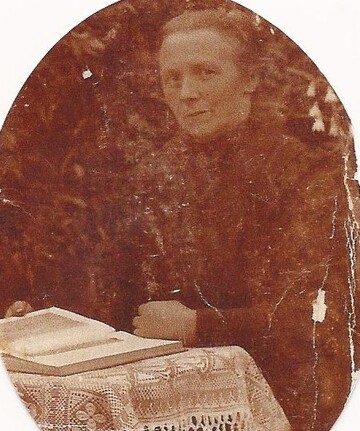 | ||||||||||||||||||||||||||||||||||
1892 | ||||||||||||||||||||||||||||||||||
Gerardus van Rijn  | ||||||||||||||||||||||||||||||||||
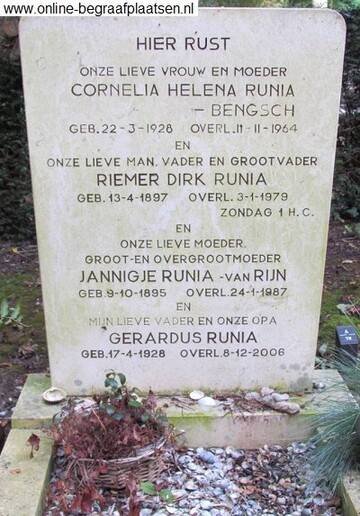
The data shown has no sources.
Matches in other publications
This person also appears in the publication: View all
Historical events
Birthday December 2, 1867
- The temperature on December 2, 1867 was about 0.7 °C. There was 0.3 mm of rain. The air pressure was 42 kgf/m2 and came mainly from the west-northwest. The airpressure was 74 cm mercury. The atmospheric humidity was 92%. Source: KNMI
- Koning Willem III (Huis van Oranje-Nassau) was from 1849 till 1890 sovereign of the Netherlands (also known as Koninkrijk der Nederlanden)
- From June 1, 1866 till June 4, 1868 the Netherlands had a cabinet Van Zuijlen van Nijevelt - Heemskerk with the prime ministers Mr. J.P.J.A. graaf Van Zuijlen van Nijevelt (AR) and Mr. J. Heemskerk Azn. (conservatief).
- In the year 1867: Source: Wikipedia
- The Netherlands had about 3.6 million citizens.
- February 13 » Work begins on the covering of the Senne, burying Brussels's primary river and creating the modern central boulevards.
- May 29 » The Austro-Hungarian Compromise of 1867 ("the Compromise") is born through Act 12, which establishes the Austro-Hungarian Empire.
- June 8 » Coronation of Franz Joseph as King of Hungary following the Austro-Hungarian compromise (Ausgleich).
- July 1 » The British North America Act takes effect as the Province of Canada, New Brunswick, and Nova Scotia join into confederation to create the modern nation of Canada. Sir John A. Macdonald is sworn in as the first Prime Minister of Canada. This date is commemorated annually in Canada as Canada Day, a national holiday.
- September 28 » Toronto becomes the capital of Ontario, having also been the capital of Ontario's predecessors since 1796.
- November 3 » Giuseppe Garibaldi and his followers are defeated in the Battle of Mentana and fail to end the Pope's Temporal power in Rome (it would be achieved three years later).
Day of marriage October 28, 1892
- The temperature on October 28, 1892 was about 11.3 °C. The airpressure was 75 cm mercury. The atmospheric humidity was 84%. Source: KNMI
- Koningin Wilhelmina (Huis van Oranje-Nassau) was from 1890 till 1948 sovereign of the Netherlands (also known as Koninkrijk der Nederlanden)
- Regentes Emma (Huis van Oranje-Nassau) was from 1890 till 1898 sovereign of the Netherlands (also known as Koninkrijk der Nederlanden)
- In The Netherlands , there was from August 21, 1891 to May 9, 1894 the cabinet Van Tienhoven, with Mr. G. van Tienhoven (unie-liberaal) as prime minister.
- In the year 1892: Source: Wikipedia
- The Netherlands had about 5.1 million citizens.
- February 29 » St. Petersburg, Florida is incorporated.
- June 6 » The Chicago "L" elevated rail system begins operation.
- September 8 » The Pledge of Allegiance is first recited.
- September 28 » The first night game for American football takes place in a contest between Wyoming Seminary and Mansfield State Normal.
- October 13 » Edward Emerson Barnard discovers first comet discovered by photographic means.
- November 8 » The New Orleans general strike begins, uniting black and white American trade unionists in a successful four-day general strike action for the first time.
Day of death February 15, 1950
- The temperature on February 15, 1950 was between 0.5 °C and 10.4 °C and averaged 7.5 °C. There was 2.4 mm of rain during 3.9 hours. The average windspeed was 5 Bft (very strong wind) and was prevailing from the southwest. Source: KNMI
- Koningin Juliana (Huis van Oranje-Nassau) was from September 4, 1948 till April 30, 1980 sovereign of the Netherlands (also known as Koninkrijk der Nederlanden)
- From August 7, 1948 till March 15, 1951 the Netherlands had a cabinet Drees - Van Schaik with the prime ministers Dr. W. Drees (PvdA) and Mr. J.R.H. van Schaik (KVP).
- In the year 1950: Source: Wikipedia
- The Netherlands had about 10.0 million citizens.
- June 28 » Korean War: North Korean Army conducts the Seoul National University Hospital massacre.
- June 29 » Korean War: U.S. President Harry S. Truman authorizes a sea blockade of Korea.
- July 4 » Cold War: Radio Free Europe first broadcasts.
- July 20 » Cold War: In Philadelphia, Harry Gold pleads guilty to spying for the Soviet Union by passing secrets from atomic scientist Klaus Fuchs.
- November 19 » US General Dwight D. Eisenhower becomes Supreme Commander of NATO-Europe.
- December 9 » Cold War: Harry Gold is sentenced to 30 years in jail for helping Klaus Fuchs pass information about the Manhattan Project to the Soviet Union. His testimony is later instrumental in the prosecution of Julius and Ethel Rosenberg.
Same birth/death day
- 1859 » Georges Seurat, French painter († 1891)
- 1860 » Charles Studd, England cricketer and missionary († 1931)
- 1863 » Charles Edward Ringling, American businessman, co-founded the Ringling Brothers Circus († 1926)
- 1866 » Harry Burleigh, American singer-songwriter († 1949)
- 1876 » Yusuf Akçura, Tatar-Turkish activist and ideologue of Turanism († 1935)
- 1884 » Erima Harvey Northcroft, New Zealand soldier, lawyer, and judge († 1953)
- 1935 » Basil Hall Chamberlain, English-Swiss historian, author, and academic (b. 1850)
- 1939 » Kuzma Petrov-Vodkin, Russian painter and author (b. 1878)
- 1956 » Vincent de Moro-Giafferi, French lawyer and politician (b. 1878)
- 1959 » Owen Willans Richardson, English physicist and academic, Nobel Prize laureate (b. 1879)
- 1961 » Laurence Owen, American figure skater (b. 1944)
- 1965 » Nat King Cole, American singer and pianist (b. 1919)
About the surname De Jong
- View the information that Genealogie Online has about the surname De Jong.
- Check the information Open Archives has about De Jong.
- Check the Wie (onder)zoekt wie? register to see who is (re)searching De Jong.
The maximum test publication was prepared by Ard van Bergen.
When copying data from this family tree, please include a reference to the origin:
Ard van Bergen, "maximum test", database, Genealogy Online (https://www.genealogieonline.nl/maximum-test/I6000000019295418469.php : accessed March 7, 2026), "Geertje de Jong (1867-1950)".
Ard van Bergen, "maximum test", database, Genealogy Online (https://www.genealogieonline.nl/maximum-test/I6000000019295418469.php : accessed March 7, 2026), "Geertje de Jong (1867-1950)".