Voorouders van Paul, Hein en Elkie Clowting » Johanna van NIJNATTEN (1842-1870)
Personal data Johanna van NIJNATTEN
- She was born on November 28, 1842 in Breda,Gemeente Breda,NOORD-BRABANT,NEDERLAND, .Source 1
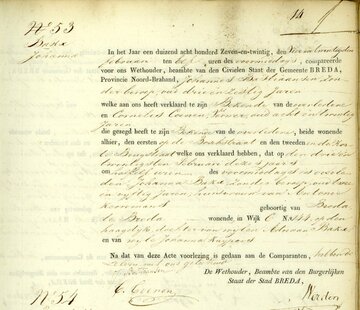
- She died on February 24, 1870 in Breda,Gemeente Breda,NOORD-BRABANT,NEDERLAND, , she was 27 years old.Source 2
- She is buried on February 27, 1870 in Breda,Gemeente Breda,NOORD-BRABANT,NEDERLAND, .Source 2
- A child of Marijnus Peeter van NIJNANTEN and Maria KERREMANS
Household of Johanna van NIJNATTEN
She is married to Johannes van GASTEL.
They got married on August 25, 1869 at Breda,Gemeente Breda,NOORD-BRABANT,NEDERLAND, , she was 26 years old.
Timeline Johanna van NIJNATTEN
This functionality is only available in Javascript supporting browsers.
Click on the names for more info.
Symbols used:  grandparents
 parents
 brothers/sisters
 children
grandparents
parents
brothers/sisters
children
Sources
Matches in other publications
This person also appears in the publication: View all
Historical events
Birthday November 28, 1842
- The temperature on November 28, 1842 was about 6.0 °C. Wind direction mainly east-southeast. Weather type: half bewolkt . Source: KNMI
- This page is only available in Dutch.De Republiek der Verenigde Nederlanden werd in 1794-1795 door de Fransen veroverd onder leiding van bevelhebber Charles Pichegru (geholpen door de Nederlander Herman Willem Daendels); de verovering werd vergemakkelijkt door het dichtvriezen van de Waterlinie; Willem V moest op 18 januari 1795 uitwijken naar Engeland (en van daaruit in 1801 naar Duitsland); de patriotten namen de macht over van de aristocratische regenten en proclameerden de Bataafsche Republiek; op 16 mei 1795 werd het Haags Verdrag gesloten, waarmee ons land een vazalstaat werd van Frankrijk; in 3.1796 kwam er een Nationale Vergadering; in 1798 pleegde Daendels een staatsgreep, die de unitarissen aan de macht bracht; er kwam een nieuwe grondwet, die een Vertegenwoordigend Lichaam (met een Eerste en Tweede Kamer) instelde en als regering een Directoire; in 1799 sloeg Daendels bij Castricum een Brits-Russische invasie af; in 1801 kwam er een nieuwe grondwet; bij de Vrede van Amiens (1802) kreeg ons land van Engeland zijn koloniën terug (behalve Ceylon); na de grondwetswijziging van 1805 kwam er een raadpensionaris als eenhoofdig gezag, namelijk Rutger Jan Schimmelpenninck (van 31 oktober 1761 tot 25 maart 1825).
- In the year 1842: Source: Wikipedia
- The Netherlands had about 3.1 million citizens.
- January 13 » Dr. William Brydon, an assistant surgeon in the British East India Company Army during the First Anglo-Afghan War, becomes famous for being the sole survivor of an army of 4,500 men and 12,000 camp followers when he reaches the safety of a garrison in Jalalabad, Afghanistan.
- February 21 » John Greenough is granted the first U.S. patent for the sewing machine.
- March 9 » The first documented discovery of gold in California occurs at Rancho San Francisco, six years before the California Gold Rush.
- March 28 » First concert of the Vienna Philharmonic Orchestra, conducted by Otto Nicolai.
- May 16 » The first major wagon train heading for the Pacific Northwest sets out on the Oregon Trail from Elm Grove, Missouri, with 100 pioneers.
- December 7 » First concert of the New York Philharmonic, founded by Ureli Corelli Hill.
Day of marriage August 25, 1869
- The temperature on August 25, 1869 was about 16.4 °C. The airpressure was 77 cm mercury. The atmospheric humidity was 87%. Source: KNMI
- Koning Willem III (Huis van Oranje-Nassau) was from 1849 till 1890 sovereign of the Netherlands (also known as Koninkrijk der Nederlanden)
- From June 4, 1868 till January 4, 1871 the Netherlands had a cabinet Van Bosse - Fock with the prime ministers Mr. P.P. van Bosse (liberaal) and Mr. C. Fock (liberaal).
- In the year 1869: Source: Wikipedia
- The Netherlands had about 3.6 million citizens.
- March 6 » Dmitri Mendeleev presents the first periodic table to the Russian Chemical Society.
- May 4 » The Naval Battle of Hakodate is fought in Japan.
- June 27 » The Republic of Ezo on the island of Hokkaido ends after being defeated by Japanese Imperial troops.
- August 2 » Japan's Edo society class system is abolished as part of the Meiji Restoration reforms.
- October 5 » The Saxby Gale devastates the Bay of Fundy region in Canada.
- November 6 » In New Brunswick, New Jersey, Rutgers College defeats Princeton University (then known as the College of New Jersey), 6–4, in the first official intercollegiate American football game.
Day of death February 24, 1870
- The temperature on February 24, 1870 was about 1.3 °C. There was 0.3 mm of rain. The air pressure was 10 kgf/m2 and came mainly from the southwest. The airpressure was 75 cm mercury. The atmospheric humidity was 96%. Source: KNMI
- Koning Willem III (Huis van Oranje-Nassau) was from 1849 till 1890 sovereign of the Netherlands (also known as Koninkrijk der Nederlanden)
- From June 4, 1868 till January 4, 1871 the Netherlands had a cabinet Van Bosse - Fock with the prime ministers Mr. P.P. van Bosse (liberaal) and Mr. C. Fock (liberaal).
- In the year 1870: Source: Wikipedia
- The Netherlands had about 3.6 million citizens.
- January 10 » John D. Rockefeller incorporates Standard Oil.
- February 9 » US president Ulysses S. Grant signs a joint resolution of Congress establishing the U.S. Weather Bureau.
- February 23 » Reconstruction Era: Post-U.S. Civil War military control of Mississippi ends and it is readmitted to the Union.
- February 27 » The current flag of Japan is first adopted as the national flag for Japanese merchant ships.
- July 18 » The First Vatican Council decrees the dogma of papal infallibility.
- September 2 » Franco-Prussian War: Battle of Sedan: Prussian forces take Napoleon III of France and 100,000 of his soldiers prisoner.
Day of burial February 27, 1870
- The temperature on February 27, 1870 was about 9.6 °C. The air pressure was 3 kgf/m2 and came mainly from the south-southeast. The airpressure was 76 cm mercury. The atmospheric humidity was 57%. Source: KNMI
- Koning Willem III (Huis van Oranje-Nassau) was from 1849 till 1890 sovereign of the Netherlands (also known as Koninkrijk der Nederlanden)
- From June 4, 1868 till January 4, 1871 the Netherlands had a cabinet Van Bosse - Fock with the prime ministers Mr. P.P. van Bosse (liberaal) and Mr. C. Fock (liberaal).
- In the year 1870: Source: Wikipedia
- The Netherlands had about 3.6 million citizens.
- February 28 » The Bulgarian Exarchate is established by decree of Sultan Abdülaziz of the Ottoman Empire.
- May 12 » The Manitoba Act is given the Royal Assent, paving the way for Manitoba to become a province of Canada on July 15.
- May 14 » The first game of rugby in New Zealand is played in Nelson between Nelson College and the Nelson Rugby Football Club.
- July 15 » Reconstruction Era of the United States: Georgia becomes the last of the former Confederate states to be readmitted to the Union.
- October 27 » Franco-Prussian War: Marshal Bazaine surrenders to Prussian forces at the conclusion of the Siege of Metz along with 140,000 French soldiers.
- November 1 » In the United States, the Weather Bureau (later renamed the National Weather Service) makes its first official meteorological forecast.
Same birth/death day
- 1820 » Friedrich Engels, German-English philosopher, economist, and journalist († 1895)
- 1829 » Anton Rubinstein, Russian pianist, composer, and conductor († 1894)
- 1837 » John Wesley Hyatt, American engineer († 1920)
- 1853 » Helen Magill White, American academic († 1944)
- 1857 » Alfonso XII of Spain († 1885)
- 1861 » Adina Emilia De Zavala, American teacher, historian and preservationist of Texas history († 1955)
- 1825 » Thomas Bowdler, English physician and philanthropist (b. 1754)
- 1856 » Nikolai Lobachevsky, Russian mathematician and academic (b. 1792)
- 1876 » Joseph Jenkins Roberts, American-Liberian politician, 1st President of Liberia (b. 1809)
- 1879 » Shiranui Kōemon, Japanese sumo wrestler, the 11th Yokozuna (b. 1825)
- 1910 » Osman Hamdi Bey, Greek archaeologist and painter (b. 1842)
- 1914 » Joshua Chamberlain, American general and politician, 32nd Governor of Maine (b. 1828)
About the surname Van NIJNATTEN
- View the information that Genealogie Online has about the surname Van NIJNATTEN.
- Check the information Open Archives has about Van NIJNATTEN.
- Check the Wie (onder)zoekt wie? register to see who is (re)searching Van NIJNATTEN.
The Voorouders van Paul, Hein en Elkie Clowting publication was prepared by Fieke Bazelmans.
When copying data from this family tree, please include a reference to the origin:
Fieke Bazelmans, "Voorouders van Paul, Hein en Elkie Clowting", database, Genealogy Online (https://www.genealogieonline.nl/genealogie-bazelmans/I802.php : accessed March 6, 2026), "Johanna van NIJNATTEN (1842-1870)".
Fieke Bazelmans, "Voorouders van Paul, Hein en Elkie Clowting", database, Genealogy Online (https://www.genealogieonline.nl/genealogie-bazelmans/I802.php : accessed March 6, 2026), "Johanna van NIJNATTEN (1842-1870)".