Family tree Cuijpers » Wiggerdina Wijgerdina Beune Bunen Beunen (1807-1880)
Personal data Wiggerdina Wijgerdina Beune Bunen Beunen
- She was born on August 12, 1807 in 's-Hertogenbosch.
- She died on January 11, 1880 in Sint-Michielsgestel, she was 72 years old.
- A child of Wilhelmus Beune Bunen Beunen and Adriane van Berkel
Household of Wiggerdina Wijgerdina Beune Bunen Beunen
She is married to Petrus Cuijpers Kuijpers 1805.
They got married
Child(ren):
Timeline Wiggerdina Wijgerdina Beune Bunen Beunen
This functionality is only available in Javascript supporting browsers.
Click on the names for more info.
Symbols used:  grandparents
 parents
 brothers/sisters
 children
grandparents
parents
brothers/sisters
children
Image(s) Wiggerdina Wijgerdina Beune Bunen Beunen


Ancestors (and descendant) of Wiggerdina Wijgerdina Beune Bunen Beunen
Wiggerdina Wijgerdina Beune Bunen Beunen 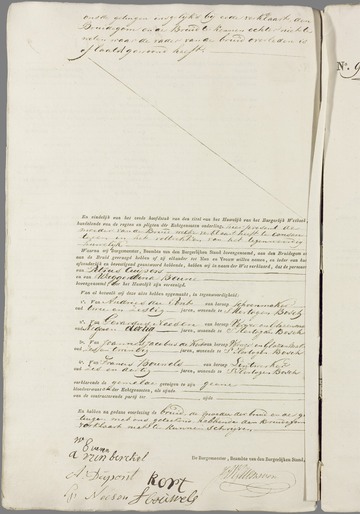 | ||||||||||||||||||||||||||||||||||
Petrus Cuijpers Kuijpers 1805 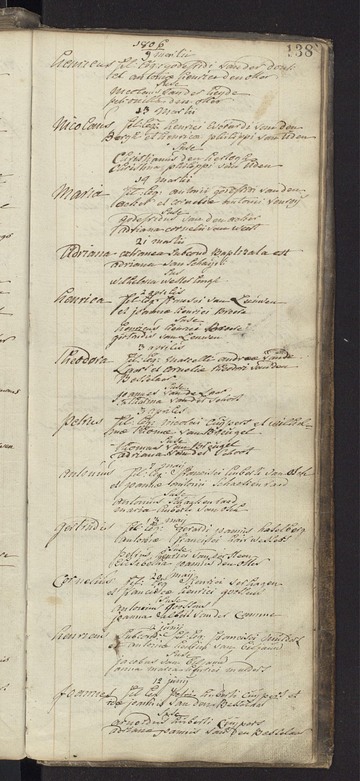 | ||||||||||||||||||||||||||||||||||
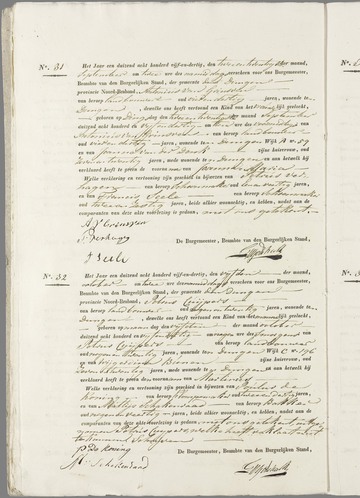
The data shown has no sources.
Historical events
Birthday August 12, 1807
- The temperature on August 12, 1807 was about 17.0 °C. Wind direction mainly south-southeast. Weather type: half bewolkt onweer regen. Source: KNMI
- This page is only available in Dutch.De Republiek der Verenigde Nederlanden werd in 1794-1795 door de Fransen veroverd onder leiding van bevelhebber Charles Pichegru (geholpen door de Nederlander Herman Willem Daendels); de verovering werd vergemakkelijkt door het dichtvriezen van de Waterlinie; Willem V moest op 18 januari 1795 uitwijken naar Engeland (en van daaruit in 1801 naar Duitsland); de patriotten namen de macht over van de aristocratische regenten en proclameerden de Bataafsche Republiek; op 16 mei 1795 werd het Haags Verdrag gesloten, waarmee ons land een vazalstaat werd van Frankrijk; in 3.1796 kwam er een Nationale Vergadering; in 1798 pleegde Daendels een staatsgreep, die de unitarissen aan de macht bracht; er kwam een nieuwe grondwet, die een Vertegenwoordigend Lichaam (met een Eerste en Tweede Kamer) instelde en als regering een Directoire; in 1799 sloeg Daendels bij Castricum een Brits-Russische invasie af; in 1801 kwam er een nieuwe grondwet; bij de Vrede van Amiens (1802) kreeg ons land van Engeland zijn koloniën terug (behalve Ceylon); na de grondwetswijziging van 1805 kwam er een raadpensionaris als eenhoofdig gezag, namelijk Rutger Jan Schimmelpenninck (van 31 oktober 1761 tot 25 maart 1825).
- In the year 1807: Source: Wikipedia
- February 8 » After two days of bitter fighting, the Russians under Bennigsen and the Prussians under L'Estocq concede the Battle of Eylau to Napoleon.
- March 25 » The Swansea and Mumbles Railway, then known as the Oystermouth Railway, becomes the first passenger-carrying railway in the world.
- April 12 » The Froberg mutiny ends when the remaining mutineers blow up the magazine of Fort Ricasoli.
- July 9 » The Treaties of Tilsit are signed by Napoleon I of France and Alexander I of Russia.
- August 17 » Robert Fulton's North River Steamboat leaves New York City for Albany, New York, on the Hudson River, inaugurating the first commercial steamboat service in the world.
- November 29 » Transfer of the Portuguese Court to Brazil: John VI of Portugal flees Lisbon from advancing Napoleonic forces during the Peninsular War, transferring the Portuguese court to Brazil.
Day of death January 11, 1880
- The temperature on January 11, 1880 was about -2.0 °C. The air pressure was 1 kgf/m2 and came mainly from the east. The airpressure was 78 cm mercury. The atmospheric humidity was 90%. Source: KNMI
- Koning Willem III (Huis van Oranje-Nassau) was from 1849 till 1890 sovereign of the Netherlands (also known as Koninkrijk der Nederlanden)
- In The Netherlands , there was from August 20, 1879 to April 23, 1883 the cabinet Van Lijnden van Sandenburg, with Mr. C.Th. baron Van Lijnden van Sandenburg (conservatief-AR) as prime minister.
- In the year 1880: Source: Wikipedia
- The Netherlands had about 4.0 million citizens.
- February 13 » Thomas Edison observes Thermionic emission.
- May 13 » In Menlo Park, New Jersey, Thomas Edison performs the first test of his electric railway.
- July 27 » Second Anglo-Afghan War: Battle of Maiwand: Afghan forces led by Mohammad Ayub Khan defeat the British Army in battle near Maiwand, Afghanistan.
- August 14 » Construction of Cologne Cathedral, the most famous landmark in Cologne, Germany, is completed.
- September 16 » The Cornell Daily Sun prints its first issue in Ithaca, New York. The Sun is the United States' oldest, continuously-independent college daily.
- November 11 » Australian bushranger Ned Kelly is hanged at Melbourne Gaol.
Same birth/death day
- 1762 » George IV of the United Kingdom († 1830)
- 1773 » Karl Faber, Prussian historian and academic († 1853)
- 1774 » Robert Southey, English poet and author († 1843)
- 1831 » Helena Blavatsky, Russian theosophist and scholar († 1891)
- 1852 » Michael J. McGivney, American priest and founder of the Knights of Columbus († 1890)
- 1856 » Diamond Jim Brady, American businessman and philanthropist († 1917)
- 1866 » Gustavus Vaughan Brooke, Irish actor (b. 1818)
- 1866 » John Woolley, English minister and academic (b. 1816)
- 1867 » Stuart Donaldson, English-Australian businessman and politician, 1st Premier of New South Wales (b. 1812)
- 1882 » Theodor Schwann, German physiologist and biologist (b. 1810)
- 1891 » Georges-Eugène Haussmann, French urban planner (b. 1809)
- 1902 » Johnny Briggs, English cricketer and rugby player (b. 1862)
About the surname Beune Bunen Beunen
- View the information that Genealogie Online has about the surname Beune Bunen Beunen.
- Check the information Open Archives has about Beune Bunen Beunen.
- Check the Wie (onder)zoekt wie? register to see who is (re)searching Beune Bunen Beunen.
The Family tree Cuijpers publication was prepared by Maarten.
When copying data from this family tree, please include a reference to the origin:
Maarten, "Family tree Cuijpers", database, Genealogy Online (https://www.genealogieonline.nl/cuijpers-stamboom/I500015.php : accessed January 30, 2026), "Wiggerdina Wijgerdina Beune Bunen Beunen (1807-1880)".
Maarten, "Family tree Cuijpers", database, Genealogy Online (https://www.genealogieonline.nl/cuijpers-stamboom/I500015.php : accessed January 30, 2026), "Wiggerdina Wijgerdina Beune Bunen Beunen (1807-1880)".