maximum test » Adelaide "von Burgund" (± 894-± 960)
Données personnelles Adelaide "von Burgund"
- Le surnom est von Burgund.
- Elle est née environ 894 dans Bourgogne, France.
- Alternative: Elle est née en l'an 955Saxony Duitsland.
- Elle a été baptisée dans Rome.
- Baptisé (à 8 ans ou plus tard) par l'autorité de la prêtrise de l'église SDJ le 23 mai 1930.
- Alternative: Baptisé (à 8 ans ou plus tard) par l'autorité de la prêtrise de l'église SDJ le 23 mai 1930.
- Alternative: Baptisé (à 8 ans ou plus tard) par l'autorité de la prêtrise de l'église SDJ le 28 mars 1992.
- Professions:
- Keiserinne.
- inhumée dans l'église Sainte-Waudru à Mons.
- Reine, d'Italie, Régente, du Saint Empire Romain Germanique.
- Résidant:
- Duitsland.
- (Misc Event) en l'an 1097.
- Elle est décédée environ 960 dans Belgium.
- Elle est enterrée en l'an 999 dans Convent Of Saints Peter And Paul, Seltz, Alsace.
- Un enfant de Richard "the Justicer" d'Ardennes et Adelaide
- Cette information a été mise à jour pour la dernière fois le 17 avril 2019.
Famille de Adelaide "von Burgund"
Elle est mariée à Reginar De Hainaut.
Ils se sont mariés environ 923 à Brabant, Belgium.
Enfant(s):
Notes par Adelaide "von Burgund"
Name Prefix:St. Name Suffix: Empress, Princess Of Burgundy
Name Suffix:Of Burgundy
Name Suffix:Of Burgundy
Grevinne av Burgund.
Adelheids far, Rudolf II av Burgund, døde i 937. Hennes mor, Bertha av Schwaben,
giftet seg igjen med kong Hugo av Italien. Adelheid ble da, mens hun enda var barn, forlovet
med Hugos sønn, Lothar og gift med ham i 947.
Kong Lothar av Italia, som var av Karl ?den Store?'s ætt, døde i 950. En maktlysten og
tyrannisk markgreve i Nord-Italia, Berengar, hadde deretter oppkastet seg til konge av Italia.
Ettersom den avdøde kong Lothars enke, den vakre og folkekjære Adelheid, ble betraktet
som arving til tronen, gjorde Berengar henne uskadelig ved å sperre henne inne, han utsatte
henne til og med for den råeste mishandling, antagelig i det håp at hun skulle dø i fengslet. Det
fortelles også at Berengar forsøkte å tvinge henne til ekteskap med sin sønn, Adelbert, for på
den måten å skaffe sin ætt i hvert fall et skinn av rett til kongekronen. Men Adelheid holdt
tappert stand.
Ryktet om den unge dronningens lidelser trengte snart over Alpene og fylte den
ridderlige kong Otto med rettferdig harme. Nå var anledningen der til å vinne den italienske
kongekronen, og han dro med en hær over Alpene for å befri den skjønne og samtidig sette en
av sine store politiske planer ut i livet. Sagnet har forøvrig pyntet litt på dette drama og har latt
Adelheid skrive et brev til Otto, hvor hun anropte ham om hjelp og bød ham sin hånd og Italias
kongekrone som takk. Otto var nemlig blitt enkemann noen år i forveien.
Mens Otto gjorde forberedelser til krigstoget, greide Adelheid å flykte fra sine
plageånder. En prest og en trofast terne som hadde fått lov til å bli hos henne, hadde med
forenede krefter greidd å grave en underjordisk gang ut fra fengslet. En natt flyktet de alle tre,
og etter å ha utstått mange farer og strabaser fant de beskyttelse i et befestet slott, som
tilhørte en av Berengars motstandere.
Så kom da Otto til Italia, og ble hilst med jubel overalt. Han holdt sitt høytidelige inntog i
Berengars hovedstad Pavia og kalte seg fra da av konge av Italia. Fra alle kanter strømmet
landets mektigste menn til og hyllet ham, mens Berengar trakk seg tilbake uten sverdslag og
søkte tilflukt i en borg oppe i fjelltraktene. Deretter sendte Otto bud til Adelheid og anholdt om
hennes hånd. Hun svarte ja og fulgte Ottos utsendinger tilbake til Pavia, hvor deres bryllup ble
feiret 25.12.951.
Adelheid øvet stor politisk innflytelse, spesielt da hun sammen med sin sønns hustru,
den kloke og viljesterke Theophano, førte riksregimentet for den lille Otto III. I de første åtte
årene ble regjeringen ledet av Theophano, og etter hennes død av Adelheid. Adelheid hadde
lenge ligget i strid med sin svigerdatter, men hadde forsonet seg med henne da det gjaldt å
bevare kronen for slekten. Adelheid fikk imidlertid aldri så stor innflytelse som Theofano hadde
hatt, fordi den unge keiseren nektet å adlyde henne. Alftfor meget smiger fra smiskende
hoffmenn hadde gjort den ualminnelig oppvakte gutten så trassig og innbilsk at farmoren til sist
ikke orket alle nykkene hans lenger og dro tilbake til Italia, hvor hun alltid hadde likt seg best.
Adelheid døde i kloster i 999.
Vi kjenner ikke hennes navn, men hun var datter til Richard av Burgund.
ADELAIDE (ADELHEID) German ADELHEID DIE HEILIGE, French SAINTE ADÉLAÏDE, Italian SANTA ADELAIDE (b. 931--d. Dec. 16, 999, Seltz, Alsace [now in France]; feast day December 16), was the daughter of Rudolph II of Burgundy, and married, in 947, Lothair, who succeeded his father Hugh as king of Italy. Lothair died in 950 and Adelaide was imprisoned at Como by his successor, Berengar II, marquis of Ivrea, who wished tocompel her to marry his son Adalbert. After four months (Aug. 951) she escaped and took refuge at Canossa with Atto, count of Modena-Reggio. Meanwhile Otto I, the German king, whose English wife, Edgitha, haddied in 946, came to Italy. Adelaide met him at Pavia, asked him to help her regain the throne. Otto marched into Lombardy (September 951),declared himself king, and married her (December 951). On Feb. 2, 962, she was crowned empress at Rome by Pope John XXII immediately afterher husband, and she accompanied Otto in 966 on his third expedition to Italy, where she remained with him for six years. She devoted her time to promoting Cluniac monasticism and to strengthening the allegiance of the German church to the emperor.
After Otto I's death (May 7, 973), Adelaide exercised for some yearsa controlling influence over her son, the new emperor, Otto II, untiltheir estrangement in 978. The causes of their estrangement are obscure, but it was possibly due to the empress' lavish expenditure in charity and church building, which was a serious drain on the imperial finances. In 978 she left the court and lived partly in Italy, partly with her brother Conrad, king of Burgundy, by whose mediation she was ultimately reconciled to her son. In 983, shortly before his death, Ottoappointed her his regent in Italy, and, in concert with the Empress Theophano, widow of Otto II, and Archbishop Wiligis of Mainz, defended the right of her infant grandson, Otto III, to the German crown against the pretensions of Henry the Quarrelsome, duke of Bavaria.
In June 984 the infant king was handed over by Henry to the care of the two empresses; but the masterful will of Theophano the Greek empress soon obtained the upper hand. Adelaide lived in Lombardy from 985 to 991and had no voice in German affairs. After the death of Theophanoon June 15, 991, Adelaide returned to Duitsland to serve as sole regent, in concert with Archbishop Willigis and a council of princes of theempire, and held it until Otto was declared of age in 995. In 996 theyoung king went to Italy to receive the imperial crown, and from thisdate Adelaide retired from court life, devoting herself to pious exercises, to correspondence with the abbots Majolus and Odilo of Cluny, and to the foundation of churches and religious houses. She died on Dec. 17, 999, and was buried in the convent of Saints Peter and Paul, her favorite foundation, at Salz in Alsace. By the emperor Otto I she had four children: Otto II (d. 983); Mathilda, abbess of Quedlinburg (d. 999); Adelheid (Adelaide), abbess of Essen (d. 974); and Liutgard
ADELAIDE (ADELHEID) German ADELHEID DIE HEILIGE, French SAINTE ADÉLAÏDE, Italian SANTA ADELAIDE (b. 931--d. Dec. 16, 999, Seltz, Alsace [now in France]; feast day December 16), was the daughter of Rudolph II of Burgundy, and married, in 947, Lothair, who succeeded his father Hugh as king of Italy. Lothair died in 950 and Adelaide was imprisoned at Como by his successor, Berengar II, marquis of Ivrea, who wished tocompel her to marry his son Adalbert. After four months (Aug. 951) she escaped and took refuge at Canossa with Atto, count of Modena-Reggio. Meanwhile Otto I, the German king, whose English wife, Edgitha, haddied in 946, came to Italy. Adelaide met him at Pavia, asked him to help her regain the throne. Otto marched into Lombardy (September 951),declared himself king, and married her (December 951). On Feb. 2, 962, she was crowned empress at Rome by Pope John XXII immediately afterher husband, and she accompanied Otto in 966 on his third expedition to Italy, where she remained with him for six years. She devoted her time to promoting Cluniac monasticism and to strengthening the allegiance of the German church to the emperor.
After Otto I's death (May 7, 973), Adelaide exercised for some yearsa controlling influence over her son, the new emperor, Otto II, untiltheir estrangement in 978. The causes of their estrangement are obscure, but it was possibly due to the empress' lavish expenditure in charity and church building, which was a serious drain on the imperial finances. In 978 she left the court and lived partly in Italy, partly with her brother Conrad, king of Burgundy, by whose mediation she was ultimately reconciled to her son. In 983, shortly before his death, Ottoappointed her his regent in Italy, and, in concert with the Empress Theophano, widow of Otto II, and Archbishop Wiligis of Mainz, defended the right of her infant grandson, Otto III, to the German crown against the pretensions of Henry the Quarrelsome, duke of Bavaria.
In June 984 the infant king was handed over by Henry to the care of the two empresses; but the masterful will of Theophano the Greek empress soon obtained the upper hand. Adelaide lived in Lombardy from 985 to 991and had no voice in German affairs. After the death of Theophanoon June 15, 991, Adelaide returned to Duitsland to serve as sole regent, in concert with Archbishop Willigis and a council of princes of theempire, and held it until Otto was declared of age in 995. In 996 theyoung king went to Italy to receive the imperial crown, and from thisdate Adelaide retired from court life, devoting herself to pious exercises, to correspondence with the abbots Majolus and Odilo of Cluny, and to the foundation of churches and religious houses. She died on Dec. 17, 999, and was buried in the convent of Saints Peter and Paul, her favorite foundation, at Salz in Alsace. By the emperor Otto I she had four children: Otto II (d. 983); Mathilda, abbess of Quedlinburg (d. 999); Adelheid (Adelaide), abbess of Essen (d. 974); and Liutgard
ADELAIDE (ADELHEID) German ADELHEID DIE HEILIGE, French SAINTE ADÉLAÏDE, Italian SANTA ADELAIDE (b. 931--d. Dec. 16, 999, Seltz, Alsace [now in France]; feast day December 16), was the daughter of Rudolph II of Burgundy, and married, in 947, Lothair, who succeeded his father Hugh as king of Italy. Lothair died in 950 and Adelaide was imprisoned at Como by his successor, Berengar II, marquis of Ivrea, who wished tocompel her to marry his son Adalbert. After four months (Aug. 951) she escaped and took refuge at Canossa with Atto, count of Modena-Reggio. Meanwhile Otto I, the German king, whose English wife, Edgitha, haddied in 946, came to Italy. Adelaide met him at Pavia, asked him to help her regain the throne. Otto marched into Lombardy (September 951),declared himself king, and married her (December 951). On Feb. 2, 962, she was crowned empress at Rome by Pope John XXII immediately afterher husband, and she accompanied Otto in 966 on his third expedition to Italy, where she remained with him for six years. She devoted her time to promoting Cluniac monasticism and to strengthening the allegiance of the German church to the emperor.
After Otto I's death (May 7, 973), Adelaide exercised for some yearsa controlling influence over her son, the new emperor, Otto II, untiltheir estrangement in 978. The causes of their estrangement are obscure, but it was possibly due to the empress' lavish expenditure in charity and church building, which was a serious drain on the imperial finances. In 978 she left the court and lived partly in Italy, partly with her brother Conrad, king of Burgundy, by whose mediation she was ultimately reconciled to her son. In 983, shortly before his death, Ottoappointed her his regent in Italy, and, in concert with the Empress Theophano, widow of Otto II, and Archbishop Wiligis of Mainz, defended the right of her infant grandson, Otto III, to the German crown against the pretensions of Henry the Quarrelsome, duke of Bavaria.
In June 984 the infant king was handed over by Henry to the care of the two empresses; but the masterful will of Theophano the Greek empress soon obtained the upper hand. Adelaide lived in Lombardy from 985 to 991and had no voice in German affairs. After the death of Theophanoon June 15, 991, Adelaide returned to Duitsland to serve as sole regent, in concert with Archbishop Willigis and a council of princes of theempire, and held it until Otto was declared of age in 995. In 996 theyoung king went to Italy to receive the imperial crown, and from thisdate Adelaide retired from court life, devoting herself to pious exercises, to correspondence with the abbots Majolus and Odilo of Cluny, and to the foundation of churches and religious houses. She died on Dec. 17, 999, and was buried in the convent of Saints Peter and Paul, her favorite foundation, at Salz in Alsace. By the emperor Otto I she had four children: Otto II (d. 983); Mathilda, abbess of Quedlinburg (d. 999); Adelheid (Adelaide), abbess of Essen (d. 974); and Liutgard
When she married Otto, she was the widow of the king of Italy. Otto extended
influence into Burgundy when the Burgundian Princess Adelaide was taken
prisoner by the margrave Berengar of Ivrea in 951. When she appealed to him
for help, Otto marched into Italy , assumed the title of King of the Lombards,
and married Adelaide himself, his first wife having died in 946. She acted as
sole regent for grandson Otto III 991-994, who died during a rebellion of the
Romans, awaiting military support from his successor, Henry II, in 1002.
ADELAIDE
Also known as
Adelaide of Burgundy; Adelaide of Italy; Adelheid
Memorial
16 December
Profile
Daughter of King Rudolf II (Rupert II) of Upper Burgundy. Promised at age two in an arranged marriage as part of a treaty between Rudolf and Hugh of Provence. Married at age 16 to Lothair of Italy, who eventually became king of Italy. Widowed in 950 while still a teenager; Lothair was probably poisoned by his successor to the throne, Berengarius. As part of his attempt to solidify his grip on power, Berengarius ordered Adelaide to marry his son; she refused, and was imprisoned. She was freed soon after when the German king Otto the Great defeated Berengarius.
Adelaide married Otto in Pavia, Italy in 951. He was crowned Emperor in Rome in 952, and Adelaide reigned with him for 20 years. Widowed in 973, she was ill-treated by her step-son, Emperor Otto II and his wife Theophano, but eventually reconciled with her royal in-laws.
When Otto II died in 983, he was succeeded by his infant son, Otto III. Theophano acted as regent, and since she still did not like Adelaide, used her power to exile her from the royal court. Theophano died in 991, and Adelaide returned once again to the court to act as regent for the child emperor. She used her position and power to help the poor, evangelize, especially among the Slavs, and to build and restore monasteries and churches. When Otto III was old enough, Adelaide retired to the convent of Selta near Keulen, a house she had built. Though she never became a nun, she spent the rest of her days there in prayer.
Born
c.931 at Burgundy, France
Died
999 at the monastery of Selta (Seltz), Alsace of natural causes
Canonized
1097 by Pope Urban II
Patronage
abuse victims; brides; empresses; exiles; in-law problems; parenthood; parents of large families; people in exile; princesses; prisoners; second marriages; step-parents; victims of abuse; widows
Representation
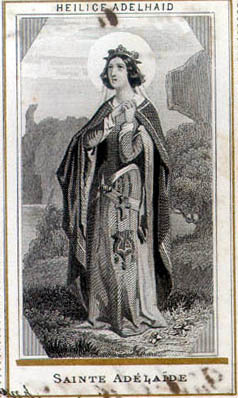
empress dispensing alms and food to the poor, often beside a ship
Additional Information
Google Directory
Saints: A concise Biographical Dictionary, by John Coulson
Catholic Encyclopedia, by T J Campbell
Wikipedia
Ecole Glossary, by Karen Rae Keck
Patronaj Sanktaj Indekso esperanto
References
Communion of Saints, by Slaves of the Immaculate Heart of Mary
Dictionary of Saints, by John Delaney
Hard Copy
printer friendly version
Translate
español | français | deutsch | italiano | português
When she married Otto, she was the widow of the king of Italy. Otto extended
influence into Burgundy when the Burgundian Princess Adelaide was taken
prisoner by the margrave Berengar of Ivrea in 951. When she appealed to him
for help, Otto marched into Italy , assumed the title of King of the Lombards,
and married Adelaide himself, his first wife having died in 946. She acted as
sole regent for grandson Otto III 991-994, who died during a rebellion of the
Romans, awaiting military support from his successor, Henry II, in 1002.
When she married Otto, she was the widow of the king of Italy. Otto extended
influence into Burgundy when the Burgundian Princess Adelaide was taken
prisoner by the margrave Berengar of Ivrea in 951. When she appealed to him
for help, Otto marched into Italy , assumed the title of King of the Lombards,
and married Adelaide himself, his first wife having died in 946. She acted as
sole regent for grandson Otto III 991-994, who died during a rebellion of the
Romans, awaiting military support from his successor, Henry II, in 1002.
When she married Otto, she was the widow of the king of Italy. Otto extended
influence into Burgundy when the Burgundian Princess Adelaide was taken
prisoner by the margrave Berengar of Ivrea in 951. When she appealed to him
for help, Otto marched into Italy , assumed the title of King of the Lombards,
and married Adelaide himself, his first wife having died in 946. She acted as
sole regent for grandson Otto III 991-994, who died during a rebellion of the
Romans, awaiting military support from his successor, Henry II, in 1002.
The Calendar of Saints says her first husband was poisoned by his successor. When she refused to marry the murderer's son, she was imprisoned. King Otto the Great freed her and married her. He died and her daughter-in-law forced Adelaide to quit the royal presence. Throughout these troubles she remained gracious and loving and was canonised a hundred years after her death. 16 Dec is her feast day.
Widowed queen of Lombardy
[3235] WSHNGT.ASC file (Geo Washington Ahnentafel) # 69766777 = 3678265 b 986 which must be in error; parents died in 921
http://library.monterey.edu/merrill/family/dorsett6/d0030/I6735.html b ABT 903 Ancestral Roots p. 135; Stuart p. 153
EDWARD3.TXT b 894
Kinship II - A collection of family, friends and U.S. Presidents
URL: http://worldconnect.genealogy.rootsweb.com/cgi-bin/igm.cgi?op=GET&db=:2902060&id=I575152338
ID: I575152338
Name: Adelaide (Alice) of BURGUNDY
Given Name: Adelaide (Alice) of
Surname: BURGUNDY
Sex: F
Birth: Abt 0880 in Burgundy (Franch Comte')
Death: Abt 0932 in Belgium?
Change Date: 4 Apr 2004 1 1 1
Note:
Name Suffix: *
Ancestral File Number: 9HMN-PN
GIVN Adelaide of
SURN BURGUNDY
NSFX *
DATE 2 MAY 2000
OCCU Alix ...
SOUR HAWKINS.GED says ABT 890; members.aol.com/sargen3 says ABT 903;
gendex.com/users/daver/rigney/D0001 says 894; www.rootsweb.com/gumbysays
ABT 903;al7fl.abts.net/green-page/greenged.html says Burgundy, France;
SOUR COMYN4.TAF (Compuserve), 29;
Adelaide? of Burgundy - HAWKINS.GED
OCCU Alix ...
SOUR HAWKINS.GED says ABT 890; members.aol.com/sargen3 says ABT 903;
gendex.com/users/daver/rigney/D0001 says 894; www.rootsweb.com/gumbysays
ABT 903;al7fl.abts.net/green-page/greenged.html says Burgundy, France;
SOUR COMYN4.TAF (Compuserve), 29;
Adelaide? of Burgundy - HAWKINS.GED
OCCU Alix ...
SOUR HAWKINS.GED says ABT 890; members.aol.com/sargen3 says ABT 903;
gendex.com/users/daver/rigney/D0001 says 894; www.rootsweb.com/gumbysays
ABT 903;al7fl.abts.net/green-page/greenged.html says Burgundy, France;
SOUR COMYN4.TAF (Compuserve), 29;
Adelaide? of Burgundy - HAWKINS.GED
GIVN Alice Adelaide
SURN Burgundy
Father: Richard Duke Of BURGUNDY b: Abt 0867 in Of, , , France
Mother: Adelaide De BURGUNDY b: Abt 0849 in Of, , Burgundy, France
Marriage 1 Rainer II Count Of HAINAULT b: Abt 0892 in
Note: _UID32FD4986BAF1C242B66C91432C91D7E21904
Children
Rainer III Count Of HAINAULT b: Abt 0924 in
Marriage 2 Spouse Unknown
Married: Abt 0923
Note: _UID2DC031B88547FC439E3F6B27F2B5BE38ED1B
Sources:
Author: The Church of Jesus Christ of Latter-day Saints
Title: Ancestral File (R)
Publication: Copyright (c) 1987, June 1998, data as of 5 January 1998
Repository:
Celebrated women of the 7th to 14th Centuries
URL: http://web.ukonline.co.uk/m.gratton/CW%20-7th%20to%2014th%20Century%20.htm
7th Century
St Etheldra (Audrey) ..... born 630 died 23rd June 679 ..... Queen, foundress and abbess of Ely, she was the daughter of the King of East Anglia. She was married twice but remained a virgin and lived an austere life on the Isle of Ely. She ate only one meal per day, wore woollen clothes and only bathed before great festivals, possibly only three times a year. Her death was caused by a tumour on the neck through the plague and when it was lanced by a doctor she said that it reminded her of her former necklaces. Thereafter, on the anniversary of her death, cheap necklaces were sold at fairs. From then comes the word "tawdry" ( St Audrey). Seventeen years after her death her body was examined and it was found that the tumour had healed and the linen clothes in which she was buried were still as fresh. Her body was placed in a marble sarcophagus and she became the most popular of the Anglo-Saxon women saints
10th Century
Adelaide - St ..... born 931 died 999 ..... Holy Roman Empress who enjoyed a position of influence over three generations of rulers. She was crowned Empress in 962 with her second husband the German King Otto 1 and in 973 their son succeeded as Otto 11. She became Queen Mother and as such had considerable influence. She later became joint regent with her daughter-in-law the empress Theophano for her grandson Otto 111 and from 991 to 996 was sole regent
St. Adelaide was a marvel of grace and beauty, according to St. Odilon of
Cluny, who was her spiritual director and biographer. Daughter of Rudolph
II, King of Burgundy, she was born in 931 and at age 15 married Lothaire II,
King of Italy. Later their daughter became Queen of France.
Adelaide was 18-years-old when she lost her husband, who was supposedly
poisoned by his political competitor Berengarius of Ivrea. The latter soon
proclaimed himself King of Italy and proposed to unite Adelaide in marriage
with his son. The widow refused and Berengarius confiscated her estates and
held her prisoner in the Castle of Garda. St. Adelaide managed to escape and
fled to the Castle of Canossa, property of the Church. From that impregnable
fortress she directed a plea to Otto I, King of Duitsland, to come to her aid.
Otto I hastened to her appeal with a powerful army. After defeating her
oppressor, Otto became King of Italy and married St. Adelaide. One year
later, in 952 he was crowned Holy Roman Emperor in Rome. The eldest son of this marriage, Otto II, succeeded his father as Emperor. At first, influenced by his jealous wife Theohano, Otto II revolted against his mother. Fearing for her life, she fled to Burgundy. There she came to know St. Odilon and became famous for her charities to many French monasteries.
Later, after her son repented, she returned to Duitsland where she continued
her saintly life. She sent a splendid imperial mantle worn by her son to be placed in the grave of St. Martin. She wrote these instructions to the one charged with the mission:
"When you will reach the tomb of the glorious St. Martin, say these words: 'Bishop of God, receive these humble gifts from Adelaide, servant of the servants of God, sinner by nature and Empress by the grace of God. Receive this mantle of Otto, her eldest son. You, who had the glory to cover Our Lord with your mantle in the person of a poor man, pray for him.'"
After Theophano died, Adelaide became the regent of her grandson, Otto III.
She used her position to help the poor, evangelize, and build and restore monasteries and churches. When she felt her end was near, she asked to be taken to the Convent of Seltz in Alsace that she had built. She was laid to rest next to the tomb of Otto the Great, her second husband.
Comments of Prof. Plinio Corrêa de Oliveira
The life of St. Adelaide is so extraordinary that it could be the subject for a medieval illumination. She was not the kind of saint who lives in a convent in the recollected life of a cloister. Rather, she is the heroine who has great adventures and passes through the most difficult dangers. She was not the kind of person whose ideal is to live in retirement. To the contrary, she saw in the risk, in the uncertainty, in the fight for the
cause of her legitimate rights, the reason for her life. For her this was the salt of life that gave it flavor. We can imagine Queen Adelaide, a saint with the innocence of the dove and the astuteness of the serpent.
I admire her escape very much. Normally one has a different picture of a holy woman in prison: a sad lady, a little overweight, seated next to a column, weeping, lacking the cunning to fool the guards. She was the opposite. We can imagine her vigilant, studying her chances to escape. And when the moment came, she had the agility of mind to act, to slip through a door, to jump over a fence, to seek provisory refuge and then continue the flight until she was out of danger. A saint is not like the caricature of
the sad fat lady; a saint has to have the virtue of fortitude.
St. Adelaide also knew where to find safety. She went to Canossa, the impregnable fortress where St. Gregory VII stayed when he received Emperor Henry IV, who went there to make penance, kiss the feet of the Pope, and ask forgiveness. Canossa was a territory that belonged to another king - the Pope, who was also a temporal sovereign. Therefore, Adelaide knew where to seek refuge: she was a good politician. She had the innocence of the dove, but also the cunning of the serpent.
After that, what did she do? Something one would not expect from a saint. She arranged a marriage for herself, and a very good one. She wrote to the King of Duitsland, the heir of the Holy Roman Empire, and asked him to come to defend her. He did, and then they were married. For her this represented the beginning of a new life. You can imagine the great fortitude of this soul, her dedication and courage. The magnificent virtues of St. Adelaide are the very opposite of the caricatures often painted of the saints!
Otto became Emperor, they married, and had a son. The son of this marriage, however, at first was not so good, and a new tragedy started for St. Adelaide. He revolted and persecuted her. She fled to Burgundy, met St. Odilon and made many gifts to the monasteries there. It is probable that she also made a promise to St. Martin in return for her son's conversion, because the incident that follows gives the impression that she was
fulfilling a promise made for a favor granted.
When she sent the Emperor's mantle to honor St. Martin, she included a message, and the most beautiful part of it, in a certain sense, was the title she chose for herself:
"Adelaide, sinner by nature and Empress by the grace of God."
There is a grandeur in this title that comes from the simplicity of the contrast of the two descriptions. She attained the highest position a woman can have on earth, but she recognized that everything was due to grace. Let us ask St. Adelaide to give us the spirit of adventure that she had. To be fighters for the right, to love the risk to its furthest limits within wisdom. To be courageous soldiers of Our Lady so that in the future someone
could say about each one of us, "Sinner by nature, but champion against the Revolution by the grace of God."
#Générale##Générale#2ʻ femme d'Otton I de Saxe, vve de Lothar d'Italie
s:ds01.10
{geni:about_me} Adelaide (Alice) of Burgundy 1 2
Born: ABT 895 in Bourgogne, France
Father: Richard I "The Justiciar" Duke of Burgundy b: ABT 860 in Ardennes, Champagne-Ardenne, France
Mother: Adelaide of Auxerre b: ABT 872 in Auxerre, Yonne, Bourgogne, France
Marriage 1 Regnier II Count of Hainault b: ABT 890 in Lorraine, France
Children:
Daughter of Hainault b: ABT 912 in Hainault, Lorraine, France
Regnier III "Long Neck" Count of Hainault b: ABT 928 in Hainault, Belgium
Sources:
Title: Ancestral Roots of Certain American Colonists, 7th Edition, by Frederick Lewis Weis, additions by Walter Lee Sheppard Jr., 1999
Page: 155-18
--------------------
Adelaide (Alice) of Burgundy 1 2
Born: ABT 895 in Bourgogne, France
Father: Richard I "The Justiciar" Duke of Burgundy b: ABT 860 in Ardennes, Champagne-Ardenne, France
Mother: Adelaide of Auxerre b: ABT 872 in Auxerre, Yonne, Bourgogne, France
Marriage 1 Regnier II Count of Hainault b: ABT 890 in Lorraine, France
Children:
Daughter of Hainault b: ABT 912 in Hainault, Lorraine, France
Regnier III "Long Neck" Count of Hainault b: ABT 928 in Hainault, Belgium
Sources:
Title: Ancestral Roots of Certain American Colonists, 7th Edition, by Frederick Lewis Weis, additions by Walter Lee Sheppard Jr., 1999
Page: 155-18
--------------------
Found at Geni.com managed by Margaret (c) and others. Thank you for allowing me to share this on my page.
Adelaide (Alice) of Burgundy 1 2
Born: ABT 895 in Bourgogne, France
Father: Richard I "The Justiciar" Duke of Burgundy b: ABT 860 in Ardennes, Champagne-Ardenne, France
Mother: Adelaide of Auxerre b: ABT 872 in Auxerre, Yonne, Bourgogne, France
Marriage 1 Regnier II Count of Hainault b: ABT 890 in Lorraine, France
Children:
Daughter of Hainault b: ABT 912 in Hainault, Lorraine, France
Regnier III "Long Neck" Count of Hainault b: ABT 928 in Hainault, Belgium
Sources:
Title: Ancestral Roots of Certain American Colonists, 7th Edition, by Frederick Lewis Weis, additions by Walter Lee Sheppard Jr., 1999
Page: 155-18
Adelaide (Alice) of Burgundy 1 2
Born: ABT 895 in Bourgogne, France
Father: Richard I "The Justiciar" Duke of Burgundy b: ABT 860 in Ardennes, Champagne-Ardenne, France
Mother: Adelaide of Auxerre b: ABT 872 in Auxerre, Yonne, Bourgogne, France
Marriage 1 Regnier II Count of Hainault b: ABT 890 in Lorraine, France
Children:
Daughter of Hainault b: ABT 912 in Hainault, Lorraine, France
Regnier III "Long Neck" Count of Hainault b: ABT 928 in Hainault, Belgium
Sources:
Title: Ancestral Roots of Certain American Colonists, 7th Edition, by Frederick Lewis Weis, additions by Walter Lee Sheppard Jr., 1999
Page: 155-18
Ancestral File Number:9HMN-PN
_P_CCINFO 1-20792
Il primo marito morì avvelenato e, al suo rifiuto di sposare il figlio dell'assassino di suo marito, venne imprigionata. Re Otto I la liberò e la sposò.
SOURCE NOTES:
http://uts.cc.utexas.edu/~churchh/edw3chrt.html
Adelheid Von BourgondiA Sluit het venster Ga naar de gezinskaart Foto geen foto Personalia Naam: Adelheid Von BourgondiA Overleden: 17-12-0 te Selz (Alsace) D Ouders: Rudolf II Van BourgondiA en Bertha Von Schwaben Broers, zussen: Conrad I Le Pacifique Roy Van Echtgenoot: Lotharius Koning Van ItaliA Echtgenoot: Otto De Grote Van Sachsen \ Duitsland Kinderen: Emma Van Otto 2 Richilde Levensloop: 0 jaar: geboorte Adelheid 0 jaar: overlijden echtgenoot Otto De Grote Van Sachsen \ 0 jaar: overlijden moeder 0 jaar: geboorte dochter Richilde 0 jaar: overlijden echtgenoot Lotharius Koning 0 jaar: Adelheid overlijdt
443595293. Grevinne Adelheid RUDOLFSDTR av Burgund (16676) was born about 931.(16677) She died on 16 Dec 999 in i Kloster. (16678) She was a Grevinne in Burgund. (16679) Ennu som barn efter farens død i 937 og mens moren giftet seg med kong Hugo av Italien, blev hun forlovet med dennes sønn Lothar og blev gift med ham i 947. Egter hans død i 950 vilde motkongen, Berengar av Ivrea, tvinge henne til å ekte en sønn av ham, Adalbert, men hun flyktet fra ham og ektet isteden Otto I., med hvem hun blev kronet i Rom 962. Hun øvet stor politisk innflytelse, især da hun sammen med sin sønns hustru , Theofanu, førte riksregimentet for den lille Otto III.
Adelheid (født ca. 931 i Burgund; død 16. desember 999 i Kloster Selz i Elsass) var en tysk keiserinne og helgen.
Liv
Adelheid var datter av Rudolf II av Burgund og Berta av Schwaben. Hun ble alt som barn forlovet med kong Lothar II av Italia. De giftet seg da hun var 16, og fikk datteren Emma, som senere ble gift med kong Lothar V av Frankrike.
Lothar II døde alt i 950, vissnok forgiftet av Berengar av Ivrea som overtok tronen. Berengar ønsket at Adelheid skulle ekte hans sønn Adalbert. Adelheid nektet dette og ble sammen med sin datter fengslet i en borg ved Gardasjøen.De greide å flykte og søkte tilflukt hos hertugen i Canossa. Derfra søkte Adelheid hjelp fra kong Otto I av Tyskland, som ledet en invasjon, beseiret Berengar, tok over den italienske tronen og ektet Adelheid i 951.
Adelheid og Otto hadde følgende barn sammen:
Mathilde av Quedlinburg (abbedisse)
Heinrich
Bruno
Otto
Adelheid var belest og snakket en rekke språk. Hun øvet stor innflytelse både i Italia og Tyskland. I 962 ble hennes ektemann Otto I kronet til tysk-romersk keiser og hun selv til keiserinne.
Etter Otto I døde i 973 fortsatte hun å øve stor innflytelse over sønnen Otto II, men hun kom etter hvert i konflikt med sin svigerdatter Theophanu av Bysans. Etter Otto IIs død i 983 ble Adelheid regent for sin mindreårige sønnesønn Otto III i Italia, mens Theophanu var regent i Tyskland. Etter Theophanus død i 991 ble hun regent også i Tyskland fram til Otto ble myndig i 993.
Sine siste år viet hun til grunnleggelser av klostre. I 995 trakk hun seg tilbake til klosteret hun hadde grunnlagt i Selz i Alsace, hvor hun døde i 999.
Adelheid ble kanonisert av pave Urban II i 1097.
Litteratur
B. Keiser: Adelheid - Königin, Kaiserin, Heilige. Piper. ISBN 3-492-22995-6
Gertrud Bäumer: Adelheid - Mutter der Königreiche ISBN 3-87067-359-1
Hentet fra ?http://no.wikipedia.org/wiki/Adelheid_av_Det_tysk-romerske_rike?
Source: THE RUFUS PARKS PEDIGREE by Brian J.L. Berry.
Page 55 chart: Adèle of Burgundy.
!Availability: The libraries of Ken, Karen, Kristen, Kevin, Brian, Amy, Adam and FAL
from "Our Folk" by Albert D Hart, Jr.
RESEARCH NOTES:
Empress of Holy Roman Empire
SOURCE NOTES:
http://uts.cc.utexas.edu/~churchh/edw3chrt.html
She is not mentioned in the Roman martyrology, but her name appears i n several calendars of Duitsland, and her relics are enshrined in Hanove r. St. Odilo of Cluny wrote her life.
"OF BURGUNDY"
Widow of Lothary, King of Italy. [BROOKES.GED]
"OF LOMBARDY"; SAINT
Canonized in the year 1097 by Pope Urban II.
patron saint of the abused, princesses, etc.
Barre chronologique Adelaide "von Burgund"
Cette fonctionnalité n'est disponible que pour les navigateurs qui supportent Javascript.
Cliquez sur le nom pour plus d'information.
Symboles utilisés:  grand-parents
 parents
 frères/soeurs
 enfants
grand-parents
parents
frères/soeurs
enfants



Les données affichées n'ont aucune source.
Des liens dans d'autres publications
On rencontre cette personne aussi dans la publication: Voir tous
Événements historiques
Jour du baptême 28 mars 1992
- La température au 28 mars 1992 était entre 0,8 et 6,7 °C et était d'une moyenne de 3,4 °C. Il y avait une précipitation de 0,4 mm pendant 0,8 heure(s). Il y avait 4,2 heures de soleil (33%). Il faisait partiellement nuageux ou couvert. La force moyenne du vent était de 3 Bft (vent modéré) et venait principalement du nord-ouest. Source: KNMI
- Du mardi, novembre 7, 1989 au lundi, août 22, 1994 il y avait aux Pays-Bas le cabinet Lubbers III avec comme premier ministre Drs. R.F.M. Lubbers (CDA).
- En l'an 1992: Source: Wikipedia
- La population des Pays-Bas était d'environ 15,1 millions d'habitants.
- 11 janvier » démission du président algérien Chadli Bendjedid.
- 15 janvier » les 12 pays membres de la Communauté européenne reconnaissent l'indépendance de la Slovénie et de la Croatie.
- 17 février » un attentat en Irlande du Nord, revendiqué par l'IRA provisoire, fait sept morts.
- 10 avril » massacre de Maragha, pendant le conflit du Haut-Karabagh.
- 5 mai » en Corse, l'effondrement d'une tribune du stade Furiani à Bastia fait 18morts, et plus de 2300 blessés, quelques minutes avant le coup d'envoi de la demi-finale de la Coupe de France de football Bastia-Marseille.
- 31 décembre » fin de l'existence de la Tchécoslovaquie et naissance de la République tchèque et de la République slovaque.
La publication maximum test a été préparée par Ard van Bergen.
Lors de la copie des données de cet arbre généalogique, veuillez inclure une référence à l'origine:
Ard van Bergen, "maximum test", base de données, Généalogie Online (https://www.genealogieonline.nl/maximum-test/I6000000012446146205.php : consultée 12 mars 2026), "Adelaide "von Burgund" (± 894-± 960)".
Ard van Bergen, "maximum test", base de données, Généalogie Online (https://www.genealogieonline.nl/maximum-test/I6000000012446146205.php : consultée 12 mars 2026), "Adelaide "von Burgund" (± 894-± 960)".