maximum test » Geza "Giza" Arpad I (1045-1077)
Données personnelles Geza "Giza" Arpad I
- Le surnom est Giza.
- Il est né entre le 1040 et le 1045Krakow
Poland. - Baptisé (à 8 ans ou plus tard) par l'autorité de la prêtrise de l'église SDJ le 14 mai 1938.
- Alternative: Baptisé (à 8 ans ou plus tard) par l'autorité de la prêtrise de l'église SDJ le 14 mai 1938.
- Alternative: Baptisé (à 8 ans ou plus tard) par l'autorité de la prêtrise de l'église SDJ le 14 mai 1938.
- Professions:
- Konge.
- Roi, de Hongrie.
- (Misc Event) de 1074 à 1077Magyarország / Hungary.
- Il est décédé le 25 avril 1077Nyitra - Nitra
Magyarország - Hungary (present Slovakia). - Il est enterré en l'an 1077Boldogságos Szűz kadedrális - cathedral Blessed Virgin of Vác
Magyarország - Hungary. - Un enfant de Béla Арпад et Richeza Adelaide Mieszkówna Piast
- Cette information a été mise à jour pour la dernière fois le 23 décembre 2019.
Famille de Geza "Giza" Arpad I
Il avait une relation avec Sophie - Zsófia van Loon.
Enfant(s):
Notes par Geza "Giza" Arpad I
GIVN Geza I, King
SURN Hungary
AFN 881B-X4
STAT SUBMITTED
DATE 9 SEP 2000
TIME 13:15:31
GIVN Geza I, King
SURN Hungary
AFN 881B-X4
STAT SUBMITTED
DATE 9 SEP 2000
TIME 13:15:31
Konge av Ungarn 1074 - 1077.
Geza kom på tronen etter å ha slått sin fars brorsønn, Salomon.
See message #1777.
Géza I of Hungary
From Wikipedia, the free encyclopedia.
Géza I (Slovak: Gejza) (c. 1040 – 1077) was the king of the Kingdom of Hungary from 1074 to 1077.
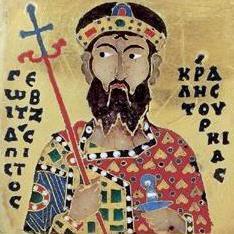
For his coronation, Géza received a crown from Byzantine Emperor Michael VII Dukas that was incorporated with the ancient crown of King Stephen I. Géza's short rule was characterized by general disorder in the kingdom. He did, however, capture Croatia from his brother-in-law Dmitar Zvonimir. He married twice; first to Sophia von Looz, daughter of the Count of Looz, and secondly to Synadene, a niece of Emperor Nicephorus III. By his first marriage, he had two children:
Coloman of Hungary
Prince Álmos
Géza died on April 25, 1077 and was succeeded by his brother Ladislaus I. Géza is buried at Vác.
Preceded by:
Solomon King of Hungary Succeeded by:
Ladislaus I
See message #1777.
See message #1777.
See message #1777.
GIVN Geza I, King
SURN Hungary
AFN 881B-X4
STAT SUBMITTED
DATE 9 SEP 2000
TIME 13:15:31
{geni:about_me} http://www.friesian.com/perifran.htm#bohemia
http://epa.oszk.hu/01500/01536/00010/pdf/UJ_1979_015-028.pdf
http://finnholbek.dk/getperson.php?personID=I26478&tree=2
http://fmg.ac/Projects/MedLands/HUNGARY.htm#GezaIA
'''GÉZA ([in Poland] [1044/45]-25 Apr 1077, bur Vac)'''. The Gesta Hungarorum names "Geichæ et Ladislai" as sons of "fratris sui Belæ" when recording that King András obtained their agreement to the future succession of his son Salomon[475]. The Kronika Węgiersko-Polska names "Geyzam et Ladislaum" as the two older sons of "Bela" and his wife "rex Polonie filiam", adding that they were both born in Poland[476]. He succeeded his cousin in 1074 as GÉZA I King of Hungary.
- see below.
http://fmg.ac/Projects/MedLands/HUNGARY.htm#GezaIB
'''GÉZA''', son of BÉLA I King of Hungary & his wife [Ryksa] of Poland ([in Poland] [1044/45]-25 Apr 1077, bur Vac).
*m firstly ([1062]) [SOPHIE de Looz, daughter of EMMO Comte de Looz & his wife ---] (before [1044/46]-[1065]).
*m secondly ([1066/75]) --- Synadene, daughter of THEODULOS Synadenos & his wife --- Botaneiatissa.
------------------------------------
'''Geisa I Arpád, King of Hungary''' 1
M, #114086, b. circa 1044, d. 1077
Last Edited=8 Mar 2007
'''Geisa I Arpád, King of Hungary''' was born circa 1044. (1) He was the son of Béla I Arpád, King of Hungary. (1) He married Synadene Synadenos, daughter of Theodore Synadenos. (1) He died in 1077. (1)
Geisa I Arpád, King of Hungary succeeded to the title of King Geisa I of Hungary in 1074. (1)
Children of Geisa I Arpád, King of Hungary and Synadene Synadenos
-1. Almus Arpád, Duke of Croatia+ d. 1129 (1)
-2. Koloman Arpád, King of Hungary+ d. 1114 (1)
I. Géza
Magyarország királya
Uralkodott 1074-1077
Megkoronázták 1074
Született 1040 körül Lengyelország
Elhunyt 1077.04.25.
?
Nyughelye A váci Boldogságos Szűzről elnevezett székesegyházban temették el.
Elődje Salamon
Utóda I. Szent László
Felesége 1. Zsófia, Arnulf belga-limburgi herceg lánya
2. Synnadené, bizánci patríciuslány
Gyermekei Könyves Kálmán, Álmos herceg
Dinasztia Árpád-ház
Apja I. Béla
Anyja Richeza lengyel hercegnő
===Utódai [szerkesztés]===
*Gézának első feleségétől, '''Zsófiá'''tól két fia maradt:
#Kálmán (a későbbi Könyves Kálmán király) és
#Álmos.
*Második felesége '''Szünadéné''', Niképhorosz Botaneiatész bizánci vezér unokahúga volt, tőle egy leány,
#Katalin született.
Forrás:
http://hu.wikipedia.org/wiki/I._G%C3%A9za
--------------------
http://en.wikipedia.org/wiki/G%C3%A9za_I_of_Hungary
==Géza I of Hungary==
From Wikipedia, the free encyclopedia
Géza I (Hungarian: I. Géza, Slovak: Gejza I) (c. 1040 – 25 April 1077), King of Hungary (1074-1077). During King Solomon's rule he governed, as Duke, one third of the Kingdom of Hungary. Afterwards, Géza rebelled against his cousin's reign and his followers proclaimed him king. However, he never achieved to strengthen his position, because King Solomon could maintain his rule over the Western part of the kingdom.
Early years
Géza was the eldest son of the future King Béla I of Hungary and his wife Adelaide/Rixa of Poland. When Géza was born, his parents were living in the court of his mother's brother, King Casimir I of Poland, because Béla had been obliged to leave Hungary after his father made an unsuccessful attempt against his cousin, King Stephen, the first King of Hungary.
Géza was probably his pagan name, because he was baptized Magnus. In 1048, the family moved to Hungary, where his father received as appanage one third of Hungary ("Tercia pars Regni") from his brother, King Andrew I of Hungary who had acquired the throne from King Peter after a pagan revolt. Following his accession, King Andrew I had to face the attacks of Henry III, Holy Roman Emperor whose supremacy had been acknowledged by King Peter. King Andrew I andDuke Béla cooperated closely against the German attacks and they could preserve Hungary's independence. However, they cooperation began to loosen from 1053 when the king fathered a son, Solomon, because from that time he wanted to ensure his son's inheritance against his brother, who pursuant to the old Hungarian costums, as the oldest member of the royal family, could lay claim to the throne in case of the king's death.
In 1057, King Andrew I had Solomon crowned to ensure his accession, and Géza had to participate in the coronation together with his father and his brothers, Ladislaus and Lampert. However, Duke Béla and his sons left the country in 1059 and they returned with Polish troops in the next year. King Andrew I lost two battles against his brother and died, and after his death Béla was crowned on 6 December 1060.
During his father's reign, Géza was his main adviser and after his father's fatal accident it was he who administered the defence of the country against the German troops which entered Hungary in order to ensure Solomon's rule whohad escaped to Duitsland in 1060. After his father's death on 11 September 1063, Géza offered to accept's his cousin's rule if he received his father's former duchy. However, King Solomon refused the offer and the superiority of his troops obliged Géza and his brothers to leave Hungary and they went to Poland. However, after the withdrawal of the German army, they came back to Hungary followed by troops King Bolesław II of Poland, their maternal cousin, provided them.
The parties, however, wanted to avoid the civil war and therefore they accepted the mediation services of the bishops, and they made an agreement on 20 January 1064 in Győr. Under the agreement Géza and his brothers accepted Solomon's rule, and they received their father's former duchy, i.e., the one third of Hungary.
[edit]Duke of Tercia pars Regni
After the conclusion of the peace, King Solomon and his three cousins celebrated Easter together in Pécs. However, when a fire broke out, the two parties accused the other's followers of incerdiarism. The bishops had to intervene again in order to appease the king and the dukes. At that time, Géza married Sophia who was probably a daughter of a German count.
In the next years, Géza and his brothers collaborated successfully with the king. In 1067, they led an army together to provide assistance to Géza's brother-in-law, King Dmitar Zvonimir of Croatia against Venice. In 1068, when thePechenegs had overrun the territories of Transylvania, Géza, his brothers and the king went together against them and they won a victory at Kerlés. In 1071, King Solomon and the dukes led a campaign against the Byzantine Empire and laid siege to the fortress of Belgrade. The siege lasted two months, and the Greek commander surrendered the fort to Géza not to the king. Moreover, Géza denied to hand over the king's share of the booty and set the Greek captives free without the king's permission.
Having the Byzantine troops reoccupied Belgrade in the next year, Géza and King Solomon led their armies together against the Greeks, but Géza left his two brothers behind, because he was worrying about that the king's partisans would try to occupy their duchy during their absence. The campaign was a total failure, because the king and the duke were not able to cooperate during the siege any more.
During 1073, both King Solomon and his cousins were preparing for the coming struggle. The king sent his envoys to his brother-in-law, King Henry IV of Duitsland, while Géza and his brothers were seeking the help of their Polish andCzech relatives. In the beginning of 1074, before the Polish and Czech troops arrived, King Solomon led his armies against the dukes' territory and defeated Géza's troops on 26 February at Kemej. However, after the arrival of thereinforcement from Poland and Bohemia, the dukes' armies started a counter-attack and they won a decisive victory over King Solomon's troops on 14 March in the Battle of Mogyoród.
[edit]King of Hungary
Following the Battle of Mogyoród, King Solomon ran to the Western borders of Hungary seeking help from King Henry IV, whose supremacy he accepted, while Géza was declared king by his followers. However, King Solomon could still maintain his rule over the Counties (megye) of Moson and Pozsony. In August 1074, the imperial troops invaded the Northern part of the kingdom and advanced till Vác, but the German king was obliged to return to his domain because ofthe Saxons' uprising.
Géza tried to obtain the international acknowledgement of his rule; therefore he sent embassies to Pope Gregory VII, who was struggling against the German king, and to Michael VII, Emperor of the Byzantine Empire. The pope claimedthe recognition of his supremacy over Hungary which Géza did not accept, but the Byzantine emperor sent a crown, that was later incorporated with the ancient crown of Hungary, to him and Géza was crowned by that crown because theancient crown was in the possession of King Solomon. At this time, Géza married a niece of Michael VII's military commander Nikephoros Botaneiates.
During his reign Géza set up the Abbey of Garamszentbenedek and finished the building of the cathedral of Vác. In 1076, he sent his troops led by his brother, Duke Ladislaus against Pozsony, but King Solomon could beat off the troops. After this failure, according to the chronicles, Géza, who had become more and more ill, was thinking of his abdication in favour of his opponent, but they did not reach an agreement.
He was buried in the cathedral of Vác.
==Marriages and children==
*∞1. c. 1062: '''Sophia''' (? – before 1075)
# King Coloman of Hungary (c. 1070 – 3 February 1116)
# Duke Álmos (c. 1070 – 1 September 1127)
*∞2. c. 1075: Unnamed daughter ("Synadene") of Theodulos Synadenos and his wife, the sister of the future Byzantine emperor Nikephoros Botaneiates (? – after 1079)
* Note from FARKAS Mihály László:
*Géza and Synadene had a daughter, (from the Hungarian version)
#Katalin
Legacy
Géza was succeeded by his brother, King Ladislaus I of Hungary who managed to establish himself on the throne after the abdication of King Solomon in 1081.
[edit]Sources
Kristó Gyula - Makk Ferenc: Az Árpád-ház uralkodói (IPC Könyvek, 1996)
Korai Magyar Történeti Lexikon (9-14. század), főszerkesztő: Kristó Gyula, szerkesztők: Engel Pál és Makk Ferenc (Akadémiai Kiadó, Budapest, 1994)
Magyarország Történeti Kronológiája I. – A kezdetektől 1526-ig, főszerkesztő: Benda Kálmán (Akadémiai Kiadó, Budapest, 1981)
Kosztolnyik, Z.J. Five Eleventh Century Hungarian Kings, 1981.
--------------------
Do NOT MERGE P L E A S E !
http://www.geni.com/people/II-Geza-ÁRPÁD-házi/6000000003897541628
and
http://www.geni.com/people/ÁRPÁD-házi-I-Géza-magyar-király/5287530087430075153
--------------------
Géza I (Hungarian: I. Géza) (c. 1040 – 25 April 1077), King of Hungary (1074-1077). During King Solomon's rule he governed, as Duke, one third of the Kingdom of Hungary. Afterwards, Géza rebelled against his cousin's reign and hisfollowers proclaimed him king. However, he never achieved to strengthen his position, because King Solomon could maintain his rule over the Western part of the kingdom.
Géza was the eldest son of the future King Béla I of Hungary and his wife Adelaide/Rixa of Poland. When Géza was born, his parents were living in the court of his mother's brother, King Casimir I of Poland, because Béla had been obliged to leave Hungary after his father made an unsuccessful attempt against his cousin, King Stephen, the first King of Hungary.
Marriages and children
m1.Sophia (? – before 1075)
#King Coloman of Hungary (c. 1070 – 3 February 1116)
#Duke Álmos (c. 1070 – 1 September 1127)
m2.Unnamed daughter ("Synadene") of Theodulos Synadenos and his wife, the sister of the future Byzantine emperor Nikephoros Botaneiates (? – after 1079)
--------------------
Géza I -Hungarian: I. Géza; c. 1040 – 25 April 1077 was King of Hungary from 1074 until his death. During King Solomon's rule he governed, as Duke, one third of the Kingdom of Hungary. Afterwards, Géza rebelled against his cousin's reign and his followers proclaimed him king. However, he never achieved to strengthen his position, because King Solomon could maintain his rule over the Western part of the kingdom.
Early years
Géza was the eldest son of the future King Béla I of Hungary and his wife Adelaide/Rixa of Poland. When Géza was born, his parents were living in the court of his mother's brother, King Casimir I of Poland, because Béla had been obliged to leave Hungary after his father made an unsuccessful attempt against his cousin, King Stephen, the first King of Hungary.
Géza was probably his pagan name, because he was baptized Magnus. In 1048, the family moved to Hungary, where his father received as appanage one third of Hungary ("Tercia pars Regni") from his brother, King Andrew I of Hungary who had acquired the throne from King Peter after a pagan revolt. Following his accession, King Andrew I had to face the attacks of Henry III, Holy Roman Emperor whose supremacy had been acknowledged by King Peter. King Andrew I andDuke Béla cooperated closely against the German attacks and they could preserve Hungary's independence. However, they cooperation began to loosen from 1053 when the king fathered a son, Solomon, because from that time he wanted to ensure his son's inheritance against his brother, who pursuant to the old Hungarian customs, as the oldest member of the royal family, could lay claim to the throne in case of the king's death.
In 1057, King Andrew I had Solomon crowned to ensure his accession, and Géza had to participate in the coronation together with his father and his brothers, Ladislaus and Lampert. However, Duke Béla and his sons left the country in 1059 and they returned with Polish troops in the next year. King Andrew I lost two battles against his brother and died, and after his death Béla was crowned on 6 December 1060.
During his father's reign, Géza was his main adviser and after his father's fatal accident it was he who administered the defence of the country against the German troops which entered Hungary in order to ensure Solomon's rule whohad escaped to Duitsland in 1060. After his father's death on 11 September 1063, Géza offered to accept his cousin's rule if he received his father's former duchy. However, King Solomon refused the offer and the superiority of his troops obliged Géza and his brothers to leave Hungary and they went to Poland. However, after the withdrawal of the German army, they came back to Hungary followed by troops King Bolesław II of Poland, their maternal cousin, provided them.
The parties, however, wanted to avoid the civil war and therefore they accepted the mediation services of the bishops, and they made an agreement on 20 January 1064 in Győr. Under the agreement Géza and his brothers accepted Solomon's rule, and they received their father's former duchy, i.e., the one third of Hungary.
Duke of Tercia pars Regni
After the conclusion of the peace, King Solomon and his three cousins celebrated Easter together in Pécs. However, when a fire broke out, the two parties accused the other's followers of incerdiarism. The bishops had to intervene again in order to appease the king and the dukes. At that time, Géza married Sophia who was probably a daughter of a German count.
In the next years, Géza and his brothers collaborated successfully with the king. In 1067, they led an army together to provide assistance to Géza's brother-in-law, King of Croatia Dmitar Zvonimir of Croatia against Venice. In 1068, when the Pechenegs had overrun the territories of Transylvania, Géza, his brothers and the king went together against them and they won a victory at Kerlés. In 1071, King Solomon and the dukes led a campaign against the Byzantine Empire and laid siege to the fortress of Belgrade. The siege lasted two months, and the Greek commander surrendered the fort to Géza not to the king. Moreover, Géza denied to hand over the king's share of the booty and set the Greek captives free without the king's permission.
Having the Byzantine troops reoccupied Belgrade in the next year, Géza and King Solomon led their armies together against the Greeks, but Géza left his two brothers behind, because he was worrying about that the king's partisans would try to occupy their duchy during their absence. The campaign was a total failure, because the king and the duke were not able to cooperate during the siege any more.
During 1073, both King Solomon and his cousins were preparing for the coming struggle. The king sent his envoys to his brother-in-law, King Henry IV of Duitsland, while Géza and his brothers were seeking the help of their Polish andCzech relatives. In the beginning of 1074, before the Polish and Czech troops arrived, King Solomon led his armies against the dukes' territory and defeated Géza's troops on 26 February at Kemej. However, after the arrival of thereinforcement from Poland and Bohemia, the dukes' armies started a counter-attack and they won a decisive victory over King Solomon's troops on 14 March in the Battle of Mogyoród.
King of Hungary
Following the Battle of Mogyoród, King Solomon ran to the Western borders of Hungary seeking help from King Henry IV, whose supremacy he accepted, while Géza was declared king by his followers. However, King Solomon could still maintain his rule over the Counties (megye) of Moson and Pozsony. In August 1074, the imperial troops invaded the Northern part of the kingdom and advanced till Vác, but the German king was obliged to return to his domain because ofthe Saxons' uprising.
Géza tried to obtain the international acknowledgement of his rule; therefore he sent embassies to Pope Gregory VII, who was struggling against the German king, and to Michael VII, Emperor of the Byzantine Empire. The pope claimedthe recognition of his supremacy over Hungary which Géza did not accept, but the Byzantine emperor sent a crown, that was later incorporated with the ancient crown of Hungary, to him and Géza was crowned by that crown because theancient crown was in the possession of King Solomon. At this time, Géza married a niece of Michael VII's military commander Nikephoros Botaneiates.
During his reign Géza set up the Abbey of Garamszentbenedek and finished the building of the cathedral of Vác. In 1076, he sent his troops led by his brother, Duke Ladislaus against Pozsony, but King Solomon could beat off the troops. After this failure, according to the chronicles, Géza, who had become more and more ill, was thinking of his abdication in favour of his opponent, but they did not reach an agreement.
He was buried in the cathedral of Vác.
Marriages and children
#1. c. 1062: Sophia (? – before 1075)
King Coloman of Hungary (c. 1070 – 3 February 1116)
Duke Álmos (c. 1070 – 1 September 1127)
#2. c. 1075: Unnamed daughter ("Synadene") of Theodulos Synadenos and his wife, the sister of the future Byzantine emperor Nikephoros Botaneiates (? – after 1079)
--------------------
Konge av Ungarn 1074 - 1077.
Geza kom på tronen etter å ha slått sin fars brorsønn, Salomon.
Tekst: Tore Nygaard
Kilder:
Mogens Bugge: Våre forfedre, nr. 1121. Bent og Vidar Billing Hansen: Rosensverdslektens forfedre, side 18.
--------------------
Géza I (Hungarian: I. Géza) (c. 1040 – 25 April 1077), King of Hungary (1074-1077). During King Solomon's rule he governed, as Duke, one third of the Kingdom of Hungary. Afterwards, Géza rebelled against his cousin's reign and hisfollowers proclaimed him king. However, he never achieved to strengthen his position, because King Solomon could maintain his rule over the Western part of the kingdom.
Géza was the eldest son of the future King Béla I of Hungary and his wife Adelaide/Rixa of Poland. When Géza was born, his parents were living in the court of his mother's brother, King Casimir I of Poland, because Béla had been obliged to leave Hungary after his father made an unsuccessful attempt against his cousin, King Stephen, the first King of Hungary.
Marriages and children
m1.Sophia (? – before 1075)
#King Coloman of Hungary (c. 1070 – 3 February 1116)
#Duke Álmos (c. 1070 – 1 September 1127)
m2.Unnamed daughter ("Synadene") of Theodulos Synadenos and his wife, the sister of the future Byzantine emperor Nikephoros Botaneiates (? – after 1079)
--------------------
http://en.wikipedia.org/wiki/G%C3%A9za_I_of_Hungary
859747692. Kong Geisa I BELASON av Ungarn was born about 1040.(20072) He was a Konge between 1074 and 1077 in Ungarn.(20073) Han kom på tronen etter å ha slått sin fars brorsønn Slomon He died on 15 Apr 1077.(20074) He was married to N. Synadena THEODULSDTR av Grekenland in 1073.
RESEARCH NOTES:
King of Hungary (1074-1077)
He reigned from 1074 to 1077.
Barre chronologique Geza "Giza" Arpad I
Cette fonctionnalité n'est disponible que pour les navigateurs qui supportent Javascript.
Cliquez sur le nom pour plus d'information.
Symboles utilisés:  grand-parents
 parents
 frères/soeurs
 enfants
grand-parents
parents
frères/soeurs
enfants

Les données affichées n'ont aucune source.
Des liens dans d'autres publications
On rencontre cette personne aussi dans la publication: Voir tous
Événements historiques
Jour du baptême 14 mai 1938
- La température au 14 mai 1938 était entre 8,1 et 25,2 °C et était d'une moyenne de 17,8 °C. Il y avait 9,9 heures de soleil (63%). La force moyenne du vent était de 3 Bft (vent modéré) et venait principalement du sud-est. Source: KNMI
- Du 24 juin 1937 au 25 juillet 1939 il y avait aux Pays-Bas le cabinet Colijn IV avec comme premier ministre Dr. H. Colijn (ARP).
- En l'an 1938: Source: Wikipedia
- La population des Pays-Bas était d'environ 8,6 millions d'habitants.
- 4 février » Hitler prend le portefeuille de la guerre et nomme ministre des Affaires étrangères Joachim von Ribbentrop.
- 11 mars » Kurt Schuschnigg, chancelier fédéral d'Autriche, est poussé à la démission par Hitler. L'Anschluss aura lieu le lendemain.
- 17 mars » en Espagne, Franco fait bombarder Barcelone.
- 8 août » début de la construction du camp de concentration de Mauthausen.
- 30 septembre » signature des accords de Munich mettant fin à la crise des Sudètes.
- 21 octobre » l'Allemagne nazie annexe la région des Sudètes à la suite des accords de Munich.
Même jour de naissance/décès
- 1077 » Géza I, roi de Hongrie (°1040).
- 1185 » Antoku, empereur du Japon (° 22 décembre 1178).
- 1196 » Alphonse II, roi d'Aragon (° 25 mars 1157).
- 1295 » Sanche IV, roi de Castille (° 12 mai 1258).
- 1342 » Benoît XII, pape (° 1285).
- 1566 » Louise Labé, poétesse française (° 1525).
Sur le nom de famille Arpad
- Afficher les informations que Genealogie Online a concernant le patronyme Arpad.
- Afficher des informations sur Arpad sur le site Archives Ouvertes.
- Trouvez dans le registre Wie (onder)zoekt wie? qui recherche le nom de famille Arpad.
La publication maximum test a été préparée par Ard van Bergen.
Lors de la copie des données de cet arbre généalogique, veuillez inclure une référence à l'origine:
Ard van Bergen, "maximum test", base de données, Généalogie Online (https://www.genealogieonline.nl/maximum-test/I5287530087430075153.php : consultée 14 février 2026), "Geza "Giza" Arpad I (1045-1077)".
Ard van Bergen, "maximum test", base de données, Généalogie Online (https://www.genealogieonline.nl/maximum-test/I5287530087430075153.php : consultée 14 février 2026), "Geza "Giza" Arpad I (1045-1077)".